Thursday, November 19, 2009

Extra! Americans losing sense of place!


One of the things that we hope will characterize Madroño Ranch: A Center for Writing and the Environment is a strong sense of place. It’s right there, implicitly and explicitly, in our mission and vision statements, just off to your right.

But how does one develop a sense of place? One answer, at least in part, and for those of us of a certain age, has been by reading the local newspaper. But the newspaper as we know it seems to be going the way of the 8-track and the VHS tape. Increasingly, people opt to get their news in a way that doesn’t leave ink smudges on their hands, or require drying in the oven on rainy mornings. In other words, they're reading the “paper” online.

In “Final Edition: Twilight of the American Newspaper,” in the November issue of Harper’s, Richard Rodriguez examines the decline of his (and my) hometown paper, the San Francisco Chronicleand the historical importance of the newspaper in American life.

The press, Rodriguez argues, was the indicator and bestower of civic stature: “It was the pride and the function of the American newspaper in the nineteenth century to declare the forming congregation of buildings and services a city—a place busy enough or populated enough to have news.” In addition, the rise of the newspaper was a sign of the small-d democratic nature of American culture, “a vestige of the low-church impulse toward universal literacy whereby the new country imagined it could read and write itself into existence.”

But, for many, the newspaper seems to have outlived its usefulness. The Atlantic Monthly’s Megan McArdle, in an online (of course) column titled “The Media Death Spiral,” writes, “The circulation figures for the top 25 dailies in the U.S. are out, and they’re horrifying. The median decline is well into the teens; only the Wall Street Journal gained (very slightly).”

She adds, “I think we’re witnessing the end of the newspaper business, full stop, not the end of the newspaper business as we know it. The economics just aren’t there.”

Those of us who read the Austin American-Statesman have noted the signs already: a shrinking paper, meaning fewer ads and less revenue; the anorexic classifieds (a victim of craigslist) tacked onto the back of the Life and Arts section; the business and metro sections combined.

Why should we care whether or not the Statesman survives? According to Rodriguez, “When a newspaper dies in America, it is not simply that a commercial enterprise has failed; a sense of place has failed. If the San Francisco Chronicle is near death... it is because San Francisco’s sense of itself as a city is perishing."

Does he exaggerate? Maybe. But once the newspapers are gone, he asks, “who will tell us what it means to live as citizens of Seattle or Denver or Ann Arbor? The truth is we no longer want to live in Seattle or Denver or Ann Arbor. Our inclination has led us to invent a digital cosmopolitanism that begins and ends with ‘I.’”

Rodriguez quotes a friend of his, a journalist from India: “If I think of what many of my friends and I read these days, it is still a newspaper, but it is clipped and forwarded in bits and pieces on email—a story from the New York Times, a piece from Salon, a blog from the Huffington Post, something from the Times of India, from YouTube. It is like a giant newspaper being assembled at all hours, from every corner of the world, still with news but no roots in a place. Perhaps we do not need a sense of place anymore.”

That statement really bothers me, for a couple of reasons. I can understand the appeal of what Philip Meyer, a student of the industry, calls “the demassification of the media”; in the bottom-up model of journalism, each consumer is free to pick and choose the information he or she deems most valuable, rather than being forced to rely on the judgment of a corporate editor. What could be more democratic?

But such a model does come with a cost. As Meyer writes in his book The Vanishing Newspaper: Saving Journalism in the Information Age, “If we’re all attending to different messages, our capacity to understand one another is diminished.”

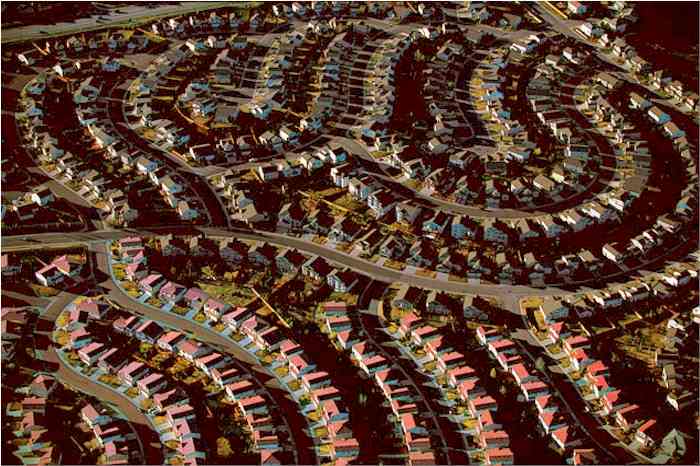
And what about that speculation from Rodriguez’s friend, “Perhaps we do not need a sense of place anymore”? Perhaps not. But I don’t want to live in a world where people no longer feel connected to the land and the people around them. In a society that has traditionally viewed “light[ing] out for the territory,” in the words of that old newspaperman Mark Twain, as the solution to every problem, how do we convince folks that they have a stake in, and a responsibility to, their surroundings? As strip malls and chain stores and fast-food outlets and cookie-cutter housing developments and, yes, the internet make every place more like every other place, how are we supposed to know or care where we are?

I don’t know the answer to that question, but I think we better find one. People who feel strongly connected to their surroundings, urban or rural or in between, feel that the place is theirs; they know it, feel it, eat it, sleep it, and live it. They’re also more likely to take care of it. I certainly hope that the things that make Madroño Ranch special to us—the hills, the water, the rocks, the trees—will outlive us, and our children, and our children’s children, and we intend to do all we can to make sure they do.
—Martin

What we’re reading
Heather: Mary Oliver (ed.), The Best American Essays 2009
Martin: Douglas Brinkley, The Wilderness Warrior: Theodore Roosevelt and the Crusade for America

Friday, November 13, 2009

Carnivorocity


Since we’re in the early planning stages for our first Madroño Ranch bison harvest, I’ve been reflecting on issues of carnivorocity, which my spell-checker tells me isn’t a word. It suggests “carnivorousness” instead. But I prefer my neologism because it retains echoes of the ferocity that undergirds all meat-eating.

I have been a happy meat-eater all my life, with the exception of my senior year in college, when I chose to be a vegetarian for financial and life-style rather than ethical reasons. Although I still eat meat, I’ve grown increasingly troubled by the system that produces most of it in the United States, and no longer eat meat at most restaurants or from supermarkets.

In some ways, I think that vegetarians may be more evolved than meat-eaters. According to Genesis, all creatures—not just humans—were vegetarians in the beginning. God said, “‘See, I have given you every plant yielding seed that is upon the face of the earth, and every tree with seed in it for fruit. And to every beast of the earth, and every bird of the air, and to everything that creeps on the earth, everything that has the breath of life, I have given every green plant for food’” (Genesis 1:29–30). Thus modern vegetarians are hearkening back to their Edenic roots, to a human dominion over nature that reflected the aboriginal harmony and mutual respect among species—unless, of course, you happened to be a green plant.

But the story became more complicated, as good stories always do. As punishment for various transgressions, God sent a flood that only Noah and the passengers on his ark survived. In thanksgiving, Noah built an altar to the Lord and made of every clean animal and bird (although this was before the laws differentiating clean from unclean) a burnt offering. When God “smelled the pleasing odor, he said in his heart, ‘I will never again curse the ground because of humankind...’” (Genesis 8:21). From that time on, humans were given animals for food, with the stipulation that they should not eat flesh that still had blood in it.

Complicated? My goodness, yes. Eating meat is God’s concession to the fact that something in the original balance of the world has been thrown out of whack—and that the smell of cooking meat is profoundly satisfying. Those who can resist the lure of barbecue are made of sterner stuff than God! The line between vegetarians and meat-eaters is the line between self-identified utopianists and realists—or between utopianists and people who don’t think about the issue. I tend toward the utopian end of the spectrum. So why do I eat meat?

In his fascinating book The River Cottage Meat Book, British chef and farmer Hugh Fearnley-Whittingstall points out that scripture has been used to justify the most heinous acts, including the abuse of animals for human consumption. He finds the “commitment to eliminate the pain and suffering of animals at the hands of humans... to be morally superior to the commitment to ignore it.” But he also finds the pro-vegetarian argument based on the desire to eliminate the pain and suffering of animals unconvincing. Animals inevitably suffer, even without human intervention. He points out that “dying of old age” rarely occurs in nature, and that wild animals are quite likely to end their lives as food for something.

Eating meat is a reminder that we belong to the system over which we exercise dominion. We are not above the law that ordered the universe; we do not lie outside the natural order. Not long ago I took a cooking class from Jesse Griffiths of Dai Due, one that took a chicken “from gallina to pollo,” as our daughter Elizabeth put it. We started with two live roosters, which we were to kill, pluck, and clean. After Jesse showed us how to hold a rooster upside down—which disorients and calms it—he put it headfirst into a lopped-off traffic cone and slit its jugular. The whole business took ten seconds or less per bird and was strangely intimate, giving me an insight into some of the labyrinthine dietary and purity laws in Leviticus. Surely we are meant to eat meat with a profound awareness of the sacrifice that doing so entails. As usual, no one has said it better than Wendell Berry:

Prayer after Eating

I have taken in the light
that quickened eye and leaf.
May my brain be bright with praise
of what I eat, in the brief blaze
of motion and of thought.
May I be worthy of my meat.
—Heather

What we’re reading
Heather: George Johnson, Fire in the Mind: Science, Faith, and the Search for Order
Martin: Richard Price, Lush Life

Friday, October 30, 2009

“Everywhere there’s lots of piggies...”


I sometimes find myself feeling a little defensive about the Texas Hill Country. Martin, a San Francisco native, and I drove across the country via Texas after we graduated from college in Massachusetts. Somewhere around Bastrop, I said, “Well, we’re at the eastern edge of the Hill Country.”

“Really?” he said. “So where are the hills?”

Okay, so our hills are a little stumpy and our landscape a little scruffy, and most of the fauna (and much of the flora) will scratch, sting, or bite you. But at least we can proudly boast that nobody’s got more feral hogs than we do.

Hogs are always lurking in the background of life at Madroño—and frequently in the foreground as well (and yes, those are some of our very own hogs making their way across a creek in the photo above). They’re smart, secretive, social, fierce, and remarkably fecund; a sow can have two, and sometimes three, litters of eight a year. Robert, the ranch manager, figures that his wife Sherry shot the Madroño heavyweight title holder, which tipped the scales at about 400 pounds, and they can get significantly bigger than that. They have no predators other than humans, whom they generally leave alone. Dogs, however, they consider fair game. These hogs are expert at slashing their tusks in an upward arc, where they can easily intersect a dog’s jugular or stomach with deadly results.

One fall day a couple of years ago, my brother-in-law Daniel and I, along with his doughty dog Mojo, were walking along the top of the property. Mojo is an unspecified breed, maybe part wolverine, low to the ground with a long heavy coat, and utterly fearless. The minute he heard porcine snorting in a nearby cedar brake, he charged, even as Daniel and I screamed for him to stop. For the next few heartbeats of eternity we yelled and listened to the invisible fight as it receded down a draw. Sure that Mojo was a goner, we trudged sadly downhill to break the horrible news to my sister Isa—Daniel’s wife—and their young children.

So when Mojo popped out of the brush halfway down, he received an ecstatic and extended hero’s welcome. His ruff was stiff with pig spit; his thick fur had saved him from what were doubtless multiple tusk slashes. Many dogs aren’t so lucky.

Here’s one good thing about hogs: they make delicious sausage. Here’s another good thing about them: they’re omnivorous, eating even snakes. Here’s a(nother) bad thing: they love grubs, especially if those grubs are under wet grass. Carefully tended yards can look like a demonic rototiller has let loose its evil fury after a rain or a watering, the grass torn up and plowed under in great sheets (see below). Robert once got so furious at the persistent destruction of the lawn he’d tended so carefully at the lake house that he vowed to sleep there until he’d hunted the culprits down. After four nights and increasingly plaintive appeals from the family he’d abandoned, Robert admitted defeat. “Those pigs outsmarted me and whupped my ass in the lake house yard,” he said ruefully. “It was a humbling experience.”


Clearly, hog tales running the gamut from slapstick to philosophical will be a recurrent theme of this blog. Share your hog tales with us—and check back for more.
—Heather

What we’re reading
Heather: Graham Swift, Last Orders
Martin: Brad Meltzer, Rags Morales, and Michael Blair, Identity Crisis

Friday, October 23, 2009

Growing hope


This summer we attended a screening of Fresh, a documentary that highlights the efficiency and productivity of organic farming and the casual cruelty and hidden costs of industrial agriculture. Along with about a hundred others, we watched the film under the pecan trees at Boggy Creek Farm while eating locally sourced vegetarian picnic dinners provided by the Alamo Drafthouse, one of the screening’s cosponsors. (The others were Edible Austin and our friend Steve Kinney’s Front Porch Project.)


This kind of setting induces feelings of satisfaction that can all too easily morph into self-righteousness, and there’s no question that this event was a classic case of preaching to the choir. One of Boggy Creek’s neighbors’ front yards frequently sports a sign demanding housing for the homeless, not food for the rich. There’s no question that the momentum behind the local/sustainable food movement has been slowed by the argument that it’s a movement for the dainty tastes of the economic elite.

Fresh delivers a powerful counterpunch—maybe even a KO—in the person and work of Will Allen, whose nonprofit Growing Power Inc. operates two acres of greenhouses in working-class Milwaukee, producing mountains of affordable, healthy food, and trains countless inner-city residents to convert empty lots into thriving organic food centers.

The son of a sharecropper, Allen believes with every fiber of his 6'7" body that healthy food is primarily a social justice issue: income should have no bearing on access to quality food. He himself is a happy consumer of doughnuts and doesn’t condemn those who have no alternative to KFC, but his passion for fresh food is altering the urban landscape and the food choices of thousands of people who might otherwise face a future of obesity and diabetes.

We’re no experts on food pricing, but we would guess that Growing Power enjoys a pricing “advantage” over other organic farmers because of grant money and a sizable volunteer labor pool. Agribusiness is able to control costs through government subsidies. What if the playing field on which organic and industrial agriculture compete were level? If organics were subsidized? If the costs of the ecological devastation caused by agribusiness monocultures, manure cesspools, and the health issues resulting from fast foods were factored into the cost of “cheap” food?

Before the 1962 publication of Rachel Carson’s Silent Spring, many considered conservation a hobby for the wealthy. Carson made clear the connection between environmental issues and civil rights. We hope that people like Will Allen and movies like Fresh will do the same for the local/sustainable food movement.

After the screening at Boggy Creek, Edible Austin sold copies of the movie on DVD, along with licensing agreements allowing purchasers to show it to groups of up to twenty people—neighborhood gatherings, church groups, book clubs, etc. Through this bottom-up, grass-roots, guerilla marketing campaign, the producers hope to spread the word far beyond those hundred or so predominantly white, relatively wealthy faces under the trees. We bought two copies, one for Robert and one for us.
—Heather

What we’re reading
Heather: Hugh Fearnley-Whittingstall, The River Cottage Meat Book
Martin: Dennis McNally, A Long Strange Trip: The Inside History of the Grateful Dead

Friday, October 16, 2009

A mother’s legacy


The first sparks for the idea of Madroño Ranch: A Center for Writing and the Environment were kindled about a year ago in conversations with my mother, Jessica Hobby Catto. She has listened carefully and thoughtfully to my sometimes wildly utopian ideas, offering hard-earned practical advice and persistent encouragement.

Her death on September 30 has left me so stunned that I’m having trouble relegating her to the past tense. I am struggling to stay in the present perfect, which refuses to point to a specific time, preferring instead to drift between the present and the past. This grammatical eddy allows me to dawdle a little longer before I face a present and future without her. At the same time, I know that at Madroño her spirit is always present, always past, always future.

My mother’s love for the outdoors shaped my life. The first house I remember was on a bluff north of the San Antonio airport, terrain that didn’t qualify as even remotely suburban at the time. Since my three siblings and I arrived within six years of each other, my mother must have deemed it a survival strategy to push us out of doors as much as possible. We had no immediate neighbors and spent our time pretending to be lost in the woods, investigating the draws and seasonal creeks that occasionally flooded and kept us home from school, and sliding down the cliff (strictly forbidden) to visit the nearest neighbors who rewarded us with butterscotch candies. The gravel road on which we lived was rural enough that people felt comfortable dumping trash on it. Every few months my mother would send us to drag a large trash can and pick up the trash on the road that we could pick up: we were permitted to leave the large appliances and dead livestock. Her point was—and is—clear: some human interactions with the landscape are unacceptable.

She also taught me that love of place is a perfectly reasonable principle by which to order a life. Converted to the Church of High Altitudes at Cimarroncita Ranch Camp in New Mexico, she began proselytizing to her children in the mid-1960s when we began annual summer treks to Aspen, Colorado. In the requisite station wagon filled with pillows, the reek of Panhandle oil and cattle, and squabbling children, we always stopped at the top of then-unpaved Independence Pass (12,000-plus feet above sea level) to play in the snow.

Aspen then had one paved street, one stop sign, a drug store with a soda fountain, and two fine old movie theaters. What more did we need? On days we didn’t hike, my mother shooed us outside to play in the puddles if it was raining or to climb up nearby Aspen Mountain with raincoats or pieces of cardboard upon which we would slide back down the meadow grasses. When my father’s career took us away from Texas and to other interesting venues, Colorado was the place we always returned to, my mother’s spiritual center. Despite her peripatetic life, she had a profound love of the Roaring Fork River valley, its smells and flowers, its imperious weather changes, the varieties of its wildness. These never ceased to sustain her, and she in turn worked to sustain them through her involvement with various environmental causes, particularly land conservation.

When she was diagnosed with metastatic colon cancer in 2007, my parents began spending more time at their San Antonio home to be near the doctors she most trusted. Since she had long since given her heart and energy to Colorado, I was worried that she would feel unmoored during her time in San Antonio, adding to the discomforts of treatment. As we talked about ways in which she could stay connected to the conservation world she loved, especially in a state like Texas that so dearly values its private property rights, the idea of creating a gathering place for people passionate about nurturing the natural world was born.

I know I will eventually move out of the strange timelessness that hovers around times of death, but never completely. Despite her preference for the mountains, she saw the beauties of the Texas Hill Country and bought the original piece of what has become Madroño Ranch more than fifteen years ago. The blessings she bestowed on me—awareness of human limits, love of place, the place itself—are with me as long as I am here to receive them.
—Heather

What we’re reading
Heather: Nicholson Baker, The Anthologist
Martin: Charles Dickens, Great Expectations


Friday, October 9, 2009

Bigfoot Wallace

Wallace Creek, which flows through Madroño Ranch, is named for Bigfoot Wallace, the legendary nineteenth-century Texas Ranger and Indian fighter who received a grant of 320 acres about five miles north of Medina in 1849. Wallace was celebrated as “the Daniel Boone of Texas,” and the stories of his exploits are plenteous and colorful. Some of them may even be true. Here’s a brief sampling:

William A. A. (Bigfoot) Wallace

William A. A. Wallace (1817-1899) weighed 13 pounds at the time of his birth in Virginia. He came west in 1837 to avenge the deaths of his older brother and cousin, who had been killed in the Goliad Massacre fighting against Mexico in the Texas Revolution; alas, the Battle of San Jacinto occurred before he left home, ending the conflict and eliminating, at least temporarily, his opportunity to “take pay out of the Mexicans.” When the schooner on which he sailed from New Orleans was caught in a violent storm, Wallace was the only person aboard, including the crew, who was not prostrated by seasickness; when they reached Galveston, he was the only one who did not have to be carried ashore.

In 1839, he unexpectedly came face to face with a Waco warrior on a narrow path on Austin's Mount Bonnell. Without taking time to aim, Wallace fired the rifle he had been carrying and the warrior, mortally wounded, fell off the cliff and into the Colorado River.

In 1842, Wallace volunteered for the ill-fated Somervell and Mier expeditions into Mexico; he was captured and survived a stint in the notorious Perote Prison. After returning to Texas, he joined the Texas Rangers and fought in the Mexican War.

Wallace was the first man to carry the mail from San Antonio to El Paso. Once, having been forced to walk many miles after losing his mules to Indians, he stopped at the first house he came to and ate 27 eggs before heading on into El Paso for a full meal.

Are all these stories true? Probably not. J. Frank Dobie wrote that “Wallace was as honest as daylight but liked to stretch the blanket and embroider his stories”—and Dobie certainly knew a bit about blanket-stretching. In the end, though, the factuality of the stories is immaterial. To quote the editor in The Man Who Shot Liberty Valance“This is the West, sir. When the truth becomes legend, print the legend.”
—Martin

What we’re reading
Heather: Austin American-Statesman comics (it’s been a tough week)
Martin: E. O. Wilson, Naturalist

Friday, October 2, 2009

By shank’s mare across England


Last month Martin and his friend Bruce spent two weeks backpacking across northern England. Here’s his report:

Bruce, who’s been going to the U.K. every summer for several decades, is a veteran country walker; he’s done the famous Wainwright Coast-to-Coast walk and numerous other routes in England and Scotland. This time, however, we followed (more or less) a relatively new alternate route, set forth by a fellow named David Maughan in his 1997 book On Foot from Coast to Coast: The North of England Way, that took us from Ravenglass on the Irish Sea to Scarborough on the North Sea.

We covered 200 miles in two weeks, which works out to an average of just over 14 miles a day, though there was one three-day stretch when we totaled about 60 miles. We brought only what would fit in our packs, and made our way using Maughan’s book, various Ordnance Survey maps, and compasses. We only got lost a few times, and never terribly badly.

There are, however, limits to our masochism; we decided we were much too old to camp out, and whereas Maughan designed his route to bring the walker to a different youth hostel each night, Bruce rejiggered our itinerary to take us from inn to inn instead. (Well, we did spend one night at the Windermere Youth Hostel in Troutbeck, but it was surprisingly upscale—not at all like the hostels I remember from when I was, um, a youth.)

We both kept journals, but the impressions have already begun to blur: was it in Ainderby Quernhow or Cold Kirby that the village cats came and greeted us? Did we walk through the grounds of Jervaulx Abbey or Rievaulx Abbey? Was it Lowgill Viaduct or Dent Head Viaduct where I took that picture of Bruce walking under the archway? Was it the market square in Masham or Helmsley that was festooned with flowers?

Despite the tricks and lapses of middle-aged memory, however, I know the parts of England that we traversed in a way that I don’t know, say, Pflugerville or Round Rock, even though they’re just up the interstate from us in Austin. Having to make your way on foot, step by laborious step, forces you to pay attention to the land and the sky and the flora and fauna around you. I certainly don’t pretend to be an expert on the Lake District or the Yorkshire Dales, but I do feel connected to them in a way that I wouldn’t otherwise have experienced.

And, I might add, there’s something indescribably wonderful about limping into a pub late in the afternoon, after many hard miles of walking, and sitting down to a cool pint of Black Sheep ale or Strongbow cider. I drink a fair amount of beer here in Texas—it’s about the best way I know to beat the heat of a Texas summer—but during our time in England, we felt like we’d really earned it.

—Martin

What we’re reading
Heather: William Boyd, Restless
Martin: James Montague, When Friday Comes: Football in the War Zone