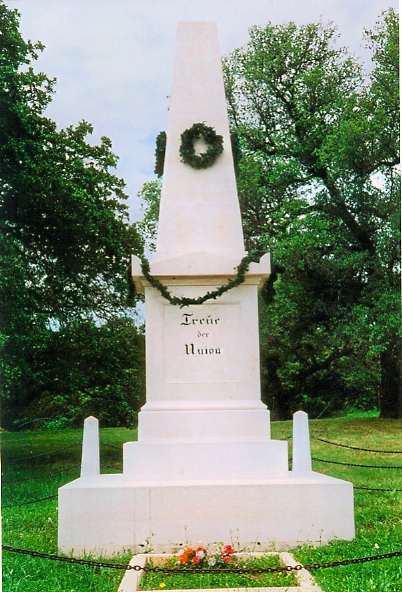
Our usual route from Austin to Madroño Ranch takes us through Johnson City to Fredericksburg via Highway 290, and then down Highway 16 through Kerrville to the turnoff opposite the Medina Children’s Home. Every time I pass the sign for Turtle Creek, an unremarkable little stream just past the turnoff for FM 1273, about five miles south of Kerrville, I am reminded of one of the bloodiest and most controversial episodes in the extraordinarily bloody and controversial history of the state: the battle of the Nueces, labeled “The Blackest Crime in Texas Warfare” by the Dallas Morning News almost seventy years later.
Central Texas is dotted with German settlements dating from the mid-nineteenth century: Fredericksburg, Boerne, New Braunfels, Comfort, Sisterdale, and many more. The German settlers—more than 7,000 of them came between 1844 and 1847 alone—were a diverse group, according to the late Terry Jordan, arguably the leading scholar of European immigration to Texas: “They included peasant farmers and intellectuals; Protestants, Catholics, Jews, and atheists; Prussians, Saxons, Hessians, and Alsatians; abolitionists and slaveowners; farmers and townsfolk; frugal, honest folk and ax murderers.”
Perhaps. But while some German Texans, including prominent journalists such as Ferdinand Lindheimer, defended slavery, and others, like August Buchel, served in the Confederate army, the popular image was, and is, of a relatively liberal, well-educated, and homogeneous group who opposed slavery and secession and remained stubbornly pro-Union. In 1854, at the annual Staats-Sängerfest (state singing festival) in San Antonio, the delegates adopted a resolution condemning the “peculiar institution,” and in 1857, as I noted in an earlier post, Frederick Law Olmsted applauded the abolitionist sentiments he found among the denizens of the Hill Country. It should come as no surprise, then, that many who supported secession and the Confederacy were suspicious of the insular, “radical” immigrants of central Texas.
To make matters worse, some of the more outspoken German Texans organized the Union Loyal League in June 1861, and by March 1862 they were openly celebrating Union victories and had organized a battalion of three well-armed militia companies, with Fritz Tegener, a Prussian emigré who owned a sawmill near Hunt and served as Kerr County treasurer, as major and commander. The militia was supposedly meant to protect the Hill Country from Indians and outlaws in the absence of Federal troops, but its presence, understandably, made the Confederate authorities nervous. Confederate general Hamilton P. Bee, commander of the Western Sub-district of Texas, sent Capt. James Duff, a former San Antonio freighter and founder of an irregular force called Duff’s Partisan Rangers, to take control of the area.
Duff, who declared martial law in July 1862, was later nicknamed “the Butcher of Fredericksburg” for his harsh actions as provost marshal; one historian, writing a century after the fact, noted that “his arrests and depredations on the citizens of these counties seem unjustifiable,” though others say that accounts of his cruelty were a “myth.”
At any rate, an atmosphere of fear, distrust, and confusion had settled over the Hill Country by August 1, when a group of about eighty men, most of them German Texans, met on Turtle Creek, just a few miles north of Madroño Ranch. Sixty-one of them, with Tegener in charge, decided that their best bet was to flee Texas until the hostilities died down—in retrospect, a tragic miscalculation. They determined to try to reach Mexico by riding west to the mouth of the Devils River on the Rio Grande (the site of present-day Amistad Reservoir) and then crossing into Mexico, but Duff learned of their plans and sent Lt. Colin D. McRae, with ninety-four mounted troopers, in pursuit.
The unsuspecting Germans made little effort to cover their tracks, and McRae and his men easily traced them across the Medina and Frio rivers before catching up to them on the afternoon of August 9 on the West Fork of the Nueces River in northeastern Kinney County. A few of Tegener’s men had reported seeing unidentified riders behind them, but the commander dismissed their reports and told the group to make camp in a grassy clearing on the west bank of the river.
The precise details of what happened next are lost to time, but the following seems to be the most commonly accepted version. McRae and his men attacked before dawn of the following day. Around twenty-five of the Unionists abandoned the fight almost immediately and managed to slip through the Confederate lines in the darkness and confusion. McRae’s troops killed nineteen of the remaining Unionists and captured nine others who had been wounded; Tegener himself was wounded, but managed to escape. Shockingly, the Confederates executed the nine wounded prisoners a few hours after the skirmish, shooting them in the head as they lay face-down and defenseless on the ground. As a final indignity, McRae’s men left the bodies of their victims unburied, “prey to the buzzards and coyotes.” The Confederate casualties included two killed and eighteen wounded, McRae among them.
And what of the surviving Unionists, you ask? Eight were killed on October 18, when another Confederate force attacked them as they attempted to cross into Mexico; nine others died in other battles. One man, August Hoffmann, reportedly made his way back to Gillespie County, where he remained in hiding, living on “pear fruit and bear grass,” until the spring of 1863. Tegener himself survived, though legend has it that during his long absence from Texas his wife, assuming he had been killed in the attack, married another man. Haha—awkward! Apparently it all worked out, though, as Tegener himself eventually remarried and went on to become a state legislator and justice of the peace in Travis County.
The encounter on the Nueces almost immediately became what historian Stanley S. McGowen called “one of the state’s most controversial and contentious historiographical events.” The Handbook of Texas notes that “Confederates regard[ed] it as a military action against insurrectionists while many German Hill Country residents viewed the event as a massacre.” Regardless of which side you’re on, it was a terrible thing. In 1865, the families of the men killed on the Nueces gathered their bones and finally interred them at Comfort, where a monument was dedicated on the battle’s fourth anniversary, in 1866. The Treue der Union (Loyal to the Union) monument, pictured above, still stands in Comfort, and historians still debate how best to describe what happened to that group of fearful men who met on humble Turtle Creek on an August day almost 150 years ago.
—Martin
What we’re reading
Heather: Philipp Meyer, American Rust
Martin: C. J. Chivers, The Gun