Showing posts with label sustainability. Show all posts

Friday, December 31, 2010

Getting to good food


Happy New Year! This week, sparing no expense as we recover from the excesses of the holiday season, we have once again secured the services of a top-shelf guest blogger. In this post, Tito Kohout reflects on some of the challenges of rethinking our societal infatuation with “easy” foods.

I start feeling self-righteous when I see some greasy, fatty dude walking out of Wendy’s with a greasy, fatty Number 5 combo. He doesn’t know anything about anything, I say to myself as I pedal furiously past him. I bet he voted for someone I find loathsome. I bet his taste in music is as bad as his taste in burgers. I bet he’s the kind of apathetic American who is, every day, moving us closer to breaking the seventh seal and unleashing some kind of very big and very biblical evil on the world. Then my stomach rumbles and I think that it’s only another dozen blocks until I’m home and can slather some Fiesta-brand peanut butter on my Fiesta-brand wheat bread fried in Crisco until it’s moist and crispy and freaking delicious.

Yeah, that’s stupid. Like really stupid. Like Titanic stupid. Here I am, with my refrigerator full of food from my neighborhood Fiesta Mart (which resides at pretty much the opposite end of the foodie spectrum from Central Market), looking down on some poor guy just trying to grab an easy meal. The Earl Campbell sausages I mix with nameless cheddar cheese in my eggs aren’t any better, and I know it. After all, my parents write this blog, and organic, local, slow, humane food—what I’ll refer to as “good food” from here on in—is obviously important to them, although they weren’t always strictly consumers of good food; I distinctly remember frozen fish sticks being one of my favorite childhood dinners.

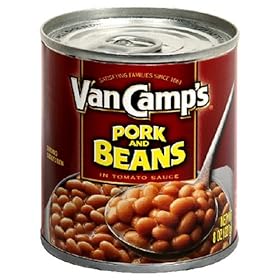
So where did they go wrong, raising a son who’s dumb enough to eat seventy-nine-cent cans of pork and beans on a regular basis? The answer is nowhere. I know that Fiesta’s meat comes from factory farms and its vegetables are probably shipped in from heaven-knows-where covered in pesticides. I know how wrong that is. But, man, it’s easy.

I’ve got the expenditures of your typical dumb male college student: rent, utilities, rugby fees, beer, and, of course, food in large quantities. To more easily afford these things, I buy the cheapest food I can. I’m not much of a cook—a few days ago, I suffered a pasta disaster of substantial proportions—but even the simple things cost more at the farmers’ market than at the supermarket.

But even more than the financial price, the price in effort puts me off. I could find ways to save money. I could get a plot in the community garden a block from my house. I could put myself out on the tutoring circuit again. I could sell my car, since I barely drive it anyway. I could be a better citizen of the earth, but I know I’ll keep on eating seventy-nine-cent cans of pork and beans as long as it’s convenient.

The other day, my older sister told me that Americans spend a smaller proportion of their incomes on food than the inhabitants of any other country. I believe her, both because she’s generally pretty well informed for an older sister and because it’s believable; I certainly work to spend less time and money on food. The question is, “How do we not only make good food competitive in prices with the other stuff, but make the U.S. of A. and the world realize that good food isn’t some weird and mildly threatening eccentricity reserved for rich, white, liberal yuppies and scary people from the lunatic fringe?”

I read my parents’ blog posts, and this is the part where they generally propose a solution to the problems they’ve outlined. I got nothing. I just know that good food is important for the survival of our species and of many others, and that we—not we the consumers of good food (I don’t include myself), but we the people—need to make good food not just a societal priority but a societal norm. Otherwise, we’re all in deep trouble, and I’m going to keep on eating Earl Campbell’s tasty, questionable, preservative-packed sausages.
—Tito


What we’re reading
Heather: Marilynne Robinson, Absence of Mind: The Dispelling of Inwardness from the Modern Myth of the Self 

Martin: Jane Leavy, The Last Boy: Mickey Mantle and the End of America’s Childhood

Friday, April 16, 2010

It's a wonderful town


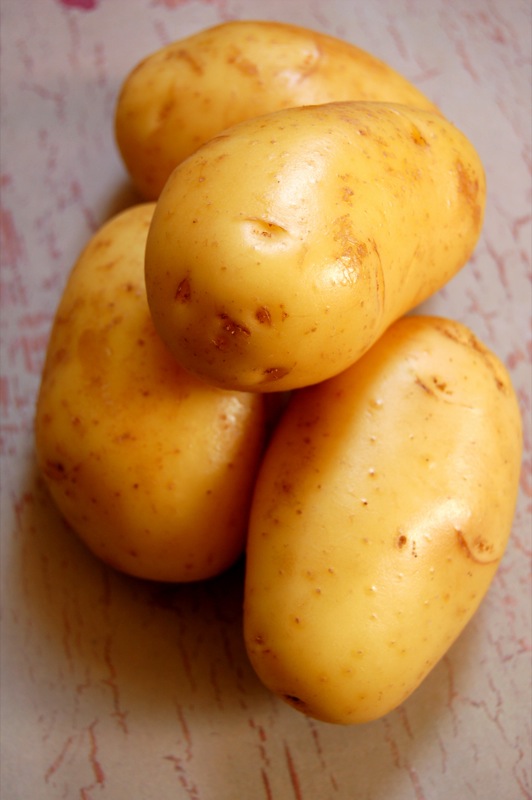
We recently spent a few days in the Big Apple, and the fact that the only souvenir we brought back was a bag of Nicola potatoes probably tells you all you need to know about us and our priorities.

Basically, I find New York completely overwhelming. We stayed mostly in midtown and downtown Manhattan, and my reaction upon venturing forth onto the chaotic streets and teeming sidewalks was always the same: Great googly moogly! Get a load of all them tall buildings, Maw!

You have to understand that I don’t know the city at all. The last time I spent any time there was during college, when we used to make occasional forays down from rural western Massachusetts in search of live jazz, cocktails, and the illusion of sophistication. Back then—I’m talking thirty years ago or more—New York seemed a really menacing place, which of course was part of the attraction; taking the subway in the middle of the night made us feel, well, dangerous. Even though we were actually just, you know, stupid.

On this trip, though, I discovered another Manhattan, one that exists behind or along with the gray concrete canyons and jostling hordes and schools of predatory taxis. The principal element of this greener, gentler Manhattan is, of course, Frederick Law Olmsted’s Central Park, the true heart (or perhaps I should say lungs) of the city.


Even when it’s jammed with pedestrians, as I imagine is usually the case in the spring, Central Park, with its forsythia and cherry trees blooming and its undulating serpentine walkways, is a true oasis from the frantic sensory overload that surrounds it. Even the constant din of car horns—the true soundtrack of any New York experience—seems muted and distant. I love Zilker Park in Austin, and Golden Gate Park in my native San Francisco, but neither of them seems as necessary as Central Park.

The hidden Manhattan also includes the High Line, an extremely cool elevated park on the West Side. Talk about creative use of space! On an island such as Manhattan, all the empty spaces in the grid have long since been filled in. But Rob Hammond (the son of our San Antonio friends Hall and Pat Hammond) had the bright idea of turning a disused elevated railroad track into a park. Walking above the streets of Chelsea opens up unexpected vistas; you look down into the surrounding neighborhoods, over the Hudson, and into New Jersey from above, and see them as if for the first time.


Another component of this city-within-the-city is the Union Square Greenmarket, an enormous (140 vendors) farmers market that’s open Mondays, Wednesdays, Fridays, and Saturdays and brings all manner of stuff—meat, vegetables, fruit, flowers,  bread, wine, cider—from the surrounding countryside into the heart of the city. (That’s where we bought the potatoes.) According to one of the vendors we talked to, Sarah Shapiro of Hawthorne Valley Farm, the Union Square market is one of about forty in the city. By my extremely rough calculations, given an estimated New York City population of circa 20 million, that works out to about one market for every 500,000 people in New York.


Speaking of food, we had lunch on Saturday at the Green Table, a tiny sustainable eatery tucked inside Chelsea Market, in the old Nabisco plant on Ninth Avenue. And we had a wonderful Easter dinner with friends at Savoy, a charming little Soho bistro specializing in fresh, locally sourced ingredients. It was all delicious.

I guess you really can find anything in New York, from a cast-iron Chrysler Building lantern to overhead parkland, if you just know where and how to look. Funny how a city that, to me at least, has always symbolized traditional, even obsolescent, urban culture—the subway! Radio City! the Brooklyn Bridge! Broadway! Grand Central!—can turn out to be so full of innovation. Those potatoes we brought back were darn tasty, too. Maybe in another five years or so, when we’ve recovered from this visit, we’ll be ready for another!
—Martin


What we’re reading
Heather: Alexander McCall Smith, Tea Time for the Traditionally Built
Martin: Bill Bryson, The Life and Times of the Thunderbolt Kid: A Memoir

Friday, September 4, 2009

The naming of writing centers


There are a lot of questions that will need to be answered before Madroño Ranch: A Center for Writing and the Environment becomes a reality. Among the more unexpectedly troubling was, what to call the dang thing?

Heather decided fairly early on that she didn’t want to use the word “retreat,” since it implied withdrawal and isolation, and we hoped that our program would in fact interact with and benefit the local community in some as-yet-undetermined fashion. She also decided she didn’t want to use the word “sustainability,” because it smacked of trendiness, even though sustainability is one of the things we hope the center will be all about.

We tried to think of a name that might convey something of our hopes and expectations for the place. One early candidate was the Companis Center, from the Latin source (meaning “with bread”) of the English word companion; another was the Tavola Center, tavola being the Italian word for table; a third was the Nexus Center, since we hoped it would be a place where different ways of thinking would come together, but we concluded that all of those sounded too much like office buildings.

Ultimately, we decided that the most sensible and easiest thing to do would be to stick with the name by which we already knew the place—Madroño Ranch—and add a “subtitle” that would (we hoped) explain what it was intended to be. (And yes, that is a photo of one of our madrone trees at the beginning of this post.)

So far, so good. Except that when we sat down and tried to come up with that subtitle, we found ourselves stuck again. It turns out that the naming of writing centers, to paraphrase T. S. Eliot, is a difficult matter. All sorts of possibilities, most of them silly, suggested themselves—for example, Madroño Ranch: Next Door to Utopia (a reference to the fact that our closest neighbor is Kinky Friedman’s utterly wonderful Utopia Animal Rescue Ranch) and my personal favorite, Madroño Ranch: A Center for Writin’ and Wranglin’. We finally settled on Madroño Ranch: A Center for Writing and the Environment as the simplest and clearest alternative. Now doesn’t that sound like the kind of place at which you brilliant literary types would like to come spend some time?
—Martin

What we’re reading
Heather: Mary Ann Shaffer and Annie Barrows, The Guernsey Literary and Potato Peel Pie Society