Showing posts with label The New Yorker. Show all posts

Friday, October 22, 2010

Barbers, bison meat, and the invisible hand


I was back in my shiny new persona as salesperson last week, driving out to all the dude ranches around Bandera in hopes of scaring up a market for the hundreds and hundreds of pounds of bison meat we will soon have for sale. Reaction was generally favorable, despite the fact that I didn’t have some basic information at hand, like the prices we’ll be charging.

Aside from feeling like a dummy, a phony, and a bat-brained loony, I had fun. First, there’s very little that I enjoy more than looking at other people’s property. Second, I got to drive down some Hill Country roads I hadn’t been on before and go through the Hill Country State Natural Area, a secluded 5,000-plus-acre park dappled with beautiful blooming grasses and gayflowers, stands of hardwoods, and shining creeks. The third fun thing was getting out and meeting people—not a pleasure my usually introverted self would have anticipated. Our pattern when we go to Madroño has been to get there and dig in, not coming out unless we need something really important, like the newspaper or beer or ice cream or antihistamines. Now, for the first time, we’re starting to meet our neighbors. We’re starting—just barely—to find our way into the community.

I’ve also been rereading Wendell Berry’s Jayber Crow: The Life Story of Jayber Crow, Barber, of the Port William Membership, as Written by Himself, in which community is a central concern. (The book has easily reaffirmed its place on my top-ten favorite novels list.) So this week “community” seems to be the theme that wants to beat me over the head until I wake up and pay attention.

As you might guess from the subtitle, Jayber Crow concerns a small-town Kentucky barber whose life spans most of the twentieth century. Orphaned at an early age, Jayber is raised by a loving great-aunt and -uncle, who die when he is ten. He is sent to an orphanage and finally, a dozen years later, makes his way back to Port William to become its barber, grave-digger, and church janitor. A philosophical-minded bachelor, Jayber watches the community (that’s a map of the whole fictitious area above) over the course of several wars and the encroachment of highways and agricultural technology. Although he witnesses and endures great suffering, at the end he can say truthfully that his book is about Heaven because of the profound love the community bears for itself and for its place, both temporal and spatial.

In part, this love manifests itself in Port William’s economic life. When Jayber returns to Port William, he finds that the town’s previous barber has left, not being able to support his family on his shop’s limited income. Jayber is immediately taken by an old friend to see the town banker, who in introducing himself says, “I’m glad to know you. I knew your mother’s people.” He offers to loan Jayber the money to buy the old barbershop; Jayber describes the terms of the loan as “fair enough, but very strict in what he would expect of me.”

Jayber adds, “You will appreciate the tenderness of my situation if I remind you that I had managed to live for years without being known to anybody. And that day two men who knew who and where I had come from had looked at me face-on, as I had not been looked at since I was a child.... I felt revealed, as if to buy the shop I had to take off all my clothes.” Going into business requires him to become a part of the community, to care about its constituent parts in order to make his own way in the world.

I had imagined that this community might make Adam Smith, the patron saint of free-market economics, sneer: it lives within the limits of the land’s fertility, repairs what is broken, patches what is torn, and remains deeply suspicious of debt. Its citizens are generous to those in need, recognizing that they cannot prosper individually without prospering corporately. The antihero of the novel, Troy Chattam, is an ambitious young farmer who contemptuously rejects the old-fashioned ways of his father-in-law; Troy’s mantra is “modernize, mechanize, specialize, grow.” He goes into debt to buy new machinery and listens to agribusiness experts who tell him to use every bit of soil on the place: “never let a quarter’s worth of equity stand idle.” He seems to be a firm believer in the “invisible hand,” famously posited by Smith in his magnum opus The Wealth of Nations, which supposedly guides markets to produce the highest quality goods for the lowest price to the benefit of both producers and buyers; this is what we used to call the American way. Like that of the city for which he was named, however, Troy’s is not a story with a happy ending.

But wait—why in heaven’s name is Adam Smith suddenly part of this conversation? Because I, despite my shocking ignorance of economics, just read Adam Gopnik’s fascinating article on Smith in the October 18 issue of The New Yorker. In it Gopnik argues that Smith’s real question “was not the economist’s question, How do we get richer or poorer?, or even the philospher’s question, How should one live? It was the modern question, Darwin’s question: How do you find and make order in a world without God?”

Gopnik is ostensibly reviewing Adam Smith: An Enlightened Life, by Nicholas Phillipson, but he is really using Phillipson’s book as a jumping-off point for his own meditations on economics and community. Readers of The Wealth of Nations tend to ignore Smith’s earlier The Theory of Moral Sentiments, but by doing so, according to Gopnik, we “lobotomize our own understanding of modern life, making economics into a stand-alone, statistical quasi-science rather than, as Smith intended, a branch of the humanities.” In order for humanity to live in community, Smith posits the necessity of “an impartial observer who lives within us, and whom we invent to judge our actions.” Without this imaginative capacity, a market economy can’t exist; unless we can put ourselves in the place of our fellows, we can’t imagine what they might need. “For Smith, the plain-seeing Scot,” writes Gopnik, “the market may not have been the most elegant instance of human sympathy, but it’s the most insistent: everybody has skin in this game. It can proceed peaceably only because of those moral sentiments, those imaginary internal judges.”

Unfortunately, those imaginary internal judges recede into the background when producers band together in order to eliminate competition and control prices; according to Phillipson (via Gopnik), Smith believed that “the market moves toward monopoly; it is the job of the philosopher to define, and of the sovereign state to restore, free play.” The market works toward the benefit of all only when it is broadly just—defined (by me) as being in the long-term interests of both producer and consumer. When the scenario Berry imagines in Jayber Crow comes to pass—when economic and business practices fray the fabric of community rather than protect it—then we live in epically tragic times, like those of Troy. When we find communities in economic disarray, then, according to the father of free-market economics, imaginations incapable of sympathy are at the root of the problem.

Of course, this is a pretty self-serving position, since we at Madroño are about to go head-to-head with such giants as H-E-B, who can charge much less for bison meat than we can. But I honestly believe that the long-term health of H-E-B depends on a diverse economic ecosystem in which the building of community—which requires a mutually sympathetic imagination—will rest on the flexible backs of small, dynamic businesses. Which maybe, with the help of our local community, we will become.
—Heather


What we’re reading
Heather:
Wendell Berry, Jayber Crow: The Life Story of Jayber Crow, Barber, of the Port William Membership, as Written by Himself
Martin: Bill Minutaglio, In Search of the Blues: A Journey to the Soul of Black Texas

Friday, May 28, 2010

Still more on violence: there will be blood


The other day, I stopped my car to chat with neighbors (a frequent occurrence in our chatty neighborhood). We quickly got to the topic of the Deepwater Horizon oil spill and its spreading devastation. D. told me that he’d heard an interview on National Public Radio with a worker at an oil and gas pipe factory in Youngstown, Ohio, after President Obama had spoken there to promote his economic policies. This worker was notably unimpressed with the president’s moratorium on offshore drilling. (According to the transcript on the NPR website, the worker, Larry Collins, actually said, “I’d like for [President Obama] to say it’s a go and let’s start drilling. The more rigs we have out there drilling, the more demand for our product.”)

To D., I snorted something snarky about Mr. Collins’s self-centeredness and shortsightedness and then realized in the midst of sneering that I had left my car running while we were chatting. Once I got home, I turned off lights that had been left on all day, presumably so our dogs and cats wouldn’t need to use their reading glasses. I remembered my father doing the same thing during the energy crisis of the 1970s, usually while asking, “Do you think your daddy owns the electric company?”

I recount this unremarkable scenario as part of my ongoing musings about violence and our usually invisible participation in and promulgation of it. In light of Martin’s last post, this seems like a precious way to continue the conversation about our individual and collective violence footprints, but after turning off the ignition and the lights, I realized that Mr. Collins and I had more in common than I had initially acknowledged. Am I prepared to examine my energy consumption—from the mechanical pencils in my desk drawer, to the food I eat, to the trash I throw away, to the investments I make—and change my expectations and habits? Am I Just Saying No to habits that keep drilling an attractive option to companies like British Petroleum? Well, no, not really. I keep hoping someone will invent something that will painlessly neutralize my energy cravings, sort of like those diet pills advertised in women’s magazines. But as Bill McKibben points out in an article in the latest issue of The Christian Century, we are addicted to cheap oil: “You think maybe, just maybe, that the needle BP stuck into the bottom of the sea flows straight into our veins?”

To me, one of the most appealing facets of the American character is our buoyant sense of optimism. Our hopefulness attracts hopeful people of all other nationalities, like Saul Griffith, featured in The New Yorker’s May 17 “Innovators Issue.” Born and raised in Sydney, Australia, he came to the United States in 1998 as a doctoral student at MIT, initially to work on electronic ink – the idea which eventually became the Kindle. The author of the New Yorker article, David Owen, describes Griffith thusly: “His hair, which is reddish brown, is usually an omnidirectional mess, and he often looks as though he had dressed from the bottom of the laundry pile.” I love that “omnidirectional,” which apparently describes Griffith’s brain as well as his hair: in 2004, he won the $30,000 prize awarded to the MIT student who shows great promise as an innovator, and in 2007 he received a MacArthur Foundation “genius grant.” Since then, among other things, he has been thinking about and working on energy efficiency.

My favorite anecdote in the article describes Griffith, who now lives in San Francisco, riding to his lab on the prototype of an electricity-assisted tricycle he had designed. The tricycle included an enclosure for carrying cargo, and on the rainy morning in question the cargo was his infant son Huxley. The rain caused a short circuit in the tricycle’s wiring, resulting in a small fire under Huxley’s seat, which Griffith extinguished after hauling the baby off the trike. Writes Owen, “Huxley had reacted placidly to the crisis, as though, at eight months, he was already accustomed to life as the child of an inventor.” Genetic buoyancy and hopefulness at work here, clearly.

But the article charts Griffith’s growing disenchantment with technology as a means of avoiding the ecological disasters lying ahead. The things that he and his colleagues produce, while ingenious, often aren’t addressing the actual problems, because the problems aren’t fundamentally technological in nature. Griffith believed, for example, that waste from discarded cellphones could be reduced by the production of hand-cranked cellphones, using technology developed in the 1920s. But the problem of discarded cellphones isn’t technological, he realized, it’s cultural; people discard their cellphones because they want the latest model, not because their old phones stop working.

Griffith also notes that the nations with the lowest energy needs and highest standards of living, like Portugal, built their infrastructures long ago, when energy was much more costly than it is today. Houses built before the advent of cheap coal and oil were (and remain) energy efficient because they had to be; they are small, with small windows and thick walls. So here’s the kicker: “Such low-tech ideas are crucial to forming viable environmental strategies, Griffith believes, because implementing more complicated technologies... would consume natural resources and generate greenhouse gasses at unsustainable rates.” Griffith currently lives in what he describes as a “thermodynamic nightmare” of a house in San Francisco’s Mission District. “If I were building a house from scratch,” he says, “I could totally design a thermodynamically amazing, almost zero-energy house—but a huge amount of energy would go into building it, just in the materials, and right now most of that energy would come from burning fossil fuels.” In other words, in trying to use technological innovation to solve the problems of our increasing demand for energy, we’re more often than not acting like Wile E. Coyote, busily sawing off the branch of the tree we’re sitting on.

Assuming that Griffith has a broader perspective on the issues of energy use than I do, I am coming to lose some of my American optimism. I’m thinking that if, like Mr. Collins in Youngstown, I as an individual and we as a nation continue to take a short-sighted, self-centered view of our energy needs, I and we will, in effect, be demanding that BP and its cohorts keep taking the kinds of risks for which the Gulf of Mexico and the countless beings in, around, and over it are now paying in blood. What do we consider acceptable losses? What will make us change before we kill what is most precious to us, including our sense of hope?

I’ll try to write something cheerier next time, I promise.
—Heather


What we’re reading
Heather: Anne Fadiman, The Spirit Catches You and You Fall Down: A Hmong Child, Her American Doctors, and the Collision of Two Cultures
Martin: Terry Teachout, Pops: A Life of Louis Armstrong

Friday, February 12, 2010

The Great Texas Camel Experiment


Susan Orlean’s wonderful story on mules in the military in this week’s issue of The New Yorker mentions one of my favorite, and most unlikely, episodes of Hill Country history: the U.S. Army’s Great Texas Camel Experiment of the 1850s.

Ultimately, the experiment was a failure; in Orlean’s words, “The camels were superior in terms of strength, but they were vicious, tended to cough up foul-smelling chunks of food, and made horrible groans and roars that terrified the horses.” Still, enough of the beasts went AWOL that for several decades unwary sojourners in the American Southwest occasionally found themselves face to face with a living, spitting embodiment of Oriental exoticism.

Before the Civil War, much of Texas was considered to be part of the “Great American Desert,” a vast area of the Southwest that was still largely uninhabited and considered unsuitable for agriculture. American expansionism was about to prove that characterization wrong, at least in the short term, though Timothy Egan’s terrific book The Worst Hard Time: The Untold Story of Those Who Survived the Great American Dust Bowl vividly describes the horrific long-term result. But in the mid-nineteenth century, the War Department had to figure out a way to protect settlers and supply lines in this fearsome territory, and decided that using camels, instead of horses or mules, to carry troops and freight might be one way to do so.

The story of the Texas camel experiment actually begins in Florida, where Col. George H. Crosman apparently first thought about using camels for military purposes as far back as 1836. Crosman eventually asked Maj. Henry C. Wayne to look into the idea, and Wayne eventually reported to Secretary of War Jefferson Davis that the experiment would cost a mere $30,000. Congress duly authorized the expenditure in March 1855, and a little over a year later, on April 29, 1856, the naval storeship Supply arrived in Indianola, Texas, carrying thirty-three of the beasts (both one-hump Arabians and two-hump Bactrians), including one calf that had been born at sea, and three Arabs and two Turks whose job it would be to tend the creatures. The crossing had not been easy; the crew had to tie the camels to the deck during storms so they wouldn’t slide overboard, and the animals proved to be susceptible to seasickness.

On June 4, Wayne finally started his exotic caravan westward toward Camp Verde, south of Kerrville, pausing in Victoria to have the camels clipped. The industrious Mrs. Mary A. Shirkey of that town spun and knit a pair of camel hair socks as a gift for President Franklin Pierce, but Pierce reportedly found them so foul-smelling that he refused to wear them.

Wayne put the camels to work ferrying supplies between Camp Verde (a little over ten miles east of the future site of Madroño Ranch, as the crow flies) and San Antonio, with encouraging results. A second boatload of camels arrived in 1857, and some made the long trek to new quarters in California. An officer who led a caravan to the Big Bend country noted in his journal that the camels “performed most admirably,” adding that “No such march as this could be made with any security without them.”

Unfortunately, however, reports soon surfaced that the camels’ wide, soft feet, perfectly adapted for crossing desert sands in North Africa and the Near East, were not well suited to the rocky terrain of the the American Southwest. In addition, the soldiers were not fond of the camels, and vice versa; the officer who led the expedition to California noted that the beasts smelled bad and tended to bite or spit at the troops, and the horses and mules were unable to keep up with them.

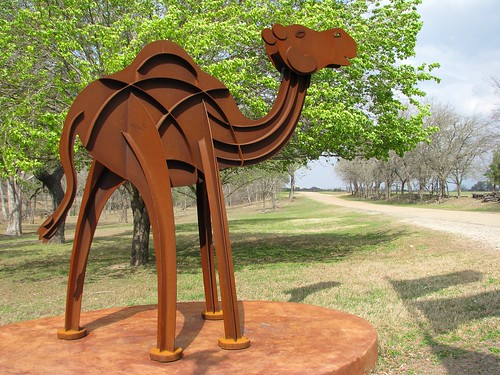
Eventually, thanks in part to the complications brought on by the Civil War, the army decided to get out of the camel business. Some of the animals were sold to zoos, circuses, and mine operators. Others were simply turned loose to wander the Southwest; in 1885, the five-year-old Douglas MacArthur was terrified when he unexpectedly encountered one of the unlikely beasts near an army fort in New Mexico. Ten years later, the San Francisco Chronicle noted that Many a passenger on the Southern Pacific railroad trains has had a sight of some gaunt, bony and decrepit old camel away off in the distance.” Today, the last of the original camels has long since disappeared, though a metal statue in front of the Camp Verde General Store commemorates their presence, and the Texas Camel Corps, a dedicated group of enthusiasts, keeps a number of the animals for pack trips, commercials, Christmas pageants, and the like.


Medina’s Early Days, one of the late Dorothy Hatfield Ferguson’s books of local history, includes the reminiscences of James Washington “Okra” Walker, who worked with the camels at Camp Verde. Walker was born in 1847, and in 1862, with the Civil War underway, decided to join the army and have a share in the fighting. Instead, much to his chagrin, the fifteen-year-old orphan found himself assigned to take care of the camels at Camp Verde. Looking back on the experience years later, Okra grudgingly admitted that the camels did have some advantages over other beasts of burden, principally “the ability to do without water for an incredibly long time,” but he never really warmed up to them, noting that “they weren’t as easy to look at as a good cuttin’ pony.” Moreover, they seemed much given to malingering, held grudges for any perceived mistreatment, and had the habit of spitting on those they didn’t like. “They also frightened the mules and horses and generally looked mighty out of place.”

When the experiment finally ended, Okra Walker, for one, was not sorry to see them go: “I guess I’d fooled with those beasts so long, and was [so] disgusted that I’d had to herd camels instead of fighting in the Civil War, that I never as much [as] asked one question pertaining to those camels or the buyer’s plans for them.... When those camels left Camp Verde, they went out of my life forever. I shouted after them, ‘Thank God you’re gone!’”

We have no plans to acquire camels for Madroño—I’m pretty sure Robert, our manager, would kill us if we did—but I like to imagine them roaming the ranch’s hills like the aoudads and other fugitive exotics we occasionally see today. And who knows? Perhaps the great-grandchild of some Arabian or Bactrian import is still out there, running free and gazing down at us with that inimitable camelicious mixture of disdain and amusement, sneering, “I’ll never be your beast of burden.”
—Martin 


What we’re reading
Heather: Philip Pullman, His Dark Materials trilogy
Martin: Ted Gioia, Delta Blues: The Life and Times of the Mississippi Masters Who Revolutionized American Music