Showing posts with label Texas Hill Country. Show all posts

Friday, March 11, 2011

Lenten reflections: dead trees, bafflement, and submission


Fittingly, this Ash Wednesday began with a vigorous north wind, the kind that knocks dead branches out of trees and can make you a little leery about walking outdoors. It blew me back to the moment that I first got a glimpse into the meaning of Lent.

I had vaguely thought of “giving something up for Lent” as an opportunity to practice self-discipline and to display a sense of commitment to a “good” life, a sort of spiritual calisthenics that made you feel better, especially when you stopped. The events I recalled weren’t, on the surface, particularly interesting or dramatic, but they allowed me to see myself from a previously undiscovered vantage point; for the first time, I could see I was like a tree filled with dead branches that needed some serious pruning in order to keep growing. Observing Lent wasn’t a way to prove how strong I was; it was a space offered in which I might look at all my dead branches and wonder how I, with the north wind’s help, might clear some of them out, while trusting that I wouldn’t get knocked out by falling timber.

A time for submission—no wonder Lent gets a bad rap. Who wants to submit, especially after a look at the roots of the word: “sub-” is from the Latin for “under,” and “-mit” is from “mittere,” to send or throw or hurl. To submit to something is to hurl yourself under it—“it” presumably being a force much greater than your itty-bitty self, a force like, say, a speeding F350 pick-up. In fact, it might even take some courage to submit to the scouring blast of Lent.

In last week’s post, Martin considered some of the complexities of being from a particular place, ending with a beautifully expressed desire to be here, rooted in this rocky Hill Country soil. Imagine his exasperation when I said last night that I felt like I needed a vacation. My desire to run away (presumably temporary) probably has several sources, but one of them may be an awareness that the idea of Madroño Ranch is taking on heft and weight, leaving behind the dreamy elasticity of fantasy.

I’m reminded of my reaction to our daughter Elizabeth’s first vision test. It had been suggested by her third grade teacher, who had never had a student make so many arithmetic mistakes, especially in copying problems from the chalkboard onto paper. The test results were normal; Elizabeth wasn’t nearsighted, just math-impaired. First I mourned that she would never be an astronaut or an engineer or a mathematician, but then I realized that we now knew more about who she really was; she was beginning to take on her own form, independent of my fantasies for her.

In a lovely essay entitled “Poetry and Marriage: The Use of Old Forms,” Wendell Berry (of course) unearths the kinship between marriage and formal poetry: both begin in “the giving of words,” and live out their time standing by those words:
In marriage as in poetry, the given word implies the acceptance of a form that is never entirely of one’s own making. When understood seriously enough, a form is a way of accepting and living within the limits of creaturely life. We live only one life and die only one death. A marriage cannot include everybody, because the reach of responsibility is short. A poem cannot be about everything, for the reach of attention and insight is short.
Choosing a form implies the setting of limits, limits that appear arbitrary from the outside or at the outset, but that can open into generosity and possibility as they are practiced. Even as they limit, these old forms point their practitioners to a way through self-delusion toward truth, through loneliness toward community. Individual failures are certainly possible, but they aren’t necessarily arguments against the forms themselves. In fact,
“[i]t may be... that form serves us best when it works as an obstruction to baffle us and deflect our intended course. It may be that when we no longer know what to do we have come to our real work and that we no longer know which way to go we have begun our real journey. The mind that is not baffled is not employed. The impeded stream is the one that sings.”
This past weekend we hosted “Hog School” at the ranch, the second in an ongoing series of sustainable hunting/butchering/cooking/eating extravaganzas put on by Jesse Griffith of Austin’s Dai Due supper club. I spent much of the weekend baffled (and not in a good way) by rifle-toting guests scattered across the property hunting feral hogs, by the seemingly effortless magic with which chef Morgan Angelone produced gorgeous and delicious treats from the kitchen (my kitchen, mind you, my philandering kitchen purring in someone else’s hands), by my own mental contortions.

I finally decided to go for a walk where I was unlikely to be mistaken for a hog. Marching through the field by the lake and muttering imprecations against the wind (no birds to watch), the lack of rain (no grass coming up), and the hunters (no long walks available), I decided to climb to the base of the cliffs above me and head back to the house by a new route.

Though they can be steep, the Hill Country hills aren’t exactly the Alps; climbing to the base of the cliffs only takes a few minutes and a lot of grabs at branches to keep from sliding back down in the loose mulch and rocks that just barely hold the hills up. Once I got into the still-leafless trees, I began lurching across the perpetually shifting terrain and found that it was impossible to walk and look at the same time; if I wanted to walk, I had to watch my feet carefully, and if I wanted to look, I had to stop and make sure I was balanced before I shifted my gaze. It made for slow going because, unexpectedly, there was a lot to see that I hadn’t noticed from below.

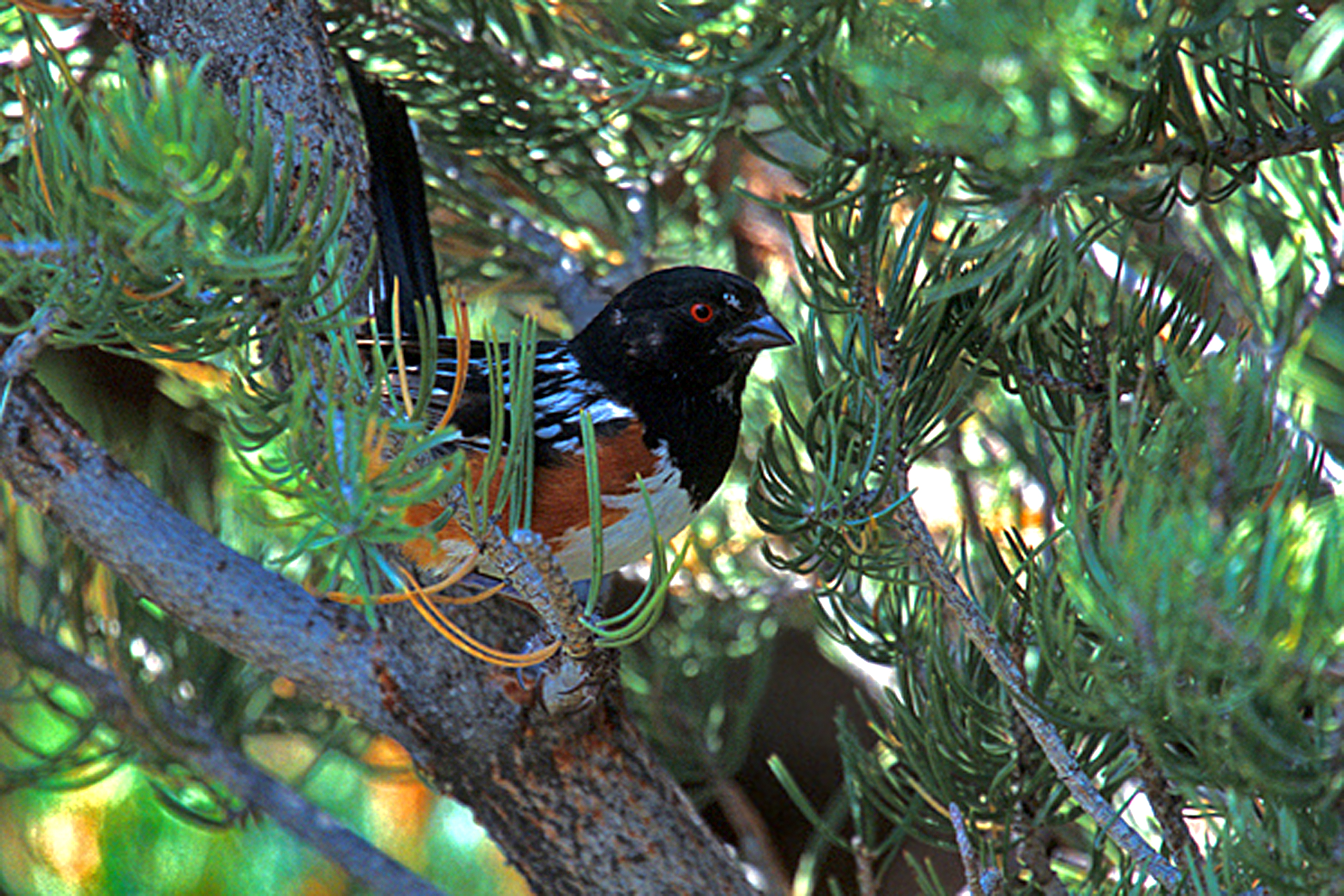
I found a fine moss-covered boulder that allowed me a new vantage point from which to look down and into the trees and brush I normally looked up at, a posture that causes the painful condition among birders known as “warbler neck.” I quickly misidentified several sparrows, and with an un-aching neck, was able to track down some raucous spotted towhees making rude observations from a clump of yaupons and to lecture them briefly. Staring at my feet as I staggered across the hillside, I found that grasses, indeed, were beginning to sprout, despite the drought. Skidding onto my derriere—it always happens off-roading on these hills—I was able to observe the first blush of blooming redbud tree, closely guarded by the great daggered yucca beside it. And then, as the wind picked up again, the rich thick smell of honey clogged the air. The source? Tiny yellow blossoms nestled under agarita spines—tiny and extravagantly generous and impossible to pick without getting pricked. The wind blew my hat off, and, setting off multiple rockslides, I chased it gracelessly down the hill.

Limits: from dust you were made and to dust you shall return. Bafflement: unexpected forms arising, unforeseen paths opening. Submission: throwing the deadwood of the ego into the flames of the Unnamable One. That’s a lot to wrestle with for the mere forty days of Lent.
—Heather


What we’re reading
Heather:
Adam Gopnick, Angels and Ages: A Short Book About Darwin, Lincoln, and Modern Life
Martin: Donovan Hohn, Moby-Duck: The True Story of 28,800 Bath Toys Lost at Sea and of the Beachcombers, Oceanographers, Environmentalists, and Fools, Including the Author, Who Went in Search of Them

Friday, January 21, 2011

South Texas: a fierce and unexpected beauty


Yum! This week has afforded me yet another in a long—seemingly infinite, in fact—series of opportunities to eat crow. Heather and I returned yesterday from a visit to our friends Hugh and Sarah Fitzsimons’ Shape Ranch, outside Carrizo Springs.

As regular readers know, Hugh and Sarah have loomed large in our efforts to get Madroño Ranch off the ground. Hugh, the dueño of Thunder Heart Bison, is our guru in all things bison; in fact, we bought our original herd of twelve animals (which has now tripled in size) from him three years ago.

But our connections with Hugh and Sarah go back much farther than that. Heather had been buying their meat at the farmers’ market for several years before picking up one of the business cards Hugh happened to set out at his booth one day. When she saw his name, something clicked.

“Did your grandmother live on Argyle Avenue?” she asked him.

Startled, Hugh affirmed that she did, and within a very short time he and Heather had determined that their grandparents had lived across the street from each other in Alamo Heights; that Heather had enjoyed many a snack of milk and cookies in Hugh’s grandmother’s kitchen; and that Heather was “Uncle Henry’s” granddaughter (“uncle” in this case being a term of friendship rather than kinship). They hadn’t seen each other for about forty years, but that shared history was the basis of a new friendship.

Furthermore, Sarah‘s brother sings in the choir at our church in Austin, and, as if all that weren’t enough, we subsequently discovered that our daughter Elizabeth and Hugh and Sarah’s daughter Evelyn were not just cabin mates, but actually shared a bunk during a summer at Camp Mystic, many years ago.

The connections, in other words, are various and deep. But even though Heather had been down to Shape Ranch several times to observe Hugh’s bison operation, this week’s visit was my first. Heather had told me that the place was gorgeous, but Heather is after all a native Texan and therefore not to be trusted on such matters.

Now, you have to understand that Carrizo Springs is in South Texas. Flat, scrubby, harsh South Texas, of course, couldn’t be more different from the hilly, wooded, green Central Texas Hill Country which is home to Madroño Ranch. Never mind that most of my experience of them has been restricted to what you can see from a car at seventy miles an hour; as far as I’m concerned, flat places like the central California valleys, the Midwestern corn belt, and, yes, South Texas are to be avoided, or at least passed through as rapidly as possible en route to hillier, and ergo prettier and more interesting, places: the Bay Area, the Sierra Nevada, the Rockies, and the Hill Country.

On Wednesday afternoon, the landscape grew steadily flatter as we made our way from Madroño down to Carrizo Springs via Medina, Utopia, Sabinal, Uvalde, La Pryor, and Crystal City, and all my old prejudices were kicking in, but I was prepared to be a good sport about it, for Hugh and Sarah’s sake.

We drove south out of Carrizo Springs on FM 186 and, a few miles after the pavement gave out, turned in at their front gate, and I began to taste that familiar corvine tang in my mouth. The land was not in fact perfectly flat, but softly undulating, yielding sudden and unexpected vistas. And it was undeniably scrubby, but the winter mesquite and sage and rust-colored seacoast bluestem and purple, pink, and yellow prickly pear were undeniably lovely.


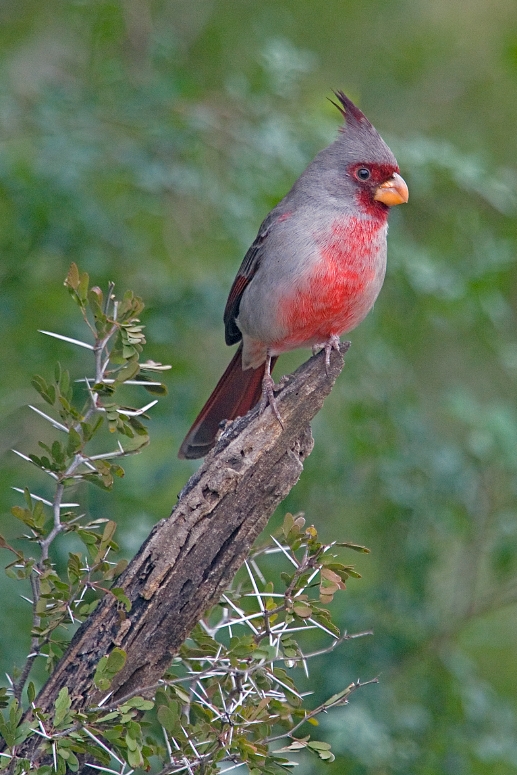
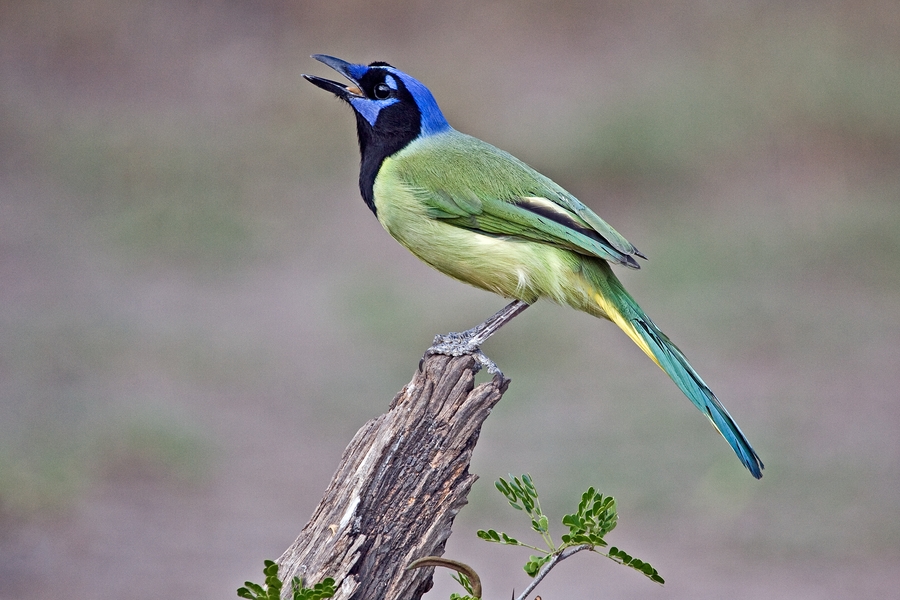
And the birds! Heather is the birder in the family, but even I was amazed by the number and variety of the birds we saw: caracaras and pyrrhuloxias and cardinals and thrashers (both brown and curved-billed) and green jays and white-crowned sparrows and one big blue heron and assorted hawks and kestrels and... well, you get the idea.

After driving several more miles of labyrinthine dirt roads seemingly devoid of physical landmarks, other than the occasional oil pump jack, we somehow arrived at Hugh and Sarah’s house, which is shaded by Arizona ash trees (virtually the only real trees on the place). Hugh and Sarah suggested we dump our bags, grab some beverages, jump in the pickup, and drive up to a picnic table that is their favorite place to watch the sunset. We pulled up and found an amazing 360-degree panorama, with the sun sinking low in the western sky. Sarah told us that when the sun sank low enough, we’d be able to see the mountains of Mexico on the horizon.

Sure enough, as the sky turned tropical-drink orange and pink the mountains came into view. And then, a few minutes later, from the opposite direction, we saw the bright orange full moon rising behind the windmill. Then, to complete the jaw-dropping array of effects, the coyotes—at least two different packs—began serenading us. Clearly, the only thing to do was to return to the house and enjoy dinner and conversation, and still more red wine, around the fire that Hugh built on the back patio.

Yesterday a front blew in, cold and gray and misty, while we were on our morning walk with Hugh and Sarah; the sharp, wet wind made the brunch that followed, of scrambled eggs and sausage and sliced avocado and grapefruit and lots and lots of strong hot coffee, even more welcome. In some ways, with its unnerving, disorienting sameness and plentiful thorns and scarcity of water and shade, this is not a particularly gentle or hospitable land, but yesterday afternoon, when Heather and I finally left to begin the long drive over to I-35 and up to Austin, it felt, just a little, as though we had been expelled from the Garden of Eden. And, believe me, those are not words I ever imagined myself writing about South Texas.

Hey, could I get a side of fries with that order of crow, please?
—Martin


What we’re reading
Heather:
Jon Fasman, The Geographer’s Library
Martin: Suzannah Lessard, The Architect of Desire: Beauty and Danger in the Stanford White Family

Friday, December 3, 2010

Hosts, guests, and strangers: thoughts on hospitality


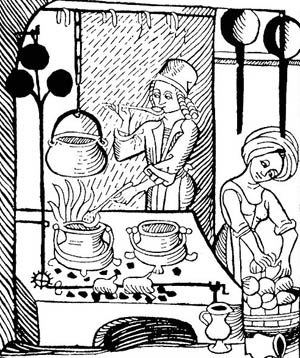
The season of hospitality is upon us, with all its pleasures and burdens. Known in the Christian tradition as Advent, it focuses on the need for preparation, both for the very intimate event of a baby’s birth and for the cosmic birth of a new order. One of my favorite images for the season, if I’m remembering rightly, comes from a series of woodcuts made by a northern Renaissance nun. In it, she imagines herself as a housewife, preparing for the coming company of the Child and the Judge by cleaning the house of her heart: dusting, sweeping, washing, polishing. The images refuse any pretensions to profound theology or high art; they are reassuringly earth-bound and homey. If you pay attention, you can almost smell the baking bread.

“Hospitality” is one of those words whose meaning has changed over the years. In our current culture, it often refers to an industry directed toward travelers or those in need who are expected to pay for its services. If hospitality isn’t a primarily economic exchange, it usually refers to the opening of home and hearth to friends, family, and associates.

In ancient times (or in places that still hew to ancient ways), hospitality wasn’t a service or an option; it was a necessity and a moral imperative. Before the development of institutional hospitality (hospitals, hospices, hostels), vulnerable individuals outside of the normal network of social relations—travelers, refugees, the sick, pilgrims, orphans, widows—were able to rely, at least for a while, on a code of hospitality that brought shame to those who were able and refused to engage it. Christine Pohl, professor of Christian social ethics at Asbury Theological Seminary, writes: “In a number of ancient civilizations, hospitality was viewed as a pillar on which all other morality rested: it encompassed ‘the good.’”

Curiously, the words “host” and “guest” are closely related etymologically, if they don’t actually come from the same source. Even more interestingly, “guest” shares an etymological bed with “enemy,” rooted in the notion of “stranger.” The idea that any of us might move from providing hospitality to needing it—to and from strangers—gives the word a kind of trinitarian energy that caroms from the poles of host to guest to stranger/enemy until the parts are indistinguishable from the whole. I don’t usually feel that charge when I check into a motel, but I think the hospitable artist nun knew that she was a part of that energy, as hostess opening her heart to the Child; as guest and sojourner on the earth; as stranger before the greatest mystery.

One of the reasons I’m thinking about hospitality, aside from the advent of Advent, is that today we’ll welcome seven guests, whom we have never met, to Madroño for the weekend. They’ll be attending “Deer School,” the brainchild of Jesse Griffiths, chef, butcher, and proprietor (with his wife Tamara Mayfield) of the Dai Due supper club and butcher shop. Deer School will include several guided hunts followed by instructions on how to field-dress and use the animal from nose to tail, followed by some really fine eating.

While I’ve been thinking recently about what it means to be a good host (new sheets and shower curtains), I’m also thinking about my role as guest, sojourner, stranger, enemy; after all, they are intimately connected. In last week’s Thanksgiving post, Martin wrote about the hospitable nature of the feast: “On Thanksgiving the acts of preparing, serving, and eating become consciously sacramental; the cook(s) giving, the guest(s) receiving, in a spirit of gratitude that can, sadly, be all too rare at other times of the year....” As one of the cooks this year, I was less attuned to what I was giving than to what had been given to me: the gorgeous vegetables from local farms, the fresh turkey from our over-subscribed friends Jim and Kay Richardson, and the freshly shot and skinned half-hog that unceremoniously appeared on the kitchen counter (and then spent eight hours roasting in a pit) after my brother, his son, our son, and Robert, the redoubtable ranch manager, went hunting early Thursday morning. The astonishing abundance and hospitality of the land was quite literally overwhelming: half a 150-plus-pound sow is a lot of meat.

I’m blundering onto mushy and possibly treacherous literary territory here, I know: Mother Earth nourishing her offspring, big hugs all around. But I’m increasingly grateful for the bounty of the place and hope the same for those who come here seeking community, solitude, rest, refreshment, and, yes, fresh deer meat. We call Madroño Ranch ours by some weird cosmic accident; the more we know it, the more we know that it belongs to itself or to something even broader, wider, more generous. What we hope now is to avoid being the nightmare guest/enemy, the one who comes and overstays his or her welcome within twenty minutes, who demands foods you don’t have, strews clothes all over the house, leaves trash and dirty dishes in the guest room, noisily stays up late, assumes you’ll do all the laundry, and never says please or thank you. Who seems to think he or she owns the place.

We all know places where that’s exactly what has happened; for me, one such place is the stretch of Interstate 35 between San Antonio and Austin, which Martin and I drove last Sunday morning, and which is almost completely lined with outlet malls, chain stores, fast-food franchises, and other such marks of our collective thoughtlessness. Somehow, we’ve managed to promote the idea, especially in the American West and particularly in Texas, that among the rights accruing to property owners is the right to destroy or devalue their property in the name of short-term economic gain. In fact, destroying property may be seen as the ultimate proof of ownership.

I struggled in an earlier post with the idea of land ownership, and I struggle with it still. All land came as a gift at some point. Not literally to its current owner, perhaps, but the land still bears the trace of its giftedness somewhere on that deed. In this season when we prepare for the arrival of guests, giving the gift of hospitality, or head somewhere hoping to be good guests, bringing gifts of thanks, it can be easy to forget that we are also always empty-handed strangers, constantly looking for a wider hospitality than we are ever able to offer or sometimes even to know that we need. We’re only a week past Thanksgiving; this is as good a time as any to thank the land that sustains us. Without it, we can never fill a house with the smells of baking bread and roasting meat—or any of the other things that sustain us.
—Heather


What we’re reading
Heather:
Wallace Stegner, Crossing to Safety (still)
Martin: Ben Macintyre, Operation Mincemeat: How a Dead Man and a Bizarre Plan Fooled the Nazis and Assured an Allied Victory

Friday, October 29, 2010

"The Blackest Crime in Texas Warfare"


Our usual route from Austin to Madroño Ranch takes us through Johnson City to Fredericksburg via Highway 290, and then down Highway 16 through Kerrville to the turnoff opposite the Medina Children’s Home. Every time I pass the sign for Turtle Creek, an unremarkable little stream just past the turnoff for FM 1273, about five miles south of Kerrville, I am reminded of one of the bloodiest and most controversial episodes in the extraordinarily bloody and controversial history of the state: the battle of the Nueces, labeled “The Blackest Crime in Texas Warfare” by the Dallas Morning News almost seventy years later.

Central Texas is dotted with German settlements dating from the mid-nineteenth century: Fredericksburg, Boerne, New Braunfels, Comfort, Sisterdale, and many more. The German settlers—more than 7,000 of them came between 1844 and 1847 alone—were a diverse group, according to the late Terry Jordan, arguably the leading scholar of European immigration to Texas: “They included peasant farmers and intellectuals; Protestants, Catholics, Jews, and atheists; Prussians, Saxons, Hessians, and Alsatians; abolitionists and slaveowners; farmers and townsfolk; frugal, honest folk and ax murderers.”

Perhaps. But while some German Texans, including prominent journalists such as Ferdinand Lindheimer, defended slavery, and others, like August Buchel, served in the Confederate army, the popular image was, and is, of a relatively liberal, well-educated, and homogeneous group who opposed slavery and secession and remained stubbornly pro-Union. In 1854, at the annual Staats-Sängerfest (state singing festival) in San Antonio, the delegates adopted a resolution condemning the “peculiar institution,” and in 1857, as I noted in an earlier post, Frederick Law Olmsted applauded the abolitionist sentiments he found among the denizens of the Hill Country. It should come as no surprise, then, that many who supported secession and the Confederacy were suspicious of the insular, “radical” immigrants of central Texas.

To make matters worse, some of the more outspoken German Texans organized the Union Loyal League in June 1861, and by March 1862 they were openly celebrating Union victories and had organized a battalion of three well-armed militia companies, with Fritz Tegener, a Prussian emigré who owned a sawmill near Hunt and served as Kerr County treasurer, as major and commander. The militia was supposedly meant to protect the Hill Country from Indians and outlaws in the absence of Federal troops, but its presence, understandably, made the Confederate authorities nervous. Confederate general Hamilton P. Bee, commander of the Western Sub-district of Texas, sent Capt. James Duff, a former San Antonio freighter and founder of an irregular force called Duff’s Partisan Rangers, to take control of the area.

Duff, who declared martial law in July 1862, was later nicknamed “the Butcher of Fredericksburg” for his harsh actions as provost marshal; one historian, writing a century after the fact, noted that “his arrests and depredations on the citizens of these counties seem unjustifiable,” though others say that accounts of his cruelty were a “myth.”

At any rate, an atmosphere of fear, distrust, and confusion had settled over the Hill Country by August 1, when a group of about eighty men, most of them German Texans, met on Turtle Creek, just a few miles north of Madroño Ranch. Sixty-one of them, with Tegener in charge, decided that their best bet was to flee Texas until the hostilities died down—in retrospect, a tragic miscalculation. They determined to try to reach Mexico by riding west to the mouth of the Devils River on the Rio Grande (the site of present-day Amistad Reservoir) and then crossing into Mexico, but Duff learned of their plans and sent Lt. Colin D. McRae, with ninety-four mounted troopers, in pursuit.

The unsuspecting Germans made little effort to cover their tracks, and McRae and his men easily traced them across the Medina and Frio rivers before catching up to them on the afternoon of August 9 on the West Fork of the Nueces River in northeastern Kinney County. A few of Tegener’s men had reported seeing unidentified riders behind them, but the commander dismissed their reports and told the group to make camp in a grassy clearing on the west bank of the river.

The precise details of what happened next are lost to time, but the following seems to be the most commonly accepted version. McRae and his men attacked before dawn of the following day. Around twenty-five of the Unionists abandoned the fight almost immediately and managed to slip through the Confederate lines in the darkness and confusion. McRae’s troops killed nineteen of the remaining Unionists and captured nine others who had been wounded; Tegener himself was wounded, but managed to escape. Shockingly, the Confederates executed the nine wounded prisoners a few hours after the skirmish, shooting them in the head as they lay face-down and defenseless on the ground. As a final indignity, McRae’s men left the bodies of their victims unburied, “prey to the buzzards and coyotes.” The Confederate casualties included two killed and eighteen wounded, McRae among them.

And what of the surviving Unionists, you ask? Eight were killed on October 18, when another Confederate force attacked them as they attempted to cross into Mexico; nine others died in other battles. One man, August Hoffmann, reportedly made his way back to Gillespie County, where he remained in hiding, living on “pear fruit and bear grass,” until the spring of 1863. Tegener himself survived, though legend has it that during his long absence from Texas his wife, assuming he had been killed in the attack, married another man. Haha—awkward! Apparently it all worked out, though, as Tegener himself eventually remarried and went on to become a state legislator and justice of the peace in Travis County.

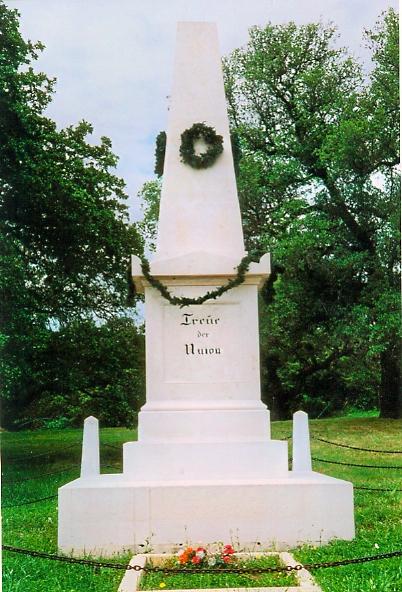
The encounter on the Nueces almost immediately became what historian Stanley S. McGowen called “one of the state’s most controversial and contentious historiographical events.” The Handbook of Texas notes that “Confederates regard[ed] it as a military action against insurrectionists while many German Hill Country residents viewed the event as a massacre.” Regardless of which side you’re on, it was a terrible thing. In 1865, the families of the men killed on the Nueces gathered their bones and finally interred them at Comfort, where a monument was dedicated on the battle’s fourth anniversary, in 1866. The Treue der Union (Loyal to the Union) monument, pictured above, still stands in Comfort, and historians still debate how best to describe what happened to that group of fearful men who met on humble Turtle Creek on an August day almost 150 years ago.
—Martin


What we’re reading
Heather:
Philipp Meyer, American Rust
Martin: C. J. Chivers, The Gun

Friday, August 20, 2010

“A cup of tea, a warm bath, and a brisk walk”


A path is little more than a habit that comes with knowledge of a place.
—Wendell Berry

If you are ready to leave father and mother, and brother and sister, and wife and child and friends, and never see them again; if you have paid your debts, and made your will, and settled all your affairs, and are a free man; then you are ready for a walk.
—Henry David Thoreau

I’m an enthusiastic walker and believe firmly in walking’s spiritual, psychic, and medicinal benefits. Whenever our kids were feeling puny, they were usually told that a cup of tea, a warm bath, and a brisk walk would put them in order—one of the reasons my family nickname is “Deathmarch.” “We’re DYING,” they’d moan. “You’ll feel better after a walk,” I’d respond. After tugging a drooping daughter on one particularly frustrating foot-dragging outing, we discovered she had mono. But I’m sure the walk did her good.

Both nature and nurture have gone into creating this momster that is me: my mother used to frog-march my three siblings and me up the mountains around the Roaring Fork Valley in Colorado, hoping to create the conditions for quiet evenings in the little cabin we stayed in every summer. “It didn’t work,” she admitted. “The four of you never got worn out, but I sure did.” (That’s a somewhat older me walking in Colorado in the photo above.)

So whether it’s genetics or training, I walk, and Madroño has been—and surely will continue to be—a treasure trove of most excellent walks.

When we first started going to Madroño, when our youngest was a wee babe and the other two not much older, sneaking out for walks made me feel both guilty and liberated: for a brief time, at least, I was free to look at, listen to, think about, or not think about whatever I wanted, without interruption. Now that our youngest is leaving for college, I still feel that solitary walks are a guilty pleasure, albeit one about which I’m increasingly less apologetic, but I still feel the sense of release that comes when I head out the door with at least one ecstatic dog who’s noticed I’ve put on my boots and my hat and picked up my binoculars. (Walking with unbelievably brave and stupid dogs will be undoubtedly be my next blog topic.)

For a long time, I went for what my dear friend Ellen calls the yodelaiEEoo pace of walking: trying to cover as much ground as quickly as possible, preferably headed up or down steep inclines. This is a really dumb way to walk in the Texas Hill Country, especially if you’re not on a road and even if you are. First of all, if you’re off-roading and going uphill, there’s not a lot of purchase, given the rocks, leaves, and cedar detritus that cover the heavily wooded hills. There’s even less purchase when you’re coming downhill, which can look a lot like skiing, especially if you’re a really spastic skier. But off-road descents can be easier than on-road ones: once, when our youngest was about five or six, I bullied her into walking down the steepest road on the ranch with me, after we had driven up. She was so little that her relatively slight weight couldn't overcome the force of incline + scree; the final equation was an extremely sore little heinie from having her feet shoot out from under her every three steps or so.

Aside from the falling down problem, when you’re moving at the yodelaiEEoo pace, it’s very easy to miss all the Interesting Stuff to be found—or to run straight into it when you’d really rather not. I was walking on one of the roads on top one morning in June many years ago at a yodelaiEEoo pace only to find myself entangled in an enormous—no, I mean ENORMOUS—spider web. After shrieking, dancing, frantically patting my head, pulling my clothes off, etc., I slowed down enough to notice these spiders. I still don’t know what kind they were—maybe golden orbs? As I walked along, twitching and squinting with every step I took, I saw their webs everywhere. Some of them spanned fifteen- to twenty-foot gaps. How had they done that? Parachuted? Hailed taxis to drive them across? Not only were the webs huge, but they were invisible until you were two inches away from them. They taught me to slow down AND to limbo.

Once the kids got big enough, we went for what we called scrambles, which involved walking up and/or down one of the many mysterious draws that pepper the ranch. Walking with children, of course, cannot occur at a yodelaiEEoo pace, at least not until they’re bigger and stronger than you and you start calling plaintively: “Guys? Guys? Hey, wait for me!” But while I was still bigger and stronger than they were, we loved to go poke around in the draws, especially with some of our family’s emergency back-up children. (We haven’t actually outgrown this.) The kids were the ones who found all the Interesting Stuff: the rocks that looked like Swiss cheese or hearts, the iron bedsteads alongside a cast-iron Dutch oven, the fossils, the arrowheads and stone tools, the tiny flowers and ferns hiding in the shade, the little caves, the really weird bugs, the secret springs. And the snakes.

I must say a word about walking and snakes. I’ve climbed up, fallen down, and poked through a lot (though not nearly all) of the property, and I’ve concluded that snakes don’t want to see me any more than I want to see them. I try to be sure I can see where I’m putting my hands and feet, and dogs (at least the smart ones, if any such exist) are often helpful, hopping sideways to let you know that you shouldn’t step on that spot. Robert, the intrepid ranch manager, sees them all the time, but he does things like drain and dig around in the bottom of ponds. I’ve been lucky so far, with one notable exception.

One warm November day my then-fifteen-year-old son and I went walking to the back of the property. For some reason, he had brought a shotgun, and as we were walking through a patch of tall grass, he stopped and said calmly but urgently, “Mom. Snake.” And one step ahead of me was the fattest, longest, ugliest water moccasin I had ever seen. As it slithered off, he shot it, securing his place in my heart (and my ankles, where I probably would have been bitten had he not been there) as a hero.

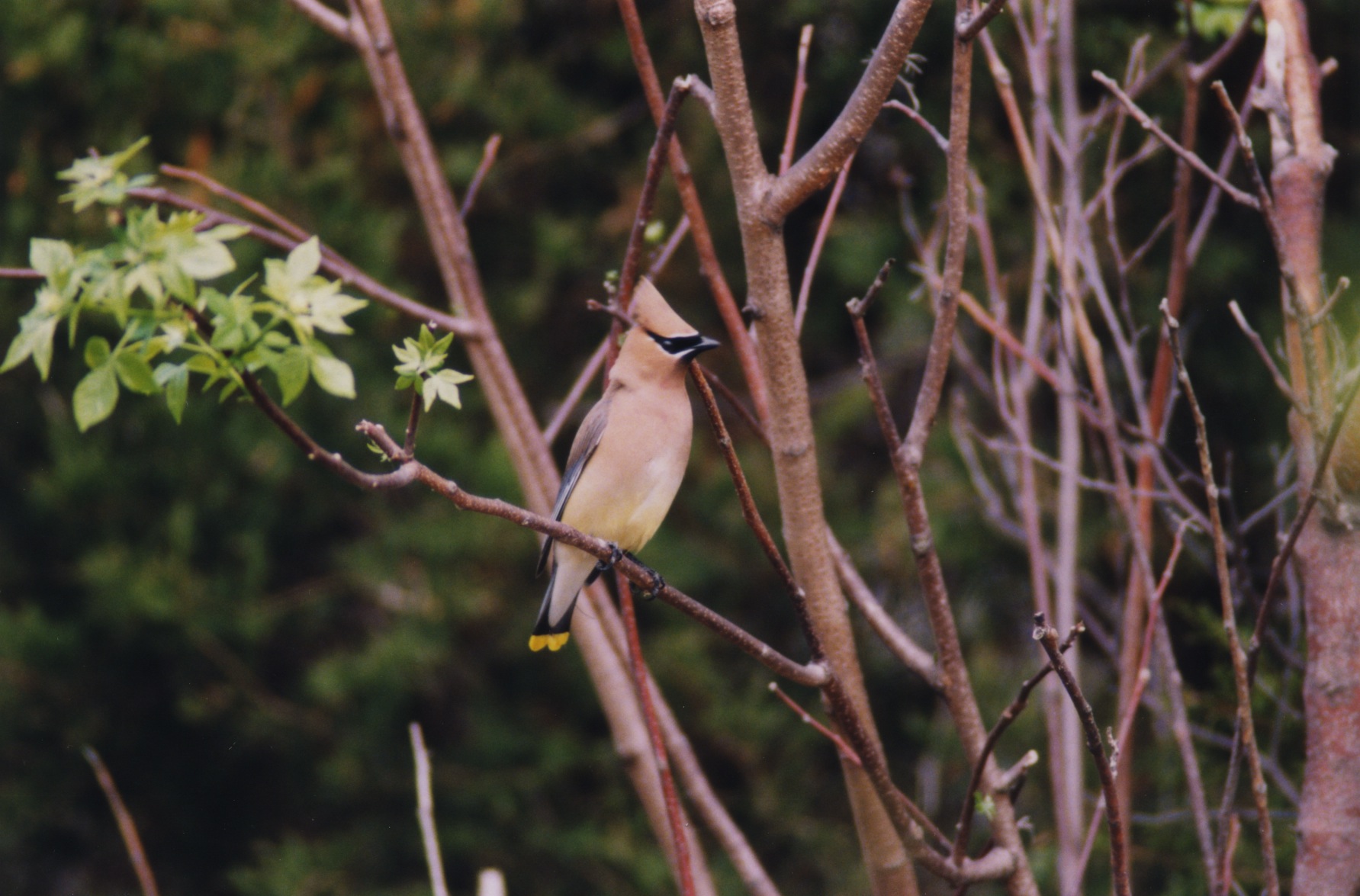
As I've become more interested in birds, my yodelaiEEoo pace has become a thing of the past, for a couple of reasons. One is the difficulty of trying to track the little boogers through thick live-oak canopies or heavy underbrush. Another is having to stop and listen to them over the clatter I make. Our beloved old black Lab Phoebe is too blind and creaky to walk with me now, but back in the day she hated these stop-and-listen moments; if I paused for more than a minute or two she commenced with a low and pitiful moaning that wouldn’t let up until we started again. Phoebe liked the yodelaiEEoo pace. But even she was stilled into silence that February day when we turned into a usually still canyon only to hear the voices of what turned out to be literally thousands of robins and cedar waxwings, feasting—and maybe drunk—on cedar berries. The noise level was on par with I don’t know what: maybe a middle school hallway after the last class of the year, but considerably less smelly.

In fact, much to my family’s astonishment, I’ve learned to walk places and then just sit, at least sometimes. Chula the Goggle-Eyed Ricochet Hound walks with me now that Phoebe can’t, and Chula is fine with just sitting. (She has other issues that will be revealed in my walking-with-dogs post.) Did you know that certain grasses snap and crackle when the sun first hits them on cold mornings? I must have spent twenty minutes on my hands and knees one morning trying to figure out what was making that noise. Bugs? The little creatures in my head? Nope, it was just the grass talking. We had a lovely conversation, while Chula looked on, quietly concerned.

Perhaps, finally, it’s time for a new family nickname.
—Heather


What we’re reading
Heather:
Rebecca Solnit, A Paradise Built in Hell: The Extraordinary Communities That Arise in Disaster
Martin: Ellen Lupton, Thinking with Type: A Critical Guide for Designers, Writers, Editors, & Students (still)

Friday, July 23, 2010

Double vision: prophets, tribalism, eugenics, and the environment


As I dog-paddle through the sea of books threatening to drown not just me but the overwhelmed shores of my bedside table, I found these sentences: “For those who draw near and offer themselves before God, satisfaction of hunger is neither an end in itself nor a wholly ‘secular’ event.... [E]ating is a worshipful event, even revelatory; it engenders a healthful knowledge of God.” When I read this, I thought, “Ah, I am a member of the tribe that believes this.”

I briefly met Ellen F. Davis, author of Scripture, Culture, and Agriculture: An Agrarian Reading of the Bible and professor of Bible and practical theology at Duke Divinity School, when she spoke at our church about ten years ago, and I immediately developed a helpless intellectual crush on her. The crush is not diminished by the fact that Our Hero Wendell Berry wrote the foreword to the book and is quoted at the beginning of each chapter.

Davis’s basic claim is that the fertility and habitability of the Earth—and particularly of Israel—are the best indices of the health of the covenant relationship between God and his people. She writes beautifully about that stickiest of words in Genesis 1, when mankind is given “dominion” over the earth. Made in God’s image, we are meant to exercise dominion as God does, and in Genesis 1, the way God exercises dominion is to exclaim in delight over the goodness of his work, and then to declare a day of rest for his delightful creation. Reckless topsoil depletion, toxic pesticides, and Confined Animal Factory Operations, among many other current agricultural practices, would probably not pass the Delight Test.

I read all this with a double vision: on the one hand, I underline passages, write notes, and spray exclamation points in the margins. On the other hand, I think about my neighbors in the Hill Country, many of whom are very conservative Christians, and I wonder how they would react to Davis’s scathing comparison of pharaonic agricultural and economic policies (the ones that made God really, really mad) with the practices of American agribusiness. I’m not sure the book will get a lot of traction here. (Well, or anywhere; the book’s title is so unsexy it might as well be wearing a suit of armor.) And yet it seems to me so clear that Davis’s analysis is Right and needs to be broadcast.

So how do you convince someone you’re right? Well, here’s how not to do it: the way the American conservation movement sounded its earliest notes, at least politically. The current issue of Orion magazine carries a feature story entitled “Conservation and Eugenics: The Environmental Movement’s Dirty Secret.” Charles Wolforth, the author, links Teddy Roosevelt’s New Nationalism, with its emphasis on patriotism and conservation, to the propagation of “higher races,” as opposed to Native Americans, Eskimos, and other "lower races."

Wolforth writes, “These ideas had been developed at Ivy League and other universities, at museums of natural history and anthropology in New York and Washington, in learned societies and in scientific literature. When... world’s fairs focused on the West, the link between natural resources, morality, and racism was drawn ever more explicitly.” Pointedly, Wolforth quotes from Roosevelt’s New Nationalism speech, arguably the launching of the modern conservation movement:

“Of all the questions which can come before this nation, short of the actual preservation of its existence in a great war, there is none which compares in importance with the great central task of leaving this land even a better land for our descendants than it is for us, and training them into a better race to inhabit the land and pass it on. Conservation is a great moral issue, for it involves the patriotic duty of insuring the safety and continuance of the nation.” It also, apparently, involved practicing eugenics.

Awash in my sea of books, I am a descendent of this tribe. No wonder it’s hard to convince many people I'm right.

When I walk through my beloved Austin neighborhood, I’m often beset with the same double vision I have when reading the prophetic environmental writing I’m prone to read. I walk through my neighborhood pleased—delighted—with my wonderful neighbors and their well-tended homes and gardens. As I have mentioned before, walking a couple of blocks can take forty-five minutes or more, depending on who else is out and about and what news needs to be exchanged, which dogs need to be admired, whose children are doing fabulously or exasperatingly nutty things. How can this be a bad thing? And yet I can’t help but be aware of the multitudes of cars, the endless whir of air conditioners, the trucks bearing pesticides that fertilize lawns, the lights that are on all night, the sprinklers running even as it rains. (We, too, are guilty of some of these.) How do you convince people without double vision that the goodness they’re seeing in their way of life is resting on something destructive?

In the fruit of the American environmental movement there is a noxious worm: a sense of righteousness that often gnaws its way into self-righteous tribalism. The ways in which we eat and live are often markers of who we are; when told (or bullyragged) to change these ways, it can seem as if something essential in us has been condemned, most particularly when judgment comes from outside the tribe. Like triumphalist Christians who refuse to acknowledge the ugliness and violence that comes bundled with the hope and beauty of Christian history, triumphalist environmentalism will foment ill-will from people whose health and livelihoods could be enhanced or saved by its message.

Every movement must have its prophets. Traditionally, prophets haven’t been the sort of people you want to invite home for dinner; they eat locusts, dress in skins or nothing at all, sit in cisterns, moan a lot—that sort of thing. The true prophets get listened to not because they're scare-mongering but because they always have an accurate sense of their tribe’s history, an acute awareness of when it has fallen away from its original goodness. They include themselves in their judgments. Despite their very visible eccentricities, there is an essential humility to them. When I pull up behind a pickup truck with a bumper sticker that says “Drill Here Drill Now Pay Less” (along with a Rick Perry sticker) and my first impulse is to jump out of my car and bash in the windshield, I know I’m no prophet. We’re both driving, after all, and I need that gas as much as the other driver does. I’m not passing that humility test.

So where does that leave my tribe, the irritable non-prophets of the environmental persuasion? As an oldest child, I always like to have the right answer to pass on—and enforce, whenever possible. My tribe is frequently stymied. But here’s one thing: invite someone over for dinner, someone not of the tribe. Feed them something that’s beautiful, that’s grown in accordance with the revelatory economy of food kindly produced. And think about this passage from one of Wendell Berry’s Sabbath poems:

Leave your windows and go out, people of the world,
go into the streets, go into the fields, go into the woods
and along the streams. Go together, go alone.
Say no to the Lords of War which is money
which is Fire. Say no by saying yes
to the air, to the earth, to the trees,
yes to the grasses, to the rivers, to the birds
and the animals and every living thing, yes
to the small houses, yes to the children. Yes.
—Heather


What we’re reading
Heather:
Thomas Perry, Strip
Martin: Russell Shorto, The Island at the Center of the World: The Epic Story of Dutch Manhattan and the Forgotten Colony That Shaped America

Friday, July 2, 2010

The literary environment (with apologies to the Williams Alumni Review)


Confession: I consider myself a loyal son of alma mater, but I usually just skim the quarterly Williams Alumni Review before tossing it into the recycling pile. A story in the June issue, however, caught my eye. “The Literary Environment,” by Denise DiFulco, is about the director of the college’s Center for Environmental Studies (CES), a Spanish professor named, confusingly, Jennifer French.

The article notes that a lot of people have asked French how a Spanish professor came to be named the director of the CES. The answer involves her first book, Nature, Neo-Colonialism, and the Spanish American Regional Writers (2005), which examined early twentieth century Latin American literary responses to European economic hegemony in the region. Or something like that. Explains French, “Often those writers, including Horacio Quiroga and José Eustasio Rivera, made central to their narratives the deleterious effects of agriculture and other industries.”

Sadly, I know next to nothing about Latin American literature, and I’d never heard of Quiroga or Rivera, but another quotation from the article really struck me: “At their best, environmental history, philosophy, religion, literary studies, and the like engage the underlying assumptions of environmental policy and environmental science.”

Exactly! I thought. This is a view that resonates profoundly with Heather and me—we are, after all, both English majors—and when we eventually begin accepting environmental writers for residencies at Madroño Ranch, we hope to cast as wide a net as possible.

Say the words "environmental writer" and I suspect that most people think of folks like Bill McKibben or William Cronon or Michael Pollan or David Quammen (all of whom happen to be heroes of ours): essayists or historians with a biological or agricultural bent. They, and many others like them, are among the most important writers we have, and we would be thrilledthrilled—to have them, or their peers, as residents at Madroño. But we also hope to attract novelists and poets and philosophers and theologians and playwrights and screenwriters and memoirists and perhaps even (what the heck) bloggers—pretty much anyone who’s thinking and writing in creative ways about the land and those who have their being on it, and how they affect each other.

Think of the fiction of Wendell Berry, who (much as William Faulkner did in Mississippi) has created a complex and compelling imaginary landscape in Kentucky. (Apparently the American South is particularly suited to this sort of exercise.) Think of the novels of Willa CatherDeath Comes for the Archbishop is still my favorite—and Wallace Stegner, which depict the varied experiences of humans confronted with the vast spaces of the American West. Think of the poetry of Mary Oliver, in which the animal and vegetal and geological is a constant, almost sentient presence, and W. S. Merwin, described in the New York Times as “a fierce critic of the ecological damage humans have wrought.” Think of the economic writings of Paul Hawken and Woody Tasch, critiques of modern industrial capitalism’s obsession with short-term, bottom-line profit at the expense of just about everything else. Heck, think of David Winner’s odd little book Brilliant Orange: The Neurotic Genius of Dutch Football—one of my personal favorites—in which he examines how landscape has affected the style of soccer played in the Netherlands.

Closer to home, think of the gracious and elegant memoirs of John Graves and Roy Bedichek, two of the foundational texts of the environmental movement in Texas; or the beginning of The Path to Power, the first volume of Robert Caro’s epic three-volume biography of Lyndon Johnson, which is still the best short history of the Texas Hill Country I’ve ever read; or even Witold Rybczynski’s magisterial biography of Frederick Law Olmsted—not a Texan, but an astute observer of the state—which is a wonderful narrative summary of nineteenth-century American thought about nature in urban and suburban settings. Each of these works, I believe, has something original and important to say about community in America, community in this case defined as (to crib shamelessly from Pollan’s website) “the places where nature and culture intersect.”

We’d be pretty surprised to receive applications from Faulkner, Cather, Stegner, or Bedichek, since they're, well, dead. But would the rest of them want to come to Madroño Ranch? Well, why not? We hope that the offer of beautiful and rugged surroundings, free from distraction, in which to ponder and dream and focus and unfocus (and eat well, of course; let’s not forget eating well) and bounce ideas off peers, will prove irresistible. Are we aiming high? Of course; but if you don’t aim high, you’ll just keep hitting the ground, right? Who knows—maybe Jennifer French herself will want to come. According to the article, she’s already working on her next book, a study of how memories of the War of the Triple Alliance (fought between Paraguay and the combined forces of Argentina, Brazil, and Uruguay from 1864 to 1870) have influenced attitudes toward land use in Paraguay. Wouldn’t that be cool?
—Martin


What we’re reading
Heather:
Laurie King, Touchstone
Martin: Paul Hawken, The Ecology of Commerce: A Declaration of Sustainability (still)

Friday, June 18, 2010

Adventures in Business-Land


This week, during a solo trip to Madroño, Heather spent much of her time knocking on doors in Kerrville, Bandera, Medina, Tarpley, and vicinity, hoping to convince chefs and restaurateurs to buy locally raised, grass-fed bison meat from the ranch. Our initial herd of fifteen animals has grown to thirty-six, including a couple of young males who have already, by their obstreperous behavior, nominated themselves as the first to be harvested this fall.

I’m not particularly objective, of course, but I think she could make a pretty compelling case to those potential customers. To wit:
  • Bison meat generally has more protein, iron, and nutrients than beef or chicken;
  • Bison meat is lower in fat and calories than beef or chicken;
  • Our bison spend their lives ranging freely on Madroño’s 1,500 acres, and never set foot on feedlots;
  • Our bison are never injected with or fed growth hormones, steroids, or any other supplements;
  • To ensure the quality of the meat and reduce stress on the animals, our bison will be field-harvested on site under the supervision of a licensed inspector from the Texas Department of State Health Services.
Another point we hope to emphasize is that, since we’re a small-scale, local operation, our customers will also be our neighbors, which means we’ll be accountable and responsive to them in a way that Big Agriculture isn’t. It also means that every penny our customers spend on our meat will stay right here in Central Texas.

Our hope is that the sale of bison meat, eggs, and produce from Madroño will (eventually) provide significant financial support for the residential center for environmental writers we hope to open at the ranch. We know there’s a growing market in Austin for fresh, local, sustainably raised food, but we’re not planning to sell in Austin—too complicated and expensive logistically, plus we wouldn’t want to compete with our friend and mentor Hugh Fitzsimons of Thunder Heart Bison—so we’re hoping to find a comparable demand in the area right around Madroño. (And based on Heather’s schmoozing this week, the early returns are encouraging.)

Make no mistake, though: going into business—especially the business of turning a creature into a commodity—presents all kinds of challenges for a couple of recovering English majors. Virtually all of my adult work experience has been in the nonprofit sector; shifting to something that is explicitly designed to make money, no matter how noble we believe the cause to be, is a bit of a shock. (A couple of years ago we were told that the mother of one of our daughter’s schoolmates referred to us as “just a couple of old hippies.” She did not intend it as a compliment.) As entrepreneurs, we are babes in the woods.

I imagine our first bison harvest will be quite an adventure, as will the processing and distribution that will follow. We’re already moving out of our comfort zone—I’m pretty sure Heather never imagined herself as a salesperson—and confronting a couple thousand pounds of dead buffalo will move us even farther into unknown territory. I mean, business plans? Financial projections? Balance sheets? Puh-lease!


Of course, it’s probably good for us complacent old hippies to be forced out of our comfort zones occasionally; we just have to hope that we don’t make a total cock-up of it.

On the other hand, maybe we don’t want to get too caught up in this whole mercantile thing. I’ve been reading Ian L. McHarg’s influential book Design with Nature, originally published in 1969. McHarg, an expatriate Scot who pioneered the field of environmental planning in the United States, writes witheringly of the prevailing view in his adopted homeland: “Neither love nor compassion, health nor beauty, dignity nor freedom, grace nor delight are important unless they can be priced. If they are non-price benefits or costs they are relegated to inconsequence. The economic model proceeds inexorably towards its self-fulfillment of more and more despoliation, uglification and inhibition to life, all in the name of progress – yet, paradoxically, the components which the model excludes are the most important human ambitions and accomplishments and the requirements for survival.”

Of course, McHarg is hardly the first thinker to decry a fixation on financial gain. In the sixth century BCE, Lao-Tzu put the same sentiment somewhat more pithily: “Chase after money and security and your heart will never unclench.” In a similar vein, I Timothy tells us that “the love of money is the root of all evil.” (I Timothy is also the source of the phrase “filthy lucre,” by the way.) Jesus himself reminds us, in Matthew’s gospel, that “You cannot serve both God and Mammon.”

And yet, and yet... we live in a fallen world, and money is an intrinsic part of it. The love of money may be the root of all evil, but money itself is not necessarily evil. (Or, as Peter J. Gomes writes in The Good Book: Reading the Bible with Mind and Heart, “Wealth is not a sin, but it is a problem.”) The trick, obviously, is to learn money; to use it; to see it as a means to an end, not an end in itself. I mean, why can’t Madroño become an example of enlightened capitalism, a model of a countercultural way of thinking about commerce—a way that emphasizes the small-scale, local, sustainable long term, instead of the bigger-is-better, metastatic, smash-and-grab short term? I think we’ve all seen enough of the latter way of thinking, and its consequences, to last us a good while.

Of course, it’s easy for me to preach self-righteously about the corrupting dangers of the profit motive; we’re unlikely to make enough money selling bison to threaten the state of our souls. Indeed, just breaking even seems like an ambitious goal right now. I'm sure we’ll be writing more about Heather and Martin’s Adventures in Business-Land in the weeks and months to come. In the meantime, pray for us – and our bank account.
—Martin


What we’re reading
Heather: Richard Powers, The Echo Maker
Martin:
Ian L. McHarg, Design with Nature (still)

Friday, June 11, 2010

Home with the armadillo: a love letter to Texas


Recently we and our three kids went to Martin’s native San Francisco to help celebrate his father’s eighty-fifth birthday. The five of us spent an afternoon walking along the cliffs of Point Reyes National Seashore, where the ground was springy, the wind was fierce, and in some spots along the trail we pushed through wildflowers up to our shoulders. Hawks wheeled through the cloudless sky, elk sunned in the lees of the cliffs, and the ocean’s shining hide swelled and stretched like the flanks of a well-groomed, self-satisfied, and very large cat. At one point, our son Tito turned to us and said incredulously, “You mean we had a choice between this and Texas?”

Yes, well. Despite Martin’s entertaining recent post on how he has come to terms with living in Texas, he has spent much of his time in the Lone Star State not entirely convinced that civilized life is possible here—certainly not from May to October, and frequently not after elections. I grew up spending summers in Colorado, where despising Texans is a competitive sport, and as a teenager and young adult I also got to spend time in places of unsurpassed beauty such as the highlands of Guatemala, the Swiss Alps, the Masai Mara, Paris, and the Canadian Rockies. And yet I love Texas and can’t imagine living anywhere else. Time for that apologia, son.

Some of my love of Texas is just an old bad habit. Many fine writers have noted how people stubbornly cling to the smells and sounds of their childhood, sensations that undermine the idea that time moves only into the future. Much of my first decade was spent in the then-unbroken woods just north of the San Antonio airport. The uncanny whinny of the screech owl, the languid moan of the mourning dove, the overpowering sweetness of mountain laurel at Easter, the loneliness of the north wind on a clear winter day: each time I experience these now I’m reminded that the girl who was gripped by them forty years ago is still inside me. She isn’t gone, despite all appearances to the contrary.

There’s more to it than nostalgia, though. Texas tells stories about itself, some of them true. While I know that many find this self-conscious tale-telling irritating—maybe even pathological—I find it sort of comforting. So maybe we actually lost the battle of the Alamo. So maybe the Texas Rangers weren’t a bunch of ethically ripped superheroes. So maybe every cowboy doesn’t have the soul of a poet. But there seems to be a (nearly) conscious yearning for the power of myth to work among us with these stories. Of course, there are stories Texans tell about themselves that I loathe: bigger is better, we should each of us be our own posse, it’s manly to kill animals with automatic weapons and spurn the meat—but this is a place that recognizes the power of stories to shape reality.

One of the stories told over and over in multiple variations is the power and variety of the land itself. One of my favorite signs is on Interstate 10 at the Louisiana-Texas state line. It reads something like this: Beaumont, 20 miles; El Paso, 937 miles. While I have lived only in Central Texas—in some ways the easiest part of the state to love—I’ve learned to respect and admire many of the landscapes between the ends, from east to west and from north to south. I make no claims to anything but the cursory knowledge that comes from road trips involving grumpy children – me and my siblings years ago, and more recently our own children. My parents drove us to Colorado every summer through the Panhandle; Martin and I chose instead to make our annual pilgrimage by way of Fort Stockton and then north through the Pecos wilderness. One hot summer day the gas tank light came on when we were halfway through the hundred inhospitable miles between Pecos and Loving, New Mexico. The prospect of running out of gas here at midday with a dog and several children concentrated the mind wonderfully and caused me to sweat through my clothes despite the car’s air conditioning. (We managed to make it to the next filling station.) We passed by multiple examples of the land’s indifference to human striving: we often threatened to abandon our squabbling children in Orla, an oil ghost town baked into dusty submission, if they didn’t behave. (It didn't help.)

We always planned our route back to Austin through Balmorhea and Fort Davis and, inevitably, a thrashing summer thunderstorm would force us off the highway—or so we assumed, since we couldn’t even see the highway through the mud on the windshield. But before the storm hit, you could see the Guadalupe Mountains to the west, and when we made it to Marfa and the high grasslands, we—well, some of us—were exhilarated by the wind and the shadows, by the pitilessness and delicacy of the Chinati Mountains.

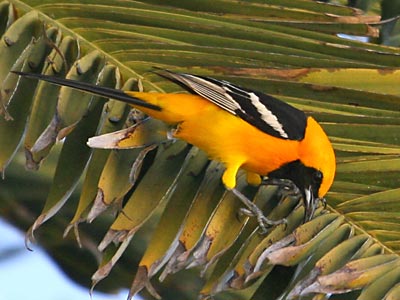
At the other end of the spectrum, I love the featurelessness of the south Texas brush country, an admittedly perverse passion. In March, the mesquite bloom neon green. At least as many things will sting, bite, or poison you as won’t. As our friend and mentor Hugh Fitzsimons of Thunder Heart Bison says, there are two seasons in south Texas: January and summer. At the rare watering holes, there are birds of remarkable beauty: green jays and hooded orioles and American widgeons. Once in April, on my way back from Piedras Negras and Eagle Pass, I drove through a migration of yellow sulphur butterflies that extended for dozens of miles. When I got back to Austin, probably a dozen people pointed out the grotesque beauty of my Suburban’s grille, which had become an extravagant collage of dead butterflies.

I’m leaving a lot of verses out of my Texas love song, but the last verse here has to be the one about the Hill Country. Loving the Colorado Rockies as much as I love any landscape, I’ve been trained to seek out views, to climb and pant and strain and exult upon reaching the summit. Well, the Hill Country upends that paradigm. Once you make it to the top of the hill—at least at Madroño—the landscape sinks into an unexpected anonymity. The personality of the Hill Country is in its draws and canyons, the intimate interstitial places where oaks and pecans crowd together, and great slabs of limestone create undulating walls and pools, and ferns and cedar sage grow with the demure confidence of cloistered beauty. In February, the draws ring with the slurred chatter of hundreds of intoxicated robins and waxwings. The draws also snarl with the movements of feral hogs, coyotes, and mountain lions, and vibrate with the possibility of rattlesnakes on sunny shelves, the clatter of unseen hooves in caves and cedar brakes, and the songs of maddeningly invisible birds that suddenly move, shine, and disappear again before they can be named. The draws protect and expose, invite and terrify. You want stories? You’ll find them here.

So, son, I’ll be happy to spend time in California, especially in August, even if the locals make fun of how I talk and where I’m from. But I’ll always want to come home.
—Heather


What we're reading
Heather: Belden C. Lane, The Solace of Fierce Landscapes: Exploring Desert and Mountain Spirituality
Martin: Ian L. McHarg, Design with Nature

Friday, May 14, 2010

Madroño’s mythical bison


We spent last weekend at Madroño with Shawn and Susanne Harrington of Asterisk Group, who are designing a visual identity for the ranch suitable for use on business cards, website, food labels, letterhead, gimme caps, T-shirts, coffee mugs, bumper stickers, etc.

Since so much of what we hope to make Madroño stand for is based on a very specific sense of the place and its unique qualities, we wanted to give Shawn and Susanne (and their son Oliver) a tour of the ranch. They especially wanted to get a first-hand look at the buffies, thinking that they’d be an ideal image for the ranch, but unfortunately, as far as the Harrington family is concerned, the Madroño bison remains a mythical beast, more rumor than reality.

It was a gray and drizzly Sunday morning when Robert Selement, our trusty ranch manager, came by and picked us up in his big ol’ pickup. Robert may love showing the place off even more than we do, and Shawn and Susanne oohed and aahed in all the right places, even though the misty weather meant that we had to imagine the normally breathtaking views from up top.


The high point of the tour, of course, was to be a close-up view of the bison, complete with newborn calf (or perhaps calves, as several of the cows seemed to be on the verge of dropping babies). So imagine our chagrin when, after driving all over the ranch for two hours, we failed to get even a single glimpse of them.

You might think it would be hard to lose a herd of thirty or so critters, each weighing in at a thousand pounds or more, even on a place as big as Madroño, but, as Robert said with some asperity, “We’ve got buffalo poop, buffalo hair [where they’d rubbed up against convenient tree branches], and buffalo tracks, but no buffalo.”

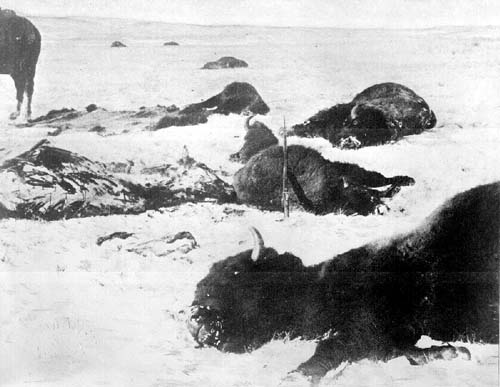
Bison are interesting animals. With a dearth of natural predators, they once roamed the North American prairies in untold millions, and were vital sources of food and other necessities for the Plains Indians. Then the railroads started building across the continent, and the real slaughter began. One of the notable things about bison is that they don’t run away when they hear a gunshot or see one of their fellows fall. Instead, they tend to wander over and nose the corpse of their fallen comrade, in a manner that can seem uncomfortably close to mourning.

This, of course, is one of the reasons they were almost eradicated by nineteenth-century buffalo hunters, but it most assuredly does not mean that they are in any way tame. In fact, they retain a distinct whiff of wildness, even on a ranch; a sublime atavism shines from their dark eyes. When we were in New York last month, we met a rancher from Pennsylvania at the Union Square Greenmarket who told us, astonishingly, that he invites school kids on field trips to wade into the midst of his herds and pat his bison. Just the thought of that made all the hair on our heads stand straight up. (It was quite a sight.)

As if their immense size and somewhat, er, unpredictable temperament weren’t sufficient encouragement to treat bison with a healthy respect, they’re also astonishingly fast and agile. They can jump into the bed of a pickup (or so we’re told; fortunately, we haven’t yet seen that firsthand), or across a cattle guard, or over a four-foot fence (when, that is, they don’t elect simply to go through it). They can work up a substantial head of steam—up to thirty-five miles an hour, in fact, which is faster than even Robert’s trusty pickup can go on Madroño’s steep and rocky roads—and they can move as fast backward as they do forward, which is why they’re sometimes used to train cutting horses. And, as we learned last weekend, they have apparently evolved the ability to turn invisible when they want to.

Shawn and Susanne were pretty good sports about it, and Oliver just wanted to play with an old ammeter that was rattling around in the back of the truck. (It’s hard to predict these things with any certainty, but Oliver at age five seems bound for a career as an electrical engineer.) But I know Robert was concerned; the fence that can keep bison in when they want to go out has yet to be invented, and we feared that they might have decided to pay a social call on the neighbors. Again.

This is always an awkward situation, not least because you can’t really compel bison to do something they don’t want to do—like, for instance, return to your property. Fortunately Robert has conditioned them to respond to the rattling of a bag of feed cubes, and can usually tempt them back from wherever they’ve strayed with the promise of treats. But having several tons of ornery meat invade the place next door is not exactly the way to foster neighborly feelings. (In March the foreman of a West Texas ranch shot fifty-one bison that had gotten loose on his property from the place next door. The fact that the place next door was a hunting ranch, and the bison would otherwise have ended up as little more than targets in a shooting gallery for rich Texans, didn’t make the story any less shocking.)

Fortunately, our neighbors have thus far responded with patience and good cheer, even when the bison cornered a herd of their terrified cattle—it must have looked a little like a scene from one of those old Westerns in which a gang of outlaws menaces some frontier town.

By the time we had to leave, late Sunday afternoon, Robert still hadn’t tracked them down. We lamely told Shawn and Susanne that we hoped they’d come back another time to see the buffies (who finally turned up above the trout ponds, safe and sound and on our side of the fence; I’m quite sure that if bison could snicker, they were snickering at us). I mean, they couldn’t possibly pull that disappearing act twice in a row, could they?

Well, could they?
—Martin

Friday, April 30, 2010

“You may ask yourself, well, how did I get here?”


Funny how things turn out sometimes.

I was born and raised in the San Francisco Bay Area, went to college in Massachusetts, and grew up (to the extent that I grew up at all) with fairly liberal political views. I am neither a hunter nor a serious fisherman. I have owned a series of foreign cars, but never a pickup. I have never owned a cowboy hat, either, and the first pair of cowboy boots I ever bought was from a hip boutique on the King’s Road in London. And I really, really hate the Dallas Cowboys. I am, in other words, a Yankee.

And then I fell in love with a girl from Texas, and everything changed. I have lived most of the last three decades—virtually my whole adult life—in the Lone Star State, a fact which still astonishes me and no doubt puzzles many of my childhood and college friends, to whom Texas is a vast desert filled with cacti, rattlesnakes, and gun-totin’, snuff-dippin’, rip-snortin’ Republican rednecks. Dangerous, in other words. But, almost thirty years later, here I am.

Heather and I were classmates and fellow English majors at that Massachusetts college, and we fell in love and/or lust during the spring of our senior year. Not only was she gorgeous, smart, and funny, but, being a native Texan, she was exotic, too. Her family lived in San Antonio until she was ten, when her father got a job with the gummint and they moved to the Washington DC area, but her father’s father still lived in the Alamo City, and she had a job lined up after graduation as a reporter for the late and not-terribly-lamented San Antonio Light.

I, on the other hand, had no job prospects whatsoever—planning ahead has never been my strong suit—and figured I might as well follow her to Texas. (I actually wrote to the San Antonio Spurs offering my services as a short, untalented point guard who couldn’t shoot, pass, jump, or go to my right, and received a surprisingly gracious rejection letter from Bob Bass, who was then the team’s general manager.)

After graduation, we embarked on an epic cross-country journey, driving in Heather’s un-air conditioned Toyota Tercel from Williamstown to San Francisco, by way of Washington DC, New Orleans, Houston, San Antonio, and Aspen, to visit my (divorced) parents, and then back to San Antonio to begin what we naively thought of as our adult lives.

The trip was full of incident, but the high points were our stays in Houston, where we visited Heather’s formidable maternal grandmother, and San Antonio, where we spent a week with her even more formidable paternal grandfather.

Boppa took one look at me, with my bushy beard, long hair, and earring, and decided, not unreasonably, that I was Bad News. The famous family story is that when we left San Antonio to push on to the West Coast, he called Heather’s father and asked, “Now where are those two going again?”

Heather’s father replied that we were heading to San Francisco to see my parents before eventually returning to San Antonio. There was a thoughtful pause, and then Boppa observed, “Lotta motels between here and San Francisco.”

When we finally made it back to San Antonio, we took him out to dinner twice a week, on the nights when “the help” was off; on Thursday nights we went to the Argyle, and on Sunday nights to the San Antonio Country Club. I drove the car, opened the doors, fetched him the one weak Chivas and water he was allowed per night, and generally did my best to ingratiate myself, but for the rest of his life (he died about six months later), he never called me anything but “Whiskers,” as in “Whiskers, get me a drink,” or “Whiskers, go git the car.” I’d tug on my forelock or fetlock or whatever that thing is and say, “Yes, sir,” and go off wondering what the hell I’d gotten myself into.

That was a tough year, in a lot of ways. I found work as the editor of a little weekly newspaper, the San Antonio Citizen-News, that served the southwestern part of the city around Lackland Air Force Base; since we were living in north-central San Antonio, I neither knew nor cared anything about that part of the city, so my job was not terribly fulfilling. I bought a used Fiat 128, which consumed several quarts of oil a week and was (in the way of all Fiats) almost comically unreliable, so twice a day I’d set off to drive across the city never knowing if I’d actually arrive at my destination, which didn’t exactly help my frame of mind. One hot afternoon the Fiat conked out in the middle of Broadway, and Heather and I had to push it several blocks to my apartment.

My most memorable co-worker at the Citizen-News was Oscar, the sports editor. He was a bald, stocky retired Air Force sergeant, and he cussed constantly and with amazing creativity. He also had a notorious temper; I was told that he carried a baseball bat in the trunk of his car, and if another driver cut him off or otherwise offended him he would pull it out and go to work on their fenders and taillights. Oscar was also apparently a creature of habit; the story was that once, when he came home to discover that his wife had rearranged the living room furniture, he wordlessly got out his toolbox, moved the furniture back to its previous positions, and nailed it to the floor. In fact, he was always perfectly nice to me, but I definitely tried to stay on his good side.

Perhaps unsurprisingly, Heather and I broke up after a year or so in San Antonio. She moved up to Austin to begin graduate school, and I, once again flying blind, decided to move to Washington DC, where I landed a job on the staff of Sen. Bill Bradley. I enjoyed my time in Our Nation’s Capital, at times perhaps a little more than was good for me; I’m not sure my liver has ever forgiven me. But I got my feet under me a little bit, found out I could more or less survive on my own in the world, and eventually, a year or so later, Heather and I patched things up. I moved back to Texas, this time to Austin, where I too began grad school, in American studies. We got married a couple of years later, and the rest, as they say, is history.

And now here we are, in the second decade of the twenty-first century, and I find myself the would-be co-proprietor of an enterprise that seeks to celebrate and emphasize the unique character of Texas, or at least the beautiful part of it known as the Hill Country. Our kids have grown up in Austin, and while all three have elected to leave the state for college (the youngest, a high school senior, is bound for Ohio next year), the older two have already come back. They’ve come back home.
—Martin


What we’re reading
Martin: Katherine Howe, The Physick Book of Deliverance Dane