Showing posts with label meat. Show all posts

Friday, February 11, 2011

Meat and flourishment: carnivorocity, take three


Martin’s post last week describing the first slaughter (and I use the word “slaughter” advisedly) in our new endeavor as purveyors of bison meat elicited a comment that urged us to consider the ethical fault line (presumably) running through every conscience, that unsteady place where we find ourselves rationalizing our actions to ourselves or to whatever audience our imaginations conjure up.

Martin tried to make his/our unease clear with the post’s title: Bloody Hands. So I’m wondering once again about the ethics of carnivorocity, as visible and treacherous a fault line as abortion, euthanasia, gun control, climate change, or cloning: when you stand on one side of the fault line, it’s easy to think that the earth itself will justify you when it opens up and swallows the dummies over there, proving that you were on the right side, at which point you can stop worrying all the time, for heaven’s sake, and go on your merry way without thinking about the issue ever again.

As usual, diving into the conversations available on the internet just sucked me deeper into the murk. A defense is available for every possible position and offered with wildly varying degrees of civility: meat-eaters supporting vegans and trashing vegetarians; meat-eaters sneering at any thought of self-restriction; vegetarians and vegans calling meat-eaters all sorts of names; vegetarians acknowledging that some meat-eating is environmentally acceptable; meat-eaters acknowledging that American meat production and consumption is for the most part grotesque. What’s a utopian-minded bison rancher to think?

Serendipity, as usual, is my guide: in chasing internet rabbits down their holes, I found a momentary resting place in a review of Maggie Kozel’s book The Color of Atmosphere: One Doctor’s Journey In and Out of Medicine. After describing a flummoxing patient she had as a second-year medical student, Kozel said, “[I] devoured the answers without asking the right questions.”

Of course, if you’re obsessive the way I am, then you’ll immediately begin worrying about what the right questions are, as in, if I’m “right” then others must be “wrong.” One of the hallmarks of the debate about meat-eating and its impact on the environment or the individual soul is the array of statistics and science that each side has amassed to prove the objective superiority of its argument. I’ve been persuaded by both sides and neither side, depending on the time of day, what I’ve just read, the weather, my most recent meal, and/or the health of my family, among other random criteria.

In other words, I don’t think science and statistics by themselves allow us to ask the right questions, since apparently convincing evidence can be found to shore up either side. Eating is one of those human activities rich with multiple levels of meaning; expecting questions directed at a specific level to adequately address the full range is a little like expecting a monoculture to support the diversity a polyculture allows. Although science poses some vitally important questions when it examines the issue of meat-eating, the nature of its inquiry must ignore other equally pressing but less quantifiable questions, such as, what conditions allow a multi-species community to flourish? Does eating meat (by humans) contribute or detract from our community’s flourishment (a word coined by our friend Hugh Fitzsimons of Thunder Heart Bison)?

I hear the howls of protest even before I finish typing this sentence: how do you measure flourishment? Who decides the standards? Invalid! Too subjective! Well, yes. That’s what makes this a fault-line issue: it addresses the limits of our humanity and so necessarily includes subjective experience. To be honest, I don’t know how to measure flourishment; I suspect you just know it when you see it. And when you see it, you’re moved to describe it, knowing that the urge will be frustrated to at least some degree because flourishment, like all fruit, is the result of such a complex interaction of elements in space and time that any description will be incomplete. And of course it’s not a steady state; it waxes and wanes as circumstances change and sometimes double back on themselves.

In this context, the question of whether meat-eating is ethical can be answered unequivocally: it depends. One of the preconditions for flourishment is a sense of justice, a perspective that includes but also rises above the immediate tit-for-tat concerns of fairness. The scope of justice includes not just humanity but the earth itself—and perhaps the cosmos. It unrolls over the course of history, recognizing that particular injustices sometimes take generations, centuries, or millennia to wither, even with the powerful witness and effort of prophets and their followers. As I said in an earlier post, it may be that vegetarians and vegans are living forward into a time where justice is more fully realized. At the same time, issues of fairness and justice press at us every moment in this world where the lion and the lamb cannot yet lie down together, where predators are a vital part of an ecosystem that has developed in sync with domesticated animals.

Can meat be produced and consumed in a way that encourages justice and, hence, flourishment? I think it can. There are multiple instances of communities and societies that eat meat and live within that delicate balance that looks to the long-term well-being and dignity of the system as a whole, places like Joel Salatin’s Polyface Farm, although there are many, many others. (We’d love to hear some of your favorites.) There are multiple instances of communities and cultures flourishing without eating meat, most notably for the purposes of this post the Hindu cultures whose vegetarian cuisines I eat with great pleasure. (We’d love to hear some of your favorites.)

Likewise, there are communities and cultures that eat meat without flourishing, including most of the industrialized world, where concern for short-term profits and their consequent incitement of unrestrained appetite smother any hope of flourishment under mountains of animal excrement and anguish. Those places that encourage us (in the industrialized world) to measure the value of food in one way only—cheap is best—smother flourishment. Food is at the center of family, of community, of myth, of life. To reduce its essence to a single component is to denature its multivalent nutritional value.

Back to the ethical fault line, that place we stand uneasily, knowing that we may be swallowed: may those of us who recognize the fault line join hands—bloody or not—across the chasm and help each other seek the firmer footing of justice as our foundation. Flourishment will surely follow.
—Heather


What we’re reading
Heather:
Hilary Mantel, Wolf Hall (still!)
Martin: Rodney Crowell, Chinaberry Sidewalks

Friday, February 4, 2011

Bloody hands: bison harvest at Madroño Ranch


The very first fruits (though “fruits” hardly seems the right word) of our very first bison harvest are ready to sell, but getting to this point has been a long and sometimes frustrating process. The last stages of that process were both harrowing and, in a dark way, fascinating; squeamish sorts may want to stop reading here. “Meat is murder,” the Smiths sang in 1985, and whether or not you agree with them, it is undeniably a bloody business.

The harvest took place on Monday, January 24. We’d been both dreading and looking forward to it, and planning for it, for months; Robert, our redoubtable ranch manager, had ingeniously cobbled together a refrigerated trailer to haul the dead animals to Mercantile Meat, in Utopia, to be turned into packages of meat, and we had long since chosen the two young bulls, the bison equivalent of obnoxious adolescents, who would be the first to go. Despite all the planning, though, the reality of assuming responsibility for the death of so large and magnificent an animal was more than a little intimidating.

Early on that beautifully clear but chilly Monday morning Heather and I drove up to the flat near Robert’s house, where the herd had gathered. There we met Robert, Meat Inspector Mike, and Robert’s buddies Robert (whom I will henceforth call Other Robert) and Keith (whom I will henceforth call Not Robert), who were there to assist. We all gathered in a circle while Heather read a prayer she’d written for the occasion, which I suspect disconcerted several of those present. Then Robert, Meat Inspector Mike, and Not Robert climbed into Robert’s Chevy Tahoe with Robert’s .270 rifle while Other Robert, Heather, and I kept a safe distance.


A few minutes later, it was over. Two rifle shots shattered the stillness of the morning, and after each, even before we’d finished flinching, 1,500 pounds of bison was dead on the ground. This was the moment we’d been waiting for, and fearing, and the magnificence and sorrow of it were overwhelming. Both deaths were instantaneous and humbling, and strangely intimate; all the world seemed somehow to have narrowed to this short stretch of dirt road; other places, other people, were unimaginable. Robert, Other Robert, and Not Robert worked quickly and efficiently to bleed the first carcass and load it into the trailer, and we turned our attention to the second.

At this point things got really interesting. We knew that bison tend not to scatter when they hear gunfire or see one of their number fall; in fact, frequently the other members of the herd gather around the victim, curious about what has happened to him or her, or perhaps paying their last respects, before getting back to business as usual. But this time, the head bull went over to the second carcass and repeatedly butted and pawed at it, determined to revive his fallen comrade.


This was a problem, since we were not particularly interested in arguing with nearly a ton of angry bison. By yelling and waving, we convinced him to back off a few feet, just far enough so that we could go to work on the carcass, but Robert kept one eye on the angry bull (and on Heather, who had appointed herself the designated angry-bull-shooer). He glared at us throughout the process, but kept his distance.

With both carcasses safely inside the trailer, which had been set to minus-ten degrees, Robert, Other Robert, and Not Robert climbed into the cab of Robert’s pickup and our little caravan set off for Utopia, some thirty miles away.


All had gone about as smoothly as we could have hoped to this point, but we encountered some metaphorical bumps on the road to Utopia. As Robert’s pickup was hauling the laden trailer up FM 337 west of Medina, smoke started pouring out from under the hood: a blown radiator fitting. They limped to the top of the hill, where they found a couple of empty whiskey bottles at the side of the road and, after coasting down the other side, filled them with water from Mill Creek which they poured into the overheated radiator.

Thankfully, the truck made it the rest of the way into Utopia—a little later than we’d planned, true, but it made it. After Robert backed the trailer up to the tiny loading dock we had to drag the dead bison out of the trailer, across the loading dock, and through the tiny door and into the plant—not an easy undertaking, and one which required the combined efforts of Robert, Not Robert, Other Robert, and me, as well as Joe, the owner, and a couple of plant employees. When we were done, I had blood on my hands literally as well as figuratively.


After all our efforts to honor and respect the death of the bison, the way in which they entered the plant seemed disrespectful and undignified. But necessity is a mother, as we say at our house, and it was a tremendous relief finally to have them there.

When we got back to the ranch, we were still a little stunned by the morning’s events. It had already been a long day, and we were still a little unnerved by the magnitude of what we had seen and done (or, more accurately, caused to be done). And we know we still have a lot of work ahead of us; actually figuring out how to sell several hundred pounds of bison meat is way out of our comfort zone. (We’re hoping to sell all of it wholesale, and only in the Bandera/Kerr County area.) But we feel like we’ve taken a major step.

After witnessing a bison harvest at our friend Hugh’s ranch several years ago, Heather wrote a poem called “Sacrifice.” The details are necessarily different, but it still captures some of what we felt:

Ash Wednesday: one year I stood in thick cool
dust along with several others, waiting for
an ancient drama to begin again,
waiting as if I weren’t an actor in it
too. Through the thorny brush the bison
entered, awkward bodies wary, dense beneath
the bulky wreath of muscle draped across
their shoulders. One shook her head—so massive
that her horns looked dainty—watching us with
eyes black as moonless snake-filled summer nights.
We climbed into the pick-up, all except
the shooter, who moved with quiet purpose
as we sat in silence, waiting for the shot
that finally came—shocking, if expected—
and penetrated mercifully, the cow dead
before she finished sinking to the dust.
Another man performed the bleeding when
she was hoisted, limp, still warm, head-down,
carotid artery cascading blood
a color and consistency I had
never seen before, a frothing cochineal
oasis in the thirsty dust. I asked
the shooter if and how he steeled himself
for harvest. Pray two days before, he said,
Sit quietly. We watched the hands prepare
her for the journey, another kind of life.
Her body, treasury of light and grass
and epic wanderings, will enrich
a larger body now, a body more than
body when it knows the incarnate cost—
be it hoofed, winged, scaled or even rooted
life—of nourishing itself. Around us,
bushes burned in lilac, white, and yellow
flames, their incense rising toward the hawks
and caracaras, wheeling in mandalic arcs,
awaiting our departure so to gather
in the dust and then consume the bloody
pool, their bounden duty.

Perhaps subsequent harvests at Madroño Ranch will become more or less routine; doubtless we’ll have a better idea of what to expect, and be somewhat better prepared. (We may even buy a more powerful pickup, one that can pull the trailer to Utopia without overheating.) But I pray we never completely lose the profound sense of awe and, yes, sorrow that attended this first harvest. May we never lose the full awareness of what we do and have done. May we remain humbly thankful for the life—and death—of these magnificent animals. May I always remember the blood on my hands.
—Martin


What we’re reading
Heather:
Hilary Mantel, Wolf Hall
Martin: Roy Bedichek, Adventures with a Texas Naturalist

Friday, December 10, 2010

Meat and unmediated experience: Deer School at Madroño Ranch


At lunch the other day, a friend opined that too much of what we all think and see and hear—and, yes, eat—passes through various filters (the media, agribusiness) before it reaches us; even our air is conditioned, he added, though I have to say I’m okay with that, at least in the summer. But his larger point is one that’s been in the back of my mind (and take it from me, there’s lots of room in there) for some time.

Unmediated experiences seem increasingly hard to find. We have lost an awareness of the connection between our actions and their consequences, especially when it comes to food, especially when it comes to meat; it’s easy to avoid the stark truth that some creature was slaughtered, blood was shed, so that we might buy shrink-wrapped chunks of meat in the supermarket. The thoughtful (and splendidly named) English chef Hugh Fearnley-Whittingstall writes in his River Cottage Meat Book that “the human act of killing animals for food, once familiar to most of society, has now become so shameful that those who condone it—by eating meat every day—are entirely protected from thinking about it. Food animals are killed and their meat is cut up and packaged far from human eyes. By the time meat reaches the consumer, the animal origins have been all but obliterated.”

Conveniently, this last weekend presented us with an opportunity to escape the shrink-wrap bubble in the form of “Deer School,” a hunting/butchering/cooking extravaganza at Madroño Ranch. Watching the skinned, eviscerated, and decapitated carcass of a 120-pound buck being carved up on your kitchen counter definitely qualifies as an unmediated experience.

The man doing the carving was Austin’s incomparable Maestro of Meat, Jesse Griffiths of Dai Due, and his audience, in addition to Heather and me, included six hunters—four experienced, two newbies, united in their love of food and dedication to the principles of ethical hunting—who had paid to spend a long weekend at the ranch. Four of them live in or around Austin, but we also had a couple who drove all the way from Michigan (!), sleeping in their Little Guy trailer all the way.

In return for their money, the guests were taken on three guided hunts (the guides were Jesse, his omnicompetent buddy Tink Pinkard, and, after poor Robert, our ranch manager, was felled by a kidney stone on Saturday morning, our son Tito) and then instructed in how to make efficient use of whatever animals they shot. They also ate a series of truly spectacular meals prepared by the indefatigable chef Morgan Dishman-Angelone, who works with Jesse.

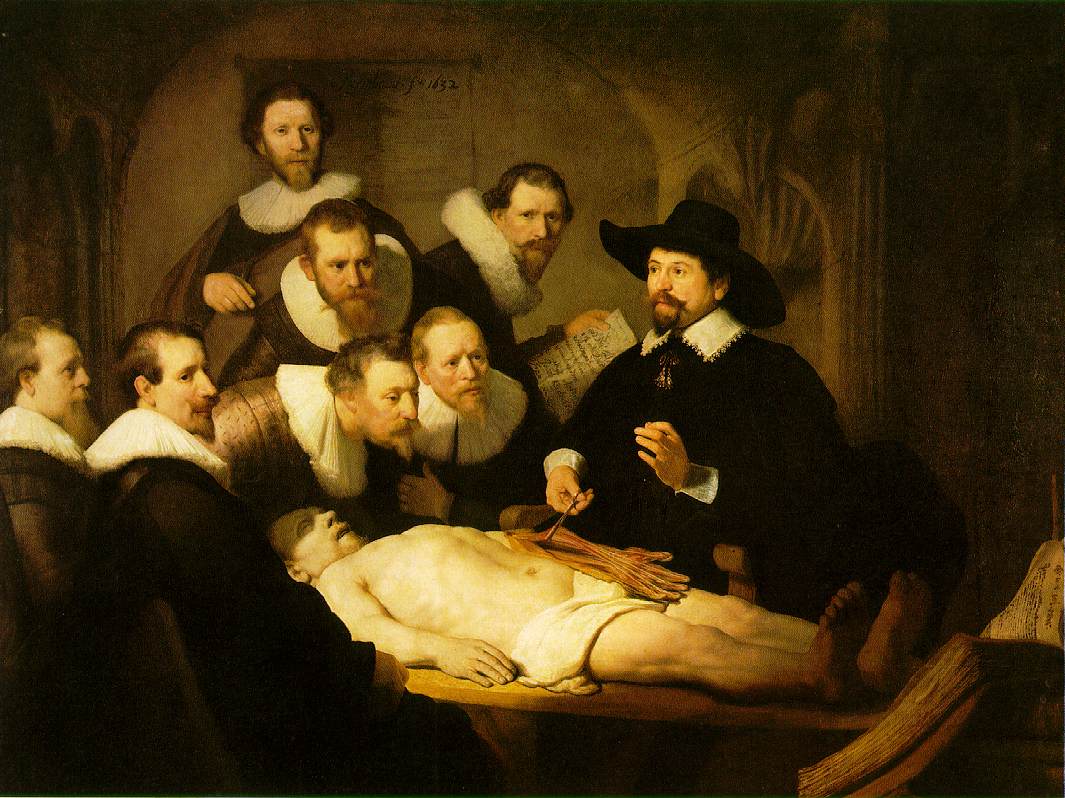
Their collective haul included five deer and several hogs, though Robert shot the buck Jesse used for his demonstration the day before the guests arrived. As we all gathered in the kitchen to watch Jesse at work on the carcass, I was reminded of Rembrandt’s famous painting “The Anatomy Lesson of Dr. Nicolaes Tulp.” A grisly spectacle, but also fascinating, and Jesse’s obvious care and skill were mesmerizing.

True confession: I am not a hunter, though I am an enthusiastic carnivore and have done a good bit of fishing in my time; the only mammal I have ever knowingly killed was an obviously diseased raccoon who was staggering around in the middle of a hot summer day at the ranch several years ago. But we live in a meat-centric state (the Republic of Barbecue, anyone?), and I have come to realize the distance between my life and the realities of blood and bone that hunters and farmers and ranchers confront on a daily basis.

Here’s Fearnley-Whittingstall again: “As I pull the trigger and... the beast tumbles, I feel the gap between me and the quarry, which a moment ago seemed unreachable, closed in an instant.” I think this is really the point of ethical hunting, responsible carnivorism, and eating meat in general: the realization that we, consumer and consumed alike, are part of the same system, much as we might try to deny it. Thus, in a funny way, a hunter—a responsible one, at least—rather than treating the animal he or she kills as an objectified and separate Other, is more likely to understand the profound interconnectedness that binds us all together.


Jesse and Morgan took virtually every piece of meat off that buck and used it for an extraordinary multicourse dinner that night. “We’re going to punish you,” Jesse warned us facetiously, and he wasn’t kidding: six courses, including venison tartare (pictured above, just prior to final assembly), venison paté with Jesse’s own coarse-grained mustard, braised venison flanks stuffed with chorizo, liver with mashed potatoes and apples, venison cutlets with grilled marinated radicchio, and, for dessert, Morgan’s signature Basque cake—salty-sweet crusted cake around a pastry crème center with candied persimmons and apples. It was an unforgettable meal, and left everyone—even Tito!—sated, at least temporarily: the next morning we had breakfast tacos with barbacoa made from the deer’s shanks and neck meat, which had been simmering in a crockpot overnight. Under the circumstances, “holy cow” hardly seems like the right expression, but you get the picture: we ate incredibly well, and that one buck provided enough meat to feed thirteen people twice, with quite a bit left over; thanks to Jesse, we’re looking forward to enjoying even more of it when we go out again over New Year’s, by which time I should be almost ready to think about eating meat again.

And who knows—maybe the next time we host Deer School at Madroño (and we do hope there will be a next time) I’ll sign up myself. After all, it wasn’t all that long ago that I was about as unconscious a carnivore as there was on the planet, and I’m in as much need of unmediated experience as the next guy. I’m not going to start refusing to eat anything I haven’t actually killed myself; that would be impractical, to say the least. But I do believe that hunting and butchering a deer or other animal for one’s own consumption is probably a useful exercise, and that the world might be better off if every unconscious carnivore were forced to undertake it at least once. A fuller awareness of the cost of satisfying our appetites cannot, I think, be a bad thing.
—Martin


What we’re reading
Heather:
Wallace Stegner, Crossing to Safety (still!)
Martin: Charles M. Robinson III, Bad Hand: A Biography of General Ranald S. Mackenzie

Friday, November 19, 2010

Faith, bureaucracy, and sheep: thoughts on changing one's mind


In my last post, I decided to postpone my public ululations over the recent elections. As I’ve spent the last week or so in an apparently endless struggle to get the Madroño Ranch bison label approved by the Texas Department of State Health Services, my ululative impulse has caught in my throat. Maybe Republicans and Tea Partiers are right.

I mean, what difference can it possibly make whether the net weight of the package appears on the bottom third of the label (as required), the middle third, or (gasp) even the upper third? And don’t get me started on the “approved” list of cuts, a list whose existence we discovered only after we’d submitted the label, and which has driven our obsessively copy-editing family mad with its redundancies and omissions. Our “Boneless hump roast” was not on the list and so was nixed, but we’re fine if we say “Bison Roast (Hump).” Generously, the state allows both “Bison for Stew” and “Bison Stew Meat.”

It’s enough to make me think Very Ungenerous Thoughts about the government’s regulatory role in business or about authority in general.

Some of these thoughts are just moans, like the ones our dog Phoebe the Fabulous used to make when she was forced to stop on our walks while I looked at birds. Oh, the personal inconvenience! But the issue of authority has, in fact, been in my thoughts recently, to wit: when does authority cease to be authoritative? What makes us change our minds? What would make me stop being a “liberal” (if that’s what I am) and become a Republican, or even join the Tea Party? I’m not talking here about repressive political authority, but rather those internalized authorities to which we bow without really being aware that we’ve made a choice.

In thinking about my own track record when it comes to mind-changing, I’ve come to the conclusion that it’s not primarily a rational process, as we often presume. Rather, it’s a supra-rational affair, requiring the willingness and discipline (and perhaps the talent) necessary to learn a new language.

Here’s what I mean: I used to think that all Christians were most likely not just fools—an identity St. Paul claimed—but idiots. Jerry Falwell and the Moral Majority began to fill the airwaves when I was about fifteen or sixteen. Not having had much contact with self-professed Christians at that point, my exposure to this most vocal sector of Christians forced me to conclude that I could never be one of them. From what I could infer, they were anti-intellectual, judgmental, and close-minded. Their rhetoric made me think that Christianity represented everything I had been taught to turn away from. (Especially the “judgmental” part.)

Imagine my chagrin when, after a series of unexpected and absurd events, I came to be enrolled as a student at the Episcopal Theological Seminary of the Southwest (now known simply as the Seminary of the Southwest). My habitual place of study was a nearby coffee shop. As I studied, I made sure that any books that had the words “God,” “Church,” or “Jesus” (especially “Jesus”—such an embarrassment) on the cover or spine were face-down and turned to the wall. I didn’t want to be mistaken for one of “them,” one of those stupid sheep who followed an anti-intellectual, judgmental, and close-minded shepherd. Authority. Whatever.

I learned during my years at the seminary—and during my years as a practicing Christian since then—that I had been mistaken in my first ideas about Christianity. I had to change my mind, and, consequently, my self-identity—an anxiety-provoking and disorienting business. This doesn’t mean that I like all Christians. Or even most of them. When I started at seminary, knowing nothing, I had expected to find a bunch of Bad Thinking I could counter and correct.

What I discovered instead was that my initial premise was wrong. I found out that practicing a religion is not the same thing as signing a lease, requiring you to follow a bunch of rules or else be kicked out. Rather, I found that practicing a religion is more like wrestling with a new language. There is a grammar to learn, there are rules to follow. But unless you immerse yourself in it, unless you try to speak it yourself with native speakers—even if you have a lousy accent—you will be just another Ugly American, unaware of your own foolishness.

Having become reasonably fluent in Christianity, I’m trying to learn at least something about the other languages around me. As I learn more about Judaism, Islam, Hinduism, and Buddhism, I don’t become less fluent in my own language; rather, I understand it more profoundly. I understand its distinctiveness and thus its limitations. I understand something of its fraught interactions with other religions and have learned the uneasy need for shame and humility. I try not to speak slowly and loudly in my own language when speaking to non-native speakers and hope they will do the same for me. In my limited experience, I’ve found hospitality, not hostility, whenever we try, in our different tongues, to speak with each other.

And so I wait to hear yet again from the inspector at the meat processing plant about the newest version of our label. I know that he’s pleased about the results of the recent election, as are most of my Hill Country neighbors. I’m pushing this metaphor past its limits, but in order to be a good neighbor myself, I may have to have to learn a little bit of a new language. To understand myself better, I may have to be willing to change my mind.
—Heather


What we’re reading
Heather:
Wallace Stegner, Crossing to Safety
Martin: S. C. Gwynne, Empire of the Summer Moon: Quanah Parker and the Rise and Fall of the Comanches, the Most Powerful Indian Tribe in American History (still)

Friday, June 18, 2010

Adventures in Business-Land


This week, during a solo trip to Madroño, Heather spent much of her time knocking on doors in Kerrville, Bandera, Medina, Tarpley, and vicinity, hoping to convince chefs and restaurateurs to buy locally raised, grass-fed bison meat from the ranch. Our initial herd of fifteen animals has grown to thirty-six, including a couple of young males who have already, by their obstreperous behavior, nominated themselves as the first to be harvested this fall.

I’m not particularly objective, of course, but I think she could make a pretty compelling case to those potential customers. To wit:
  • Bison meat generally has more protein, iron, and nutrients than beef or chicken;
  • Bison meat is lower in fat and calories than beef or chicken;
  • Our bison spend their lives ranging freely on Madroño’s 1,500 acres, and never set foot on feedlots;
  • Our bison are never injected with or fed growth hormones, steroids, or any other supplements;
  • To ensure the quality of the meat and reduce stress on the animals, our bison will be field-harvested on site under the supervision of a licensed inspector from the Texas Department of State Health Services.
Another point we hope to emphasize is that, since we’re a small-scale, local operation, our customers will also be our neighbors, which means we’ll be accountable and responsive to them in a way that Big Agriculture isn’t. It also means that every penny our customers spend on our meat will stay right here in Central Texas.

Our hope is that the sale of bison meat, eggs, and produce from Madroño will (eventually) provide significant financial support for the residential center for environmental writers we hope to open at the ranch. We know there’s a growing market in Austin for fresh, local, sustainably raised food, but we’re not planning to sell in Austin—too complicated and expensive logistically, plus we wouldn’t want to compete with our friend and mentor Hugh Fitzsimons of Thunder Heart Bison—so we’re hoping to find a comparable demand in the area right around Madroño. (And based on Heather’s schmoozing this week, the early returns are encouraging.)

Make no mistake, though: going into business—especially the business of turning a creature into a commodity—presents all kinds of challenges for a couple of recovering English majors. Virtually all of my adult work experience has been in the nonprofit sector; shifting to something that is explicitly designed to make money, no matter how noble we believe the cause to be, is a bit of a shock. (A couple of years ago we were told that the mother of one of our daughter’s schoolmates referred to us as “just a couple of old hippies.” She did not intend it as a compliment.) As entrepreneurs, we are babes in the woods.

I imagine our first bison harvest will be quite an adventure, as will the processing and distribution that will follow. We’re already moving out of our comfort zone—I’m pretty sure Heather never imagined herself as a salesperson—and confronting a couple thousand pounds of dead buffalo will move us even farther into unknown territory. I mean, business plans? Financial projections? Balance sheets? Puh-lease!


Of course, it’s probably good for us complacent old hippies to be forced out of our comfort zones occasionally; we just have to hope that we don’t make a total cock-up of it.

On the other hand, maybe we don’t want to get too caught up in this whole mercantile thing. I’ve been reading Ian L. McHarg’s influential book Design with Nature, originally published in 1969. McHarg, an expatriate Scot who pioneered the field of environmental planning in the United States, writes witheringly of the prevailing view in his adopted homeland: “Neither love nor compassion, health nor beauty, dignity nor freedom, grace nor delight are important unless they can be priced. If they are non-price benefits or costs they are relegated to inconsequence. The economic model proceeds inexorably towards its self-fulfillment of more and more despoliation, uglification and inhibition to life, all in the name of progress – yet, paradoxically, the components which the model excludes are the most important human ambitions and accomplishments and the requirements for survival.”

Of course, McHarg is hardly the first thinker to decry a fixation on financial gain. In the sixth century BCE, Lao-Tzu put the same sentiment somewhat more pithily: “Chase after money and security and your heart will never unclench.” In a similar vein, I Timothy tells us that “the love of money is the root of all evil.” (I Timothy is also the source of the phrase “filthy lucre,” by the way.) Jesus himself reminds us, in Matthew’s gospel, that “You cannot serve both God and Mammon.”

And yet, and yet... we live in a fallen world, and money is an intrinsic part of it. The love of money may be the root of all evil, but money itself is not necessarily evil. (Or, as Peter J. Gomes writes in The Good Book: Reading the Bible with Mind and Heart, “Wealth is not a sin, but it is a problem.”) The trick, obviously, is to learn money; to use it; to see it as a means to an end, not an end in itself. I mean, why can’t Madroño become an example of enlightened capitalism, a model of a countercultural way of thinking about commerce—a way that emphasizes the small-scale, local, sustainable long term, instead of the bigger-is-better, metastatic, smash-and-grab short term? I think we’ve all seen enough of the latter way of thinking, and its consequences, to last us a good while.

Of course, it’s easy for me to preach self-righteously about the corrupting dangers of the profit motive; we’re unlikely to make enough money selling bison to threaten the state of our souls. Indeed, just breaking even seems like an ambitious goal right now. I'm sure we’ll be writing more about Heather and Martin’s Adventures in Business-Land in the weeks and months to come. In the meantime, pray for us – and our bank account.
—Martin


What we’re reading
Heather: Richard Powers, The Echo Maker
Martin:
Ian L. McHarg, Design with Nature (still)

Friday, December 11, 2009

Carnivorocity, take two


Meat-eating has been the topic of much discussion recently, at least in what I’ve been reading. Jonathan Safran Foer’s new book, Eating Animals, has generated a significant buzz; if you Google “foer eating animals,” you get 961,000 results. Foer spent three years investigating meat production in the United States, factory farming in particular. Although he himself is a vegan, he says that he has no interest in converting anyone to veganocity; he just wants people to think about where their food—specifically, their meat—comes from.

Although I haven’t come to his vegan, or even vegetarian, conclusions, I think Foer is right. (Ahem. I haven’t read the book.) In my previous post on carnivorocity (a word my spell-check still doesn’t like), I wrote very convincingly about the ethical precondition necessary for meat eating, to wit: awareness of and gratitude for the sacrifice required to satisfy the appetite of the meat-eater, awareness that demands, for those who are to be sacrificed, a life of comfort in the world to which they are adapted. In fact, I think this awareness needs to be extended to vegetables as well; after all, even vegans require sacrifice—it’s just not as messy. By the very act of eating, all creatures—including, most emphatically, humans—participate in the circle of sacrifice, and a circle it most assuredly is; in nature, there is no such thing as a free lunch.

What sacrifice, then, is demanded of us? This year’s edition of The Best American Essays, edited by Mary Oliver, includes an essay by Wendell Berry entitled “Faustian Economics,” originally published in Harper’s Magazine. In it, Berry rails against the American propensity to confuse personal freedom with unlimited consumption, a fantasy that perhaps arose due to the intersection of the Industrial Revolution with the discovery of vast natural resources in the American West. As a nation, we’re confronting the end of this fantasy and “entering a time of inescapable limits”—an opportunity, according to Berry, to become reacquainted with traditional definitions of humanness. By their very nature, humans are, well, natural, and therefore limited. What distinguishes us from other animals (although I think this topic is being hotly debated) is our capacity for self-limitation, self-restraint, particularly as it is “implied in neighborliness, stewardship, thrift, temperance, generosity, care, kindness, friendship, loyalty, and love.”

As long as we base our identity on limitlessness, we deny an essential—and liberating—element of our humanity. As long as we base that fundamentally human activity, commerce, on fantasies of limitlessness, it will be inhuman and inhumane, what Berry calls an “economy of community destruction.” Instead, he would have us cultivate a mindfulness of human limits—agricultural, economic, medical, technological, scientific—in order to reclaim “the knowledge that some things, though limited, are inexhaustible.” He cites intact ecosystems like working forests and farms that give inexhaustibly, given the practice of human self-restraint. He compares this practice to the willing submission of artists to the constraints of their art forms—the poet to the sonnet, the painter to the canvas. The work that arises from this sort of discipline has the capacity to feed us inexhaustibly, a capacity we’ve all experienced when revisiting favorite novels or symphonies or buildings.

The title of Berry’s essay comes from Christopher Marlowe’s Tragical History of Doctor Faustus, first published in 1604, in which Faustus (that’s him in the picture above) sells his soul to Lucifer in exchange for knowledge and power. What Faustus learns—or, more accurately, refuses to learn—is that the human mind and soul are and ought to be subject to limits. When creatures refuse to acknowledge limits, hell is born.

So how do we practice the self-restraint necessary to maintain our humanity? Some, like Foer, argue that abstaining from eating meat is a logical and reasonable sacrifice. I don’t disagree with him, but I don’t think there’s a single way to humane self-restraint. Many indigenous cultures have focused on—even worshipped—the animals that fed them, Native Americans and bisons being a case in point.

I’m not sure any of this will mean much to those people and businesses that value scale and efficiency over humanness. Nor will it mean much to most Americans accustomed to the availability of cheap meat at every meal. But, with Berry, I believe that our humanity is at stake in the choices we make when we eat. When we choose to abet the suffering of animals and ecosystems to feed ourselves, we whittle away at our own humanness. When we choose to limit our choices, we paradoxically open ourselves to the possibility of inexhaustible plenty.

Sounds like a deal to me.
Heather

What we’re reading
Heather: Sylvia A. Earle, The World Is Blue: How Our Fate and the Ocean’s Are One
Martin: Colum McCann, Let the Great World Spin

Friday, November 13, 2009

Carnivorocity


Since we’re in the early planning stages for our first Madroño Ranch bison harvest, I’ve been reflecting on issues of carnivorocity, which my spell-checker tells me isn’t a word. It suggests “carnivorousness” instead. But I prefer my neologism because it retains echoes of the ferocity that undergirds all meat-eating.

I have been a happy meat-eater all my life, with the exception of my senior year in college, when I chose to be a vegetarian for financial and life-style rather than ethical reasons. Although I still eat meat, I’ve grown increasingly troubled by the system that produces most of it in the United States, and no longer eat meat at most restaurants or from supermarkets.

In some ways, I think that vegetarians may be more evolved than meat-eaters. According to Genesis, all creatures—not just humans—were vegetarians in the beginning. God said, “‘See, I have given you every plant yielding seed that is upon the face of the earth, and every tree with seed in it for fruit. And to every beast of the earth, and every bird of the air, and to everything that creeps on the earth, everything that has the breath of life, I have given every green plant for food’” (Genesis 1:29–30). Thus modern vegetarians are hearkening back to their Edenic roots, to a human dominion over nature that reflected the aboriginal harmony and mutual respect among species—unless, of course, you happened to be a green plant.

But the story became more complicated, as good stories always do. As punishment for various transgressions, God sent a flood that only Noah and the passengers on his ark survived. In thanksgiving, Noah built an altar to the Lord and made of every clean animal and bird (although this was before the laws differentiating clean from unclean) a burnt offering. When God “smelled the pleasing odor, he said in his heart, ‘I will never again curse the ground because of humankind...’” (Genesis 8:21). From that time on, humans were given animals for food, with the stipulation that they should not eat flesh that still had blood in it.

Complicated? My goodness, yes. Eating meat is God’s concession to the fact that something in the original balance of the world has been thrown out of whack—and that the smell of cooking meat is profoundly satisfying. Those who can resist the lure of barbecue are made of sterner stuff than God! The line between vegetarians and meat-eaters is the line between self-identified utopianists and realists—or between utopianists and people who don’t think about the issue. I tend toward the utopian end of the spectrum. So why do I eat meat?

In his fascinating book The River Cottage Meat Book, British chef and farmer Hugh Fearnley-Whittingstall points out that scripture has been used to justify the most heinous acts, including the abuse of animals for human consumption. He finds the “commitment to eliminate the pain and suffering of animals at the hands of humans... to be morally superior to the commitment to ignore it.” But he also finds the pro-vegetarian argument based on the desire to eliminate the pain and suffering of animals unconvincing. Animals inevitably suffer, even without human intervention. He points out that “dying of old age” rarely occurs in nature, and that wild animals are quite likely to end their lives as food for something.

Eating meat is a reminder that we belong to the system over which we exercise dominion. We are not above the law that ordered the universe; we do not lie outside the natural order. Not long ago I took a cooking class from Jesse Griffiths of Dai Due, one that took a chicken “from gallina to pollo,” as our daughter Elizabeth put it. We started with two live roosters, which we were to kill, pluck, and clean. After Jesse showed us how to hold a rooster upside down—which disorients and calms it—he put it headfirst into a lopped-off traffic cone and slit its jugular. The whole business took ten seconds or less per bird and was strangely intimate, giving me an insight into some of the labyrinthine dietary and purity laws in Leviticus. Surely we are meant to eat meat with a profound awareness of the sacrifice that doing so entails. As usual, no one has said it better than Wendell Berry:

Prayer after Eating

I have taken in the light
that quickened eye and leaf.
May my brain be bright with praise
of what I eat, in the brief blaze
of motion and of thought.
May I be worthy of my meat.
—Heather

What we’re reading
Heather: George Johnson, Fire in the Mind: Science, Faith, and the Search for Order
Martin: Richard Price, Lush Life