Showing posts with label Henry David Thoreau. Show all posts

Friday, December 24, 2010

Listapalooza, holiday edition: all-time top tens


Like Rob Fleming, the protagonist of Nick Hornby’s High Fidelity, I seem to have a strong taxonomic impulse. Longtime readers of this blog have already seen several manifestations of my obsession with list making, but Heather and the kids will tell you that one of my more annoying habits is my annual end-of-the-year insistence that we all update the Kohout family top ten lists.

Every New Year’s, I insist that the whole family, and whatever friends and innocent bystanders happen to be around, sit down and list their ten all-time favorite novels, movies, and albums. This always occasions a good deal of grumbling, at least from the family, but they usually do it.

Here are the basic rules:
  • Each list must include ten items, no more and no less, though I’ll cut you some slack when it comes to works in multiple parts (for example, we customarily count The Lord of the Rings trilogy or the Harry Potter series as one entry).
  • Unlike so many end-of-the-year lists, these aren’t your favorites from the last twelve months; they’re supposed to be your all-time favorites, which is why you’ll always find at least a couple of children’s books on my list.
  • The items don’t have to be in order of preference; just your ten favorites, in whatever order they occur to you.
  • Plays count as fiction, as does epic poetry (The Odyssey, Paradise Lost); lyrical poetry does not.
  • All this is done with the understanding that if you were to do it again tomorrow, you might come up with a very different list.
Since we’re approaching the end of another year, and I’m preparing to crack the whip on the family again, I thought it might be interesting to share my own most recent top-ten lists, even at the risk of exposing myself to the ridicule of our readership. (More so than usual, I mean.)

Without further ado, then, here they are:

Fiction (in alphabetical order by author)
Richard Bradford, Red Sky at Morning
Margaret Wise Brown, The Sailor Dog
Michael Chabon, The Yiddish Policemen’s Union
Kenneth Grahame, The Wind in the Willows
Dennis Lehane, The Given Day
Hilary Mantel, Wolf Hall
Herman Melville, Moby-Dick; or, The Whale
Richard Price, Lush Life
William Shakespeare, A Midsummer Night’s Dream
Wallace Stegner, Angle of Repose

Movies (in alphabetical order by title)
Casablanca
Funny Bones
The Godfather/The Godfather Part II
Groundhog Day
Local Hero
A Night at the Opera
Sense and Sensibility
The Third Man
Wings of Desire
Young Frankenstein


Albums (in alphabetical order by artist)
Dave Alvin, Ashgrove
The Cambridge Singers/La Nuova Musica, directed by John Rutter, The Sacred Flame: European Sacred Music of the Renaissance and Baroque Era
Rosanne Cash, Black Cadillac
Manu Chao, Clandestino: Esperando la Ultima Ola
Derek and the Dominoes, Layla and Other Assorted Love Songs
Howlin’ Wolf, The Definitive Collection
Iron and Wine, The Shepherd’s Dog
Mark Knopfler and Emmylou Harris, All the Roadrunning
The Rolling Stones, Exile on Main Street
Jordi Savall, El Nuevo Mundo: Folías Criollas

Bonus List: Nonfiction (in alphabetical order by author)
Brendan C. Boyd and Fred C. Harris, The Great American Baseball Card Flipping, Trading and Bubble Gum Book
Drew Gilpin Faust, This Republic of Suffering: Death and the American Civil War
Doris Kearns Goodwin, Team of Rivals: The Political Genius of Abraham Lincoln
Adam Gopnik, Angels and Ages: A Short Book About Darwin, Lincoln, and Modern Life
S. C. Gwynne, Empire of the Summer Moon: Quanah Parker and the Rise and Fall of the Comanches, the Most Powerful Indian Tribe in American History
Tracy Kidder, Home Town
Ben Macintyre, Operation Mincemeat: How a Dead Man and a Bizarre Plan Fooled the Nazis and Assured an Allied Victory
David Quammen, The Song of the Dodo: Island Biogeography in an Age of Extinctions
Henry David Thoreau, Walden; or, Life in the Woods
David Winner, Brilliant Orange: The Neurotic Genius of Dutch Football

To me, one of the pleasures of this exercise, besides the inherently enjoyable experience of summoning up cherished treasures from one’s past, is seeing what’s on other people’s lists, which can be quite revealing. (I, for example, clearly have a thing for lightweight movie comedies and for books about Abraham Lincoln and the Civil War.) They can also bring some worthy books or movies or music to your attention, or inspire you finally to read or watch or listen to that classic you’ve been meaning to read or watch or listen to for years.

So what about you, Faithful Reader? What works have mattered most to you over the course of your life?
—Martin


What we’re reading
Heather:
Gail Caldwell, A Strong West Wind: A Memoir
Martin: Elizabeth S. D. Engelhardt, Republic of Barbecue: Stories Beyond the Brisket

Friday, October 8, 2010

Of mothers and mountains


I’ve just introduced myself to the pleasures of Aldo Leopold’s A Sand County Almanac, and Sketches Here and There. Called the father of wildlife conservation in the United States, Leopold heard in the revving of the great American economic and technological engines the death knell of what he called “the biotic community,” in which humanity is merely a fellow-passenger, not the driver. A Sand County Almanac was published posthumously in 1949; more than sixty years later, Leopold’s ability to see where those engines would take us seems eerily prophetic.

Aside from what he says, I love his tone—warm and humble, courteous and scholarly. But what he says is compelling and important. In one essay, “Thinking Like a Mountain,” he recounts an experience he had as a young man working for the Forest Service in Arizona, at a time when land managers “had never heard of passing up a chance to kill a wolf.” One day, from a “high rimrock,” he and his colleagues spotted a pack of wolves, including some pups, and opened fire. Leopold, having shot a female, climbed down and “reached the old wolf in time to watch a fierce green fire dying in her eyes. I realized then, and have known ever since, that there was something new to me in those eyes—something known only to her and to the mountain. I was young then, and full of trigger-itch; I thought that because fewer wolves meant more deer, that no wolves would mean hunters’ paradise. But after seeing the green fire die, I sensed that neither the wolf nor the mountain agreed with such a view.”

Over the years, as he watched the destruction of the wolf population and the subsequent explosion of the deer population and disappearance of the mountain flora, Leopold came to understand the wolves’ vital place in the biotic community. He became a passionate, but never strident, defender of predators and other despised or voiceless members of his tribe, like soil, water, flowers, and mountains.

I’m thinking about the mind of the mountains because last week my sister Isa, my brother John, and I walked into what we consider their heart. We climbed up to Buckskin Pass, our mother’s favorite hike, on the first anniversary of her death. We agreed that one of her greatest gifts to us was a deep, abiding love for wild places, especially those in Colorado, a love she shared with everyone she could. I don’t know if she ever read A Sand County Almanac, but I know that she, too, thought about her response to the inner life of mountains and encouraged us to do likewise.

At the end of “Thinking Like a Mountain,” Leopold writes this: “We all strive for safety, prosperity, comfort, long life, and dullness.... A measure of this is all well enough, and perhaps is a requisite to objective thinking, but too much safety seems to yield only danger in the long run. Perhaps this is behind Thoreau’s dictum: In wildness is the salvation of the world. Perhaps this is the hidden meaning in the howl of the wolf, long known among mountains, but seldom perceived among men.”

I was particularly taken with his misquotation of Thoreau; in a previous post I wrestled with my own misquotation of the same line. What Thoreau actually wrote was this: “In wildness is the preservation of the world.” But I love Leopold’s rendering, since the substitution of “salvation” for “preservation” gives the minds of wolves and mountains a distinctly theological dimension. (Coincidentally, I’ve also just discovered Thomas Berry, an ecology-minded priest and writer who proclaimed himself a “geologian.”)

How might the wild minds of the mountains save us? I’m not sure there’s a single answer to that question, especially since the mountains are just as capable of destroying as saving. I remember times during our childhood forced marches when we had to sprint down from above tree line to avoid summer storms that seemed to come out of nowhere, bristling lightning. Even as their come-hither beauty draws me to these high places, their monastic austerity keeps me in my place. My brother John, an alpinist by vocation and avocation, has spent more time dangling in very thin air than most normal people, and he confirms the almost erotic call and implacable heart of the mountains—or at least I feel sure he would if I asked him.

How might the wild minds of the mountains save us? Here’s one answer: in The Solace of Fierce Places: Exploring Desert and Mountain Spirituality, Belden C. Lane recounts the parable of an Englishman visiting Tibet some years ago:

Only as the grandeur of the land drew him beyond himself did he begin to discover what he sought. Walking one day toward a remote monastery at Rde-Zong, he was distracted from his quest for spiritual attainment by the play of the sun on stones along the path. “I have no choice,” he protested, “but to be alive to this landscape and light.” Because of this delay, he never arrived at the monastery....

Most compelling to his imagination was the fact that the awesome beauty of this fierce land was in no way conditioned by his own frail presence. It was not there for him.... Hence he declared, “The things that ignore us save us in the end. Their presence awakens silence in us; they restore our courage with the purity of their detachment.” Becoming present to a reality entirely separate from his own world of turmoil strangely set him free.

As John, Isa, and I descended from the emphatic heights, talking about a strangely controversial effort to designate 350,000 nearby acres of national park as a wilderness preserve, John stopped, turning around to look at Isa and me with his mouth wide open, pantomiming astonishment. Wondering what could possibly astonish someone as unflappable as John, I looked down the rocky trail.

A young man with no legs was walking toward us. Yep, walking, on his leather-gloved hands, up a trail that sucked the breath out of people with legs. His concentration was so intense that he was unable to acknowledge our presence. I recognized him as the subject of a story I had read online a few months before. Kevin Michael Connolly, born without legs, is, at age twenty-four, a champion skier, globe-trotting photographer, and charming smart-aleck, if his website is any indication. He’s also the author of a memoir entitled Double Take.

I’ve never been quite as awe-struck by another person as I was in that moment. Once again, I felt very small, amazed by the community—this time the human community—of which I am a part. So many things, people, and circumstances by which I might be saved.

The things that ignore us save us in the end. They allow us to step out of the endless hall of mirrors we usually inhabit and to find ourselves in a relationship with something outside our fears, fantasies, and projections. This was one of our mother’s great gifts: she showed us how we could step outside our defended little selves for a while. She taught us where to find courage when we need it: in this place where we knew ourselves to be small and helpless and yet utterly at home, at least for a few ragged breaths.
—Heather


What we’re reading
Heather:
Malcolm Gladwell, Blink: The Power of Thinking Without Thinking
Martin: Ingrid D. Rowland, Giordano Bruno: Philosopher/Heretic

Friday, August 20, 2010

“A cup of tea, a warm bath, and a brisk walk”


A path is little more than a habit that comes with knowledge of a place.
—Wendell Berry

If you are ready to leave father and mother, and brother and sister, and wife and child and friends, and never see them again; if you have paid your debts, and made your will, and settled all your affairs, and are a free man; then you are ready for a walk.
—Henry David Thoreau

I’m an enthusiastic walker and believe firmly in walking’s spiritual, psychic, and medicinal benefits. Whenever our kids were feeling puny, they were usually told that a cup of tea, a warm bath, and a brisk walk would put them in order—one of the reasons my family nickname is “Deathmarch.” “We’re DYING,” they’d moan. “You’ll feel better after a walk,” I’d respond. After tugging a drooping daughter on one particularly frustrating foot-dragging outing, we discovered she had mono. But I’m sure the walk did her good.

Both nature and nurture have gone into creating this momster that is me: my mother used to frog-march my three siblings and me up the mountains around the Roaring Fork Valley in Colorado, hoping to create the conditions for quiet evenings in the little cabin we stayed in every summer. “It didn’t work,” she admitted. “The four of you never got worn out, but I sure did.” (That’s a somewhat older me walking in Colorado in the photo above.)

So whether it’s genetics or training, I walk, and Madroño has been—and surely will continue to be—a treasure trove of most excellent walks.

When we first started going to Madroño, when our youngest was a wee babe and the other two not much older, sneaking out for walks made me feel both guilty and liberated: for a brief time, at least, I was free to look at, listen to, think about, or not think about whatever I wanted, without interruption. Now that our youngest is leaving for college, I still feel that solitary walks are a guilty pleasure, albeit one about which I’m increasingly less apologetic, but I still feel the sense of release that comes when I head out the door with at least one ecstatic dog who’s noticed I’ve put on my boots and my hat and picked up my binoculars. (Walking with unbelievably brave and stupid dogs will be undoubtedly be my next blog topic.)

For a long time, I went for what my dear friend Ellen calls the yodelaiEEoo pace of walking: trying to cover as much ground as quickly as possible, preferably headed up or down steep inclines. This is a really dumb way to walk in the Texas Hill Country, especially if you’re not on a road and even if you are. First of all, if you’re off-roading and going uphill, there’s not a lot of purchase, given the rocks, leaves, and cedar detritus that cover the heavily wooded hills. There’s even less purchase when you’re coming downhill, which can look a lot like skiing, especially if you’re a really spastic skier. But off-road descents can be easier than on-road ones: once, when our youngest was about five or six, I bullied her into walking down the steepest road on the ranch with me, after we had driven up. She was so little that her relatively slight weight couldn't overcome the force of incline + scree; the final equation was an extremely sore little heinie from having her feet shoot out from under her every three steps or so.

Aside from the falling down problem, when you’re moving at the yodelaiEEoo pace, it’s very easy to miss all the Interesting Stuff to be found—or to run straight into it when you’d really rather not. I was walking on one of the roads on top one morning in June many years ago at a yodelaiEEoo pace only to find myself entangled in an enormous—no, I mean ENORMOUS—spider web. After shrieking, dancing, frantically patting my head, pulling my clothes off, etc., I slowed down enough to notice these spiders. I still don’t know what kind they were—maybe golden orbs? As I walked along, twitching and squinting with every step I took, I saw their webs everywhere. Some of them spanned fifteen- to twenty-foot gaps. How had they done that? Parachuted? Hailed taxis to drive them across? Not only were the webs huge, but they were invisible until you were two inches away from them. They taught me to slow down AND to limbo.

Once the kids got big enough, we went for what we called scrambles, which involved walking up and/or down one of the many mysterious draws that pepper the ranch. Walking with children, of course, cannot occur at a yodelaiEEoo pace, at least not until they’re bigger and stronger than you and you start calling plaintively: “Guys? Guys? Hey, wait for me!” But while I was still bigger and stronger than they were, we loved to go poke around in the draws, especially with some of our family’s emergency back-up children. (We haven’t actually outgrown this.) The kids were the ones who found all the Interesting Stuff: the rocks that looked like Swiss cheese or hearts, the iron bedsteads alongside a cast-iron Dutch oven, the fossils, the arrowheads and stone tools, the tiny flowers and ferns hiding in the shade, the little caves, the really weird bugs, the secret springs. And the snakes.

I must say a word about walking and snakes. I’ve climbed up, fallen down, and poked through a lot (though not nearly all) of the property, and I’ve concluded that snakes don’t want to see me any more than I want to see them. I try to be sure I can see where I’m putting my hands and feet, and dogs (at least the smart ones, if any such exist) are often helpful, hopping sideways to let you know that you shouldn’t step on that spot. Robert, the intrepid ranch manager, sees them all the time, but he does things like drain and dig around in the bottom of ponds. I’ve been lucky so far, with one notable exception.

One warm November day my then-fifteen-year-old son and I went walking to the back of the property. For some reason, he had brought a shotgun, and as we were walking through a patch of tall grass, he stopped and said calmly but urgently, “Mom. Snake.” And one step ahead of me was the fattest, longest, ugliest water moccasin I had ever seen. As it slithered off, he shot it, securing his place in my heart (and my ankles, where I probably would have been bitten had he not been there) as a hero.

As I've become more interested in birds, my yodelaiEEoo pace has become a thing of the past, for a couple of reasons. One is the difficulty of trying to track the little boogers through thick live-oak canopies or heavy underbrush. Another is having to stop and listen to them over the clatter I make. Our beloved old black Lab Phoebe is too blind and creaky to walk with me now, but back in the day she hated these stop-and-listen moments; if I paused for more than a minute or two she commenced with a low and pitiful moaning that wouldn’t let up until we started again. Phoebe liked the yodelaiEEoo pace. But even she was stilled into silence that February day when we turned into a usually still canyon only to hear the voices of what turned out to be literally thousands of robins and cedar waxwings, feasting—and maybe drunk—on cedar berries. The noise level was on par with I don’t know what: maybe a middle school hallway after the last class of the year, but considerably less smelly.

In fact, much to my family’s astonishment, I’ve learned to walk places and then just sit, at least sometimes. Chula the Goggle-Eyed Ricochet Hound walks with me now that Phoebe can’t, and Chula is fine with just sitting. (She has other issues that will be revealed in my walking-with-dogs post.) Did you know that certain grasses snap and crackle when the sun first hits them on cold mornings? I must have spent twenty minutes on my hands and knees one morning trying to figure out what was making that noise. Bugs? The little creatures in my head? Nope, it was just the grass talking. We had a lovely conversation, while Chula looked on, quietly concerned.

Perhaps, finally, it’s time for a new family nickname.
—Heather


What we’re reading
Heather:
Rebecca Solnit, A Paradise Built in Hell: The Extraordinary Communities That Arise in Disaster
Martin: Ellen Lupton, Thinking with Type: A Critical Guide for Designers, Writers, Editors, & Students (still)

Friday, March 12, 2010

Mapping the geography of hope: our place in the wilderness


Last week, during a visit to San Francisco that also took us to the nearby Djerassi Resident Artists Program, Martin and I spent a day exploring the Point Reyes National Seashore with his childhood friends Brad and Hans. Before setting off on our hike, we wandered into Point Reyes Books and wandered out again with the first two volumes of the West Marin Review, a nifty literary journal whose inaugural issue considers Wallace Stegner’s claim that “[w]e simply need... wild country available to us, even if we never do more than drive to its edge and look in. For it can be a means of reassuring ourselves of our sanity as creatures, a part of the geography of hope.”

Even if I can’t give coordinates for the geography of hope, I like the idea that it might exist on some map buried deep under the mess in my brain’s glove compartment. In current mainstream environmental thinking, however, humans and wilderness cannot exist together because humans are an inevitable contaminant. Having spent the drive from San Francisco to Point Reyes with my face glued to the car window taking in an enticing new vocabulary of birds, I’d like to think that the geography of hope includes a place where humans are part of wilderness, not set off from it.


Our hike took us north between Tomales Bay and the ocean, through herds of tule elk, watching waves crash on the rocky shore and tender crocuses and poppies huddled in the chilly wind. As we returned to the parking lot at Pierce Point Ranch, we heard the whine of chainsaws; the Park Service was taking down an enormous Monterey cypress, maybe 75 feet tall. The presence of rot in some branches posed a threat to the uninhabited cluster of historic ranch buildings at the head of the trail. The decision to cut down the tree seemed iconic of the destruction endemic to human activity in the natural world.

So it was with interest that I saw an essay in the West Marin Review entitled “The Fiction of Wilderness,” by Mark Dowie, the former editor and publisher of Mother Jones. Dowie suggests that the Wilderness Act of 1964 set in stone the idea that wilderness was best preserved by balkanizing large tracts of land and ejecting any permanent residents who might have lived there, as the Miwok tribe was ejected from Yosemite. He says this creates “a commodified wilderness... a deliberate charade, a culturally constructed neo-Edenic narrative played out for weary human urbanites yearning for the open frontier their ancestors ‘discovered’ then tamed—a place to absorb the sounds and images of virgin nature and forget for a moment the thoroughly unnatural lives they lead.” (Ouch.)

But Dowie suggests an alternative. His research revealed that many aboriginal peoples have nothing analogous to the Western conception of wilderness and were stumped when he tried to explain it to them. The closest equivalents in their languages were domesticated ones: “back yard,” “big farmyard,” “food,” or “pantry.” There was, in other words, no sense of separation between the people and the landscapes they lived in. Dowie quotes a Tarahumaran ethno-ecologist from Mexico who says that in his culture the landscape is granted the same love and affection as family, resulting in a “kincentric ecology.”

Dowie hopes that environmentalist notions of wilderness can change to include the possibility of human activity intimately embedded within the land in a mutually profitable relationship. When we see ourselves as apart from a pristine nature that exists outside the bonds of kinship, we are more likely to commodify and exploit it.

Serendipitously, my reading took me from the West Marin Review to a publication that our friends Hugh and Sarah Fitzsimons of Thunder Heart Bison gave me just before we left for San Francisco. Entitled Five Ways to Value the Working Landscapes of the West, it may not rise immediately to the top of the New York Times best seller list, although it makes for compelling reading. The first essay, “In Praise, and in Appraisal, of the Working Landscapes of the West,” begins with this heartening pronouncement: “The simplest fact about Western ranches tends to be the one which most folks tend to forget: raising range-fed livestock is one of the few economic activities that produces food—and potentially ecosystem health and financial wealth—by keeping landscapes relatively wild, diverse, and resilient.”

We’re planning our first bison harvest in the near future and have hopes of developing a food culture that will feed whoever happens to be staying at Madroño Ranch and perhaps others in the immediate community as well. Our concern can’t stop at our bellies, though: what feeds us must be fed as well, and well fed. The essay’s authors, Gary Paul Nabhan and Ken Meter, write of working landscapes: “if we commit ourselves to eating their bounty, we derive a good portion of our nourishment from the very ground on which we stand. We do not stand apart [my emphasis] from the energy and water flows of our home ground. Instead, they work through us, and we work because of them. The land is not mere scenery suitable only for tourism and leisure. It is a functioning community in which we either live well or poorly, depending on how efficiently and conservatively we participate in the land’s work.” And then, as the clincher, they quote my new hero Henry David Thoreau: “[P]erhaps we are here to ‘meet the expectations of the land’ and not the other way around.”

This whole blog post may be nothing more than a stemwinding rationalization for contaminating the rapidly disappearing Texas wilderness. But I hate the idea that there is no room for an ongoing and mutually satisfying exchange between the landscape and its human inhabitants. We need guides to lead us from here to there, though, guides who know both the intimate history of the land and the capacities and limits of new technologies. Increasingly, these guides are ranchers like Hugh and Sarah who cherish their working landscapes and who, in return, receive its abundance, even in lean times. We’d like Madroño Ranch to find its own place in this geography of hope.
—Heather

What we’re reading
Heather: Henri J. M. Nouwen, In Memoriam
Martin: Jay Parini, Promised Land: Thirteen Books That Changed America

Friday, February 19, 2010

Massachusetts, part III: take a walk on the wild side


A Very Long Time Ago, my mother brought home a Peter Max-style poster with this quotation from Henry David Thoreau: “In wilderness is the preservation of the world.” Each time we moved, its reappearance was an indication that I was home again despite the bewildering newness of my surroundings. Thanks to this poster, I associated “wilderness” with “home.”

During our recent and ongoing Thoreau binge, I discovered, disconcertingly, that the poster has it wrong. The quotation comes from Thoreau’s essay “Walking,” initially delivered as a (very long) lecture in 1851 and published posthumously in the Atlantic Monthly in 1862. “I wish to speak a word for nature, for absolute Freedom and Wildness, as contrasted with a freedom and Culture merely civil,” he begins. Walking is civilized humanity’s entrée into nature, but Thoreau’s notion of walking is highly particular: “I have met with but one or two persons in the course of my life who understood the art of Walking, that is, of taking walks, who had a genius, so to speak, for sauntering....” For Thoreau, to walk in nature was to be a pilgrim, a sainte-terrer,” simultaneously seeking the holy land and already graced: “It requires a direct dispensation from heaven to become a walker.” Clearly, according to Thoreau, hoofing it to the neighborhood grocery store to pick up a loaf of bread does not qualify as walking.

Nor does walking have anything to do with exercise or taking a break. Walking requires attention. “[I]t is of no use to direct our steps to the woods, if they do not carry us thither. I am alarmed when it happens that I have walked a mile into the woods bodily, without getting there in spirit.... The thought of some work will run in my head, and I am not where my body is; I am out of my senses.” Rather, he says, “you must walk like a camel, which is said to be the only beast which ruminates when walking.” (That’s a joke, I think, but even if it’s not, it ties in nicely with Martin’s post from last week.)

Thoreau found that his preferred direction for a walk was almost always southwestward. “It is hard for me to believe that I shall find fair landscapes or sufficient Wildness and freedom behind the eastern horizon.... I must walk toward Oregon, and not toward Europe.” There is something specifically American in his way of walking, and he predicts that walks through the American landscape will form the American soul: “I trust that we shall be more imaginative; that our thoughts will be clearer, fresher and more ethereal, as our sky—our understanding more comprehensive and broader, like our plains – our intellect generally on a grander scale, like our thunder and lightning, our rivers and mountains and forests—and our hearts shall even correspond in breadth and depth and grandeur to our inland seas.”

He has nothing against civilization, culture, education, the arts, but he felt that they all rely on something unexpected: “The West of which I speak is but another name for the Wild; and what I have been preparing to say is, that in Wildness is the preservation of the world.”

Here is where this Thoreauvian saunter has led us, gentle reader—back to that poster. In Wildness, not wilderness, is the preservation of the world.

I think the distinction is enormously important. “Wilderness” implies an external state; “wildness” is as easily internal as external. Thoreau didn’t want to erase human culture; rather, he sensed that it required wildness, both psychic and physical, in order to flourish.

In one of those beneficent coincidences, I put down Thoreau’s essay a couple of Sundays ago and discovered an article in the New York Times Magazine entitled “Is There an Ecological Unconscious?” The article described a somewhat inchoate field of study in which a clear link is made between human mental health and the health of wild nature. Glenn Albrecht, a philosopher and professor of sustainability at Murdoch University in Perth, Australia, has coined the term “solastagia” to designate “the pain experienced when there is recognition that the place where one resides and that one loves is under immediate assault... a form of homesickness one gets when one is still at home.” A growing number of psychologists agree with Albrecht’s assertion that there is a direct connection between environmental degradation and mental illness. One of them calls not just for intact ecosystems that include large predators but for a “re-wilding of the psyche,” a term perhaps more appealing to poets and transcendentalists than to funders of academic research.

It’s an interesting proposition. What does a re-wilded psyche look like? In his book Monster of God: The Man-Eating Predator in the Jungles of History and the Mind, David Quammen muses on the merits of what he calls “alpha predators,” among them lions, grizzly bears, Nile crocodiles, reticulated pythons, and white sharks. He considers mythical creatures as well, particularly Leviathan as he appears in the book of Job. In examining this uncomfortable perspective on humanity as meal instead of master, Quammen wants us to consider the crucial role this perspective has played “in shaping the way we humans construe our place in the natural world.” In short, it’s important for us to know ourselves as part, not masters, of the food chain. Why? For the same reason God beats Job over the head with questions about Leviathan: who can tame such a furious beast? Can Job? Duh, no. The man-eaters remind us of the life-promoting necessity of humility. As dangerous as they are, the destruction of man-eaters, or even their relegation to zoos, would be more dangerous: we might thus be further encouraged to behave as if we were masters of the universe—a time-tested guarantee for misrule if there ever was one.


A human psyche that resonates with, or trembles at, the roars of actual alpha predators is likely to be awake in a particular way, awake to its own contingency. (If you haven’t read Mary Oliver’s “Alligator Poem,” now is definitely the time to do so.) Years ago, walking in the back reaches of Madroño Ranch, Martin and I heard the unmistakeable scream of a mountain lion. I’ve never reentered that canyon—especially when I’m alone—without taking a deep breath.

So back to the misquotation. As much as I love that old poster, and as vital as I think wilderness is, I think Thoreau got it right. Without access to wildness, without knowing the necessity of bowing before it, we cease to be fully human. And if we can’t fully inhabit our humanity, what home is left for us?
—Heather

What we’re reading
Heather: John Pipkin, Woodsburner: A Novel
Martin: Philip B. Kunhardt III, Peter W. Kunhardt, and Peter W. Kunhardt Jr., Lincoln, Life-Size

Friday, February 5, 2010

Massachusetts, part II: in defense of Thoreau


On our recent trip to snowy Massachusetts, as Heather told you last week, we carved out time for a pilgrimage to Walden Pond, just south of Concord, the very wellspring of American conservationism. Walden Pond, of course, is where that notorious crank Henry David Thoreau lived alone for two years in a tiny cabin he built himself on land owned by his friend and mentor Ralph Waldo Emerson, an experience recounted in his seminal Walden; or, Life in the Woodspublished in 1854.

Off the top of my head, I can think of no book or author more misunderstood, then or now. Even Emerson missed the point; in his eulogy of Thoreau, the Sage of Concord said that his protégé’s lack of ambition meant that, “instead of engineering for all America, he was the captain of a huckleberry party.” To this day, many dismiss Thoreau as either a misanthropic hermit or a parasitic hypocrite. 

In fact, while he may indeed have been a little weird, and stubborn as hell, he was far more humane, even charming, than common opinion would have you believe. And, far from lacking ambition, he intended his book to be a revolutionary manifesto, pointing to an entirely new way of thinking amid the hustle and bustle of industrializing, materialistic nineteenth-century America. In Walden he seeks “to brag as lustily as chanticleer in the morning, standing on his roost, if only to wake my neighbors up.” Robert Sullivan calls the book (appropriately, given its context) “a machine, a device intended to charge and change the reader, rather than incite a withdrawal from society,” and this is an important point. Thoreau wanted to change the world, not ignore it. His cabin was, as he noted, only a mile and a half from the middle of Concord, and the world was constantly impinging on him, in the form of curious friends, wandering woodcutters, runaway slaves, errant fishermen, and, perhaps most obtrusive of all, the nearby railroad. That’s why I love my photo of Walden Pond at the top of this post: you can see the beauty of the woods, but you can also see the contrail of a plane passing overhead, a reminder that this place is not in fact as removed from the world as it might seem. 

I think Thoreau would have appreciated the juxtaposition. He was profoundly countercultural, but always engaged. His advice in Walden is not to retreat from the distractions of modern life, but to confront them and face them down. He was a profoundly patriotic man—I do not believe it was a coincidence that he moved into his cabin on July 4—and he deplored the degenerate materialism of his time; his residence beside the pond, and the book that resulted from it, were intended to remind his countrymen of the first principles of the nation’s founding fathers.

If you haven't actually read Walden, I highly recommend it. I was assigned it in high school, but found it so impenetrably, unutterably dull that I can't recall if I ever made it past the first page. I picked it up again recently and found it startlingly lively, occasionally maddening, and often hilarious. Why did no one ever tell me that Thoreau was so funny?

For example, early in the book’s first chapter, rather unpromisingly entitled “Economy," he disarmingly admits that much of what is to follow is self-centered, pointing out that “I should not talk so much about myself if there were any body else whom I knew as well.”

And here he is on his neighbors’ reluctance to venture out to Walden Pond at night: “I believe that men are generally still a little afraid of the dark, though the witches are all hung, and Christianity and candles have been introduced.”

And then there’s this, possibly my favorite passage in the book, on the disadvantages of living in a cabin:
One inconvenience I sometimes experienced in so small a house, the difficulty of getting to a sufficient distance from my guest when we began to utter the big thoughts in big words. You want room for your thoughts to get into sailing trim and run a course or two before they make their port. The bullet of your thought must have overcome its lateral and ricochet motion and fallen into its last and steady course before it reaches the ear of the hearer, else it may plough out again through the side of his head.
And yet, despite the flashes of shrewd New England wit (and as the critic and naturalist Joseph Wood Krutch noted, “He meant his jokes and was never more serious than when he was being funny”), I cannot think of Thoreau without a tinge of sadness. He must have been, in many ways, an exasperating and difficult man, but I suspect he never really understood why other people found him so. He tried courageously to say exactly what he meant, and believed sincerely that what he said could help make the world a better and happier place, if people would just pay attention. Alas, they didn’t; Thoreau’s writings were notoriously poor sellers during his lifetime, and Walden took five years to sell out its first printing of two thousand copies.

In his 1842 lecture "The Transcendentalist," Emerson admitted that “we have yet no man who has leaned entirely on his character, and eaten angels’ food; who, trusting to his sentiments, found life made of miracles; who, working for universal aims, found himself fed, he knew not how; clothed, sheltered, and weaponed, he knew not how; and yet it was done by his own hands.”

Thoreau began his sojourn at Walden Pond three years later, and if he didn’t quite fulfill his mentors absurdly tall order—after all, his mother still brought him food and did his laundry, and he dined frequently with the Emersons—he probably came as close as anyone, before or since. “In the long run men hit only what they aim at,” he wrote in Walden. “Therefore, though they should fail immediately, they had better aim at something high.” American literature has known few better marksmen.
—Martin

What we’re reading

Friday, January 29, 2010

Massachusetts, part I: of books and houses and hospitality


On our very brief trip to Massachusetts last weekend, Martin and I drove straight from Boston’s Logan Airport to Concord in hopes of glimpsing one of the hotbeds of American utopian thinking before the winter sun set. Driving through snowy woods and by quaint (and probably drafty) colonial homes, it was clear that we were a loooong way from Texas.

On the plane, Martin was reading a compilation of Henry David Thoreaus writings. Martin reading is not an unusual sight. Noteworthy was the fact that he was underlining in the book, something I have never seen him do in nearly thirty years of pretty continuous association. (Our ongoing discussion" over the propriety of marking up books could well be the subject of another blog.) For the first time, he just couldnt help himself; Thoreaus aphoristic and slyly funny prose begged for some kind of physical interaction. In the same vein, he required me to listen or read for myself what so tickled him. Thoreaus spirit, utterly inaccessible to Martin (and me) when Walden was assigned reading in high school, was suddenly uncontainable and had to be shared.

I found this slightly annoying. The snippets I heard and read clashed with what I was reading on the plane, Lorrie Moore’s A Gate at the Stairs, a somewhat dystopian novel about post-9/11 life in a Midwestern university town, narrated by a woman student raised on a nearby farm by early organic-minded parents. Thoreaus mid-nineteenth century voice felt arch and artificial in comparison and the contrast was grating, like walking from a quiet, dim study into the brightly lit noise of a teenager’s room. But the shock of seeing Martin underline in a book stunned me into keeping, just barely, a receptive ear.

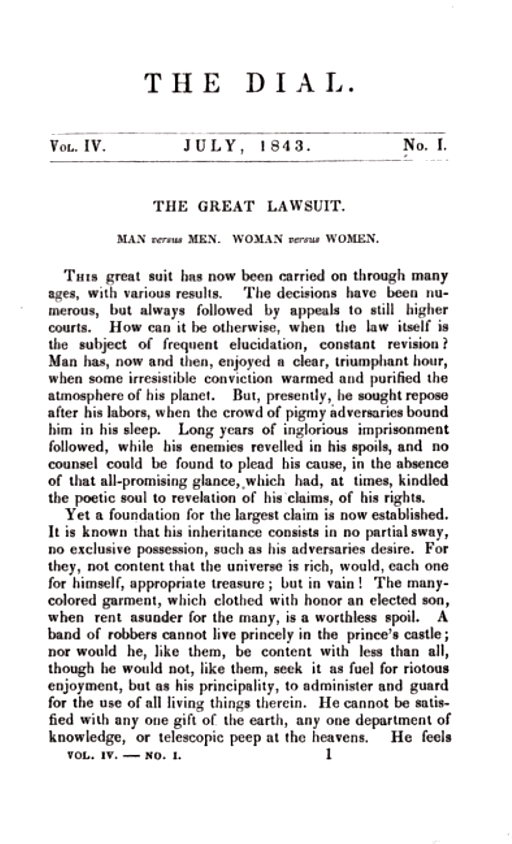
We conquered the tangle of highways to Concord with only a few wrong turns. Walking into Orchard House, the Alcott home (Louisa May, Bronson, et al.), at 2:58 and knowing that it closed at 3 (thats me approaching the front door in the photo above), we played the weve-traveled-so-far card and won a wonderful private tour with a sympathetic and knowledgeable docent. Although Little Women may have a sentimental ring to twenty-first-century ears, it resonates with the profoundly utopian thinking—and physically taxing reality—of the world Louisa May Alcott lived in. Orchard House showed signs of both worlds: charming eccentricities (Louisas sister Mays sweet pre-Raphaelite pencil drawings on her bedroom walls) and structural frailties (buckling floors, chilly drafts). Bronson Alcott, Louisas father, was a visionary of the first order, rarely concerning himself with such practicalities as earning enough money to feed and shelter his family, and thereby propelling Louisa into the unusual role of supporting her family financially with her writing. As a teacher, Alcott developed a race- and gender-neutral child-centered pedagogy that most people found scandalous, even immoral, and that most Americans today take for granted. He helped establish a commune, Fruitlands, an early back-to-nature effort, which failed quickly but interested many other questing spirits of the time, Ralph Waldo Emerson, Nathaniel Hawthorne, and Thoreau among them. He was a frequent contributor to the Transcendentalist journal The Dial and was often mocked for his opaque prose, and yet the influence of American Transcendentalism, especially in the environmental movement, is still alive and kicking today. It was a tour worth taking and a house worth visiting.


From the Alcott home we drove to Walden Pond in the waning light. Ive heard many people express the same dismay on seeing Walden Pond they do when they see the Alamo (its so small!), but its several times the size of the lake at Madroño Ranch, so I wasnt at all disappointed. We crunched through the snow along the edge, noting the space between the ponds ice and the shore while watching two men out on the ice doing something indecipherable with unidentifiable equipment. As the heatless sun began to sink behind the trees, we came to the spot where Thoreau built his cabin, now marked only by low concrete posts (see photo above), although his words remain carved on a nearby wooden sign: I went to the woods because I wished to live deliberately, to front only the essential facts of life, and see if I could not learn what it had to teach, and not, when I came to die, discover that I had not lived. As I stood there beating my hands together and stamping my frozen feet, I wondered if on a monochromatic winter afternoon like this Thoreau would have high-tailed it to Emerson’s house for a little warm food and company, as apparently he was wont to do.


Later, as we sat in a blessedly warm house in Wellesley, I began reading Martin’s volume of Thoreau and found myself beguiled, first by the slightly fustian voice of Joseph Wood Krutch, who wrote the introduction, and then by Thoreau’s own words, until Martin rather selfishly reclaimed his book. I went back to my literary farm girl, reading about the role of her father’s farm in her recovery from multiple heartbreaks.

This week, while waddling around Austin’s Lady Bird Lake (a body of water as beloved to me as Walden Pond was to Thoreau), I found myself thinking about Martin’s spontaneous overflow of powerful underlining and the odd stability of words, their capacity to be sturdy dwelling places despite their formless origins in the tohubohu of the human spirit. (Isn’t “tohubohu” a word you can live in? I do, actually, since it means chaos.) Martin’s invitation on the plane for me to join him in Thoreau’s house was a kind of evangelism, the best kind: a delighted discovery that clamors to be shared. Even though I was seated happily in Lorrie Moore’s house (which, with its love of place, is built on top of Thoreau’s) with all the doors closed and blinds drawn, Martin convinced me that the house Thoreau built was so splendid that I had to go in—which I did, grudgingly at first, but with increasing pleasure.

Hospitality from so many quarters: from the kind docent at Orchard House; between the walls of books; from my tickled husband; from the friend of a friend who opened her house to us; even in the cold empty space in Walden Woods marked off by the Massachusetts Department of Conservation and Recreation. Thoreau reached out from the past and invited us into its tohubohu, asking for our response and drawing from us a tiny new creation. Not bad for a crusty, allegedly misanthropic Yankee.
—Heather

What we’re reading
Heather: Billy Collins (ed.), Bright Wings: An Illustrated Anthology of Poems About Birds
Martin: Jonathan Gould, Can’t Buy Me Love: The Beatles, Britain, and America

Friday, December 4, 2009

Listapalooza: top ten books about the environment


And now for the next installment in our internationally celebrated series of lists... and what could be more appropriate from the proprietors of a place called Madroño Ranch: A Center for Writing and the Environment than a list (in alphabetical order by author) of our ten favorite books about the environment?

Wendell Berry, The Unsettling of America: Culture and Agriculture
William Cronon, Changes in the Land: Indians, Colonists, and the Ecology of New England
Annie Dillard, Pilgrim at Tinker Creek
John Graves, Goodbye to a River: A Narrative
Paul Hawken, The Ecology of Commerce: A Declaration of Sustainability
Mary Oliver, What Do We Know: Poems and Prose Poems
Michael Pollan, The Omnivore’s Dilemma: A Natural History of Four Meals
David Quammen, The Song of the Dodo: Island Biogeography in an Age of Extinctions
Wallace Stegner, Angle of Repose
Henry David Thoreau, Walden; Or, Life in the Woods

Of course, we’re struck by the many wonderful and influential books we had to leave out to get down to ten, and we'd love to know your favorites. Let the arguments begin!
—Martin

What we’re reading
Heather: Kate Braestrup, Here If You Need Me: A True Story
Martin: Simon Kuper and Stefan Szymanski, Soccernomics: Why England Loses, Why Germany and Brazil Win, and Why the U.S., Japan, Australia, Turkey—and Even Iraq—Are Destined to Become the Kings of the World’s Most Popular Sport