Showing posts with label predators. Show all posts

Friday, May 21, 2010

More on violence: a death in West Austin


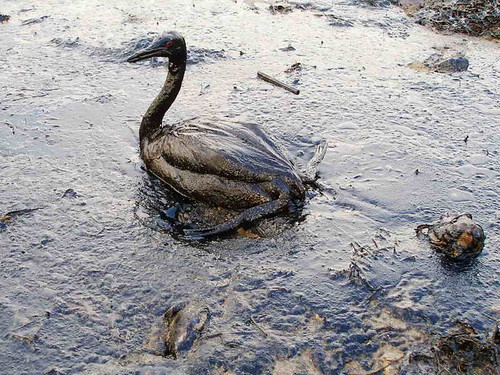
Last Thursday got off to a grisly start in our West Austin neighborhood, bringing a stark reminder of the violence inherent in the way we humans live on the land. We usually attempt, more or less successfully, to keep this violence implicit—behind the walls of slaughterhouses, say, or with the cleanup crews who scrape the roadkill off our highways—but every once in a while it bursts forth in explicit, unimaginable horror, demanding to be acknowledged, as in the aftermath of oil spills. Or, on a much smaller scale, on our street last Thursday.

It was about 6:45 a.m. and Chula the Goggle-Eyed Ricochet Hound and I had just set out on our usual two-mile morning perambulation. As we turned the corner to climb the first big hill I saw S. and A., two of our neighbors, standing in A.’s front yard. The light was still tenebrous, and my eyes were still filled with morning blear, so I asked them, stupidly, if everything was okay.

In response, A. gestured at the spiked black steel fence that encloses his back yard and said, “Deer caught on the fence.” I looked again, and sure enough there was a young buck hanging from the top of the fence by one back leg, kicking occasionally in an attempt to get free. Since Chula was getting increasingly agitated, I pulled her away and continued up the hill.

When we returned, some time later, A., S., and the buck were gone. I allowed myself to hope that all had turned out well, but then I heard the unmistakable pop of a gunshot—an unusual sound in our part of Austin—and then another a few seconds later. When we got to the bottom of the hill, I saw a small group of men gathered around something by the curb.

I put Chula back inside and went to investigate. The object by the curb was the buck, his mangled hindquarters covered by a tarp, his eyes rolling around in his head, which thrashed and clattered against the pavement in his death agony. An astonishing amount of blood rolled down the gutter toward the storm drain.

A. filled me in on what had happened in my absence: while S. had gone to fetch a pistol to dispatch the creature, the buck had worked his way loose from the fence, but not before hopelessly mangling both his back legs in his frantic efforts to free himself. He somehow dragged himself across one street and two front yards (including ours) before they caught up with him again. S. fired once and missed, then fired again from point-blank range; unfortunately, as they discovered later, the second shot merely went through the buck’s cheeks, causing him to get up and haul himself across the street, where he finally collapsed in the gutter.

Unwilling to fire any more shots, S. and A. asked C., the neighbor in front of whose house the buck had collapsed, if he had a hunting knife. C. went back inside and got what A. later described as “the world’s dullest hunting knife.” S. hacked at the buck with the knife until he finally slit his throat, but, as A. said, “waiting for the buck to bleed to death became too much, so S. was able to sever its windpipe, which quickly—and thankfully—brought the deer’s life to an end.”

It was at this point that I wandered up. I’d been standing there only a few moments, trying to take in what I was witnessing, when A. looked over my shoulder and said, “Heather doesn’t need to see this.” I turned around and saw her walking toward our little group, and headed back to intercept her. As we walked back up our driveway, I noticed several spots of bright red blood, signs of the buck’s last agonizing procession toward its death. There were more bloodstains on our front walkway, and indeed all across our front yard.

Later, as I hosed some of those stains off, I thought about the other deer which had gotten hung up on A.’s fence last year, another beautiful young buck who managed to gut himself on one of the spikes and hung there, head down, slowly dying. It had been difficult not to think of Jesus hanging on the cross while looking at the helpless creature.

A. and his family had been out of town on vacation, and no one knows how long that buck had been hanging there before someone found him. None of the neighbors who were there that day had a gun—we keep all our family firearms out at Madroño—and eventually we called our local veterinarian, who finally came and administered a lethal injection. We carefully lifted the dead buck off the fence, and a man from the city parks department took the body away.

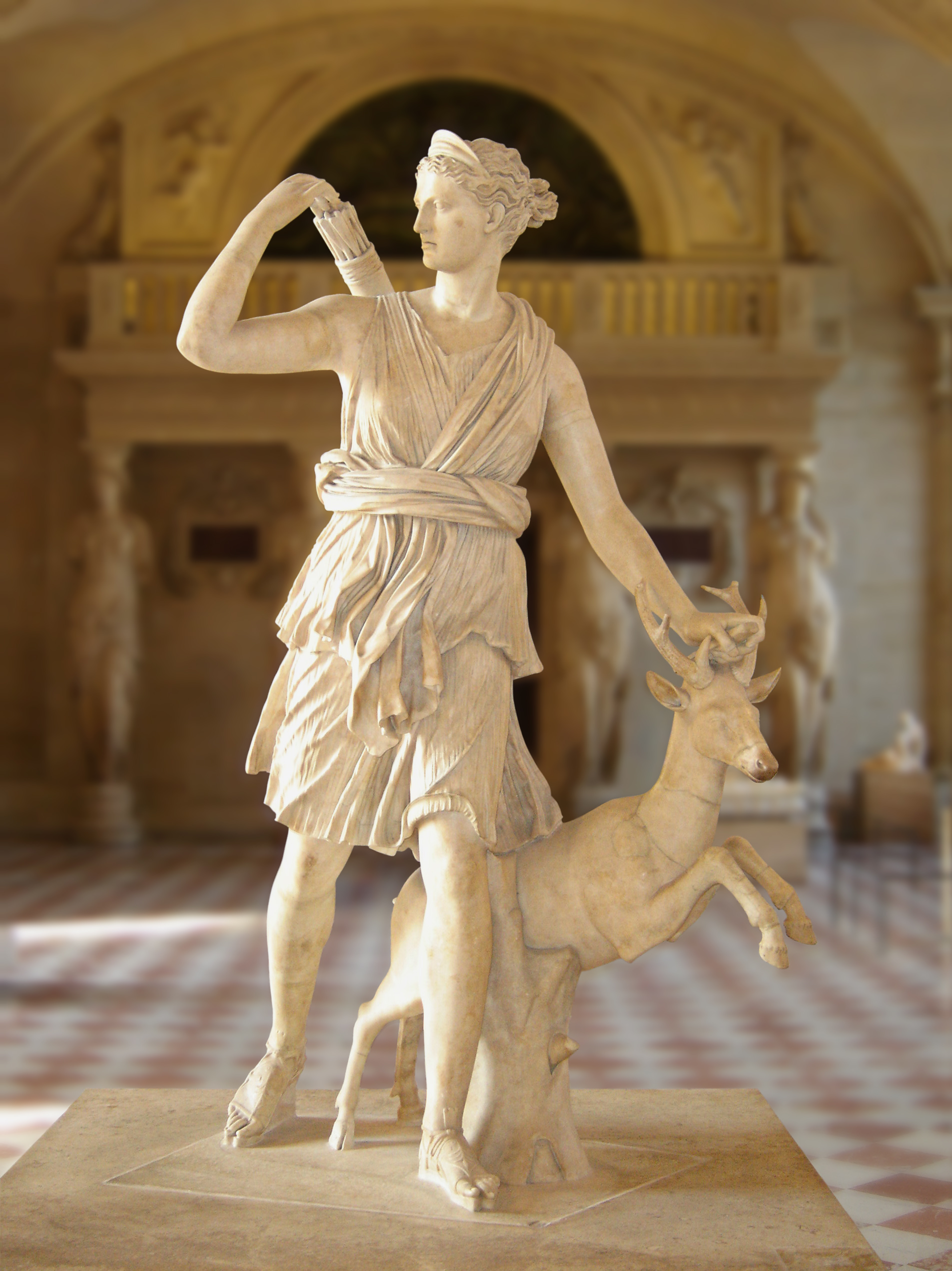
Deer have been living in close proximity to us—and sustaining us—for centuries. They are associated with Artemis/Diana in Greek and Roman mythology, and four stags feed on the world tree in Norse mythology. St. Hubertus, the patron saint of hunters, supposedly saw a crucifix on the head of a stag he’d been pursuing, and St. Giles (depicted above), the Greek hermit, lived with a doe as his only companion. The indigenous Huichol people of Mexico make offerings to the Deer of the Maize and the Deer of the Peyote, and in Shinto, deer are considered messengers to the gods. In Austin, many of us are accustomed to virtually tame deer foraging in our gardens. But the deer that died on A.’s fence, like the countless dead squirrels, raccoons, possums, and deer we see on our roads, remind us of the violence inherent when urban, automotive humanity impinges on wild (or even semi-wild) nature, or vice versa.

It’s silly to think that without us these animals’ lives would be free from suffering, pain, and terror; they all have numerous natural predators and parasites, after all, and those predators and parasites don’t go out of their way to kill humanely. (Sometimes I think it ironic that humane derives from the Middle English word for human, but the fact is we do have a choice in how we kill the animals we use.) And Madroño Ranch is, after all, in the business of selling bison meat, one of the requirements of which is first killing the bison, and we do derive income from hunting leases during deer season. But there’s something about the useless and prolonged horror of the way these deer died that hits me very hard. They weren’t shot for their meat; instead, mutilated by a symbol of human territoriality, they died slow, agonizing, gruesome deaths—victims, in effect, of our notions of private property. Where’s the redemption in that?
—Martin


What we’re reading
Heather: Michael E. McCullough, Beyond Revenge: The Evolution of the Forgiveness Instinct
Martin: Glen David Gold, Sunnyside

Friday, May 7, 2010

The devil’s bargain: on gardening and violence


I spent last weekend at the ranch planning a new garden – or, rather, watching our dear friend Glee Ingram, an Austin landscape designer; Steve Diver, a horticulturist with Sustainable Growth Texas; and Robert Selement, Madroño’s redoubtable manager, plan a new garden as I poked at bugs, stared at the sky, and occasionally said, “Huh?”

Despite me, we made good progress. Using Glee’s initial design, we flagged the perimeter of a beautiful labyrinth-inspired shape. We thought about armadillo-, feral hog-, bison-, and raccoon-proof fencing (ha!); permaculture; gates and traffic patterns; rainwater collection; hoop-house placement; compost systems and leaf corrals; how to integrate the activities of the residents of the adjacent Chicken Palace; planting fruit trees as wind barriers; and soil and amendment ratios. We (well, some of us) got really sunburned. We felt that we’d really earned that cold beer on the porch as we watched the afternoon light turn golden while scores of swallows dove and swooped around us.

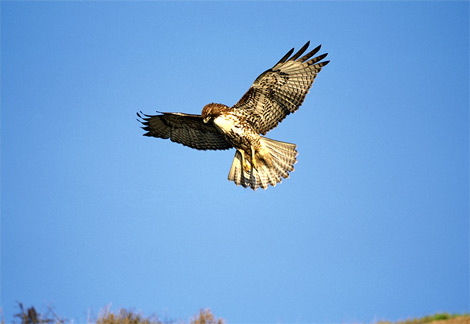
If this makes Madroño sound like Paradise and us like laborers in Eden, well, that’s what it felt like. At the same time, however, these things also happened: I watched a hungry red-tailed hawk flying low over the Chicken Palace, hoping for yet another carry-out chicken dinner. I awoke at dawn’s first glimmering to operatic squawking from the Chicken Palace but, unable to find a flashlight, had to wait until it was light to investigate. (Robert has killed more rattlers this spring than in his seven previous years at the ranch combined.) In fact, there was a dead hen, but we’re not sure what killed her; she may have been egg-bound. During my morning perambulation on the road above the lake, a dozen buzzards wheeled just overhead. I couldn’t smell anything dead, nor could I see the focus of their activity, but I remembered the shrieking white-tailed doe I’d heard at this same spot last spring. It was a heart-stopping noise. I glimpsed her thrashing through the underbrush on the cliff below me but was unable to find her again when I returned with reinforcements. Paradise it may be, but Madroño’s beauty is woven with the warp of nature’s potential and actual violence.

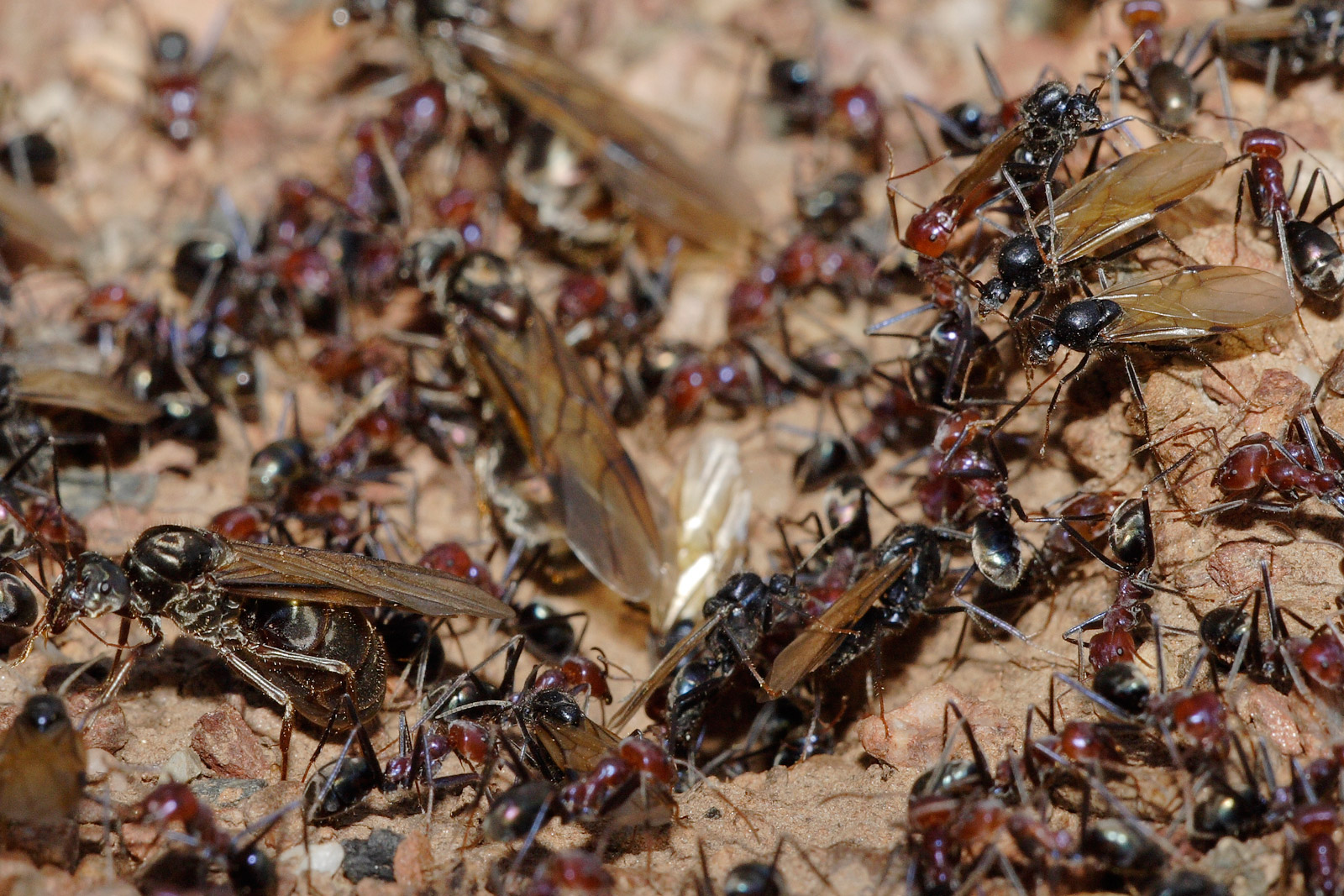
A good friend emailed me after my last post, saying, “I have read that if all the ants were eliminated from the planet it would cease to exist. My thought is that if all the humans somehow disappeared the earth would flourish.” I’ve had that thought as well, but I also think that, with or without us, earth’s flourishing has always involved violence and suffering. Predation, disease, floods, volcanic eruptions, earthquakes, tornadoes, and drought preceded human enviro-tinkering and will continue once we’re gone.

Given that humans are part of the natural order, it’s also a given that we will engage in violence. My definition of violence is idiosyncratic and personal: I define it as existing on a spectrum involving the imposition of one being’s (or group’s) will on another being (or group). So when you order your lollygagging child to stop staring at the ceiling and put on her school clothes, you are, according to my definition, moving into the realm of violence, albeit at the lowest possible vibration. If, as in this case, the imposition of said will is done to enable or assist the flourishing of the one imposed upon, maybe you get a free pass. I’m not sure about this. Nor am I sure how to word my definition to include violence against self, surely as invidious and terrible as violence against another. And of course violence is not restricted to the physical realm, nor is it directed only against humans. Our species’ casual, thoughtless violence against the natural world is relentless.

Unique to humans in this violent world, however, is the capacity to restrict the reach of our violence. Christians and Jews have been commanded to do so in no uncertain terms (as have the followers of virtually every faith tradition; it’s just that I’m most familiar with those two). Repeated several times in the Pentateuch is the phrase “an eye for an eye,” often misunderstood as an incitement to violent retribution. In fact, the point of the phrase was to minimize violence, not incite it; the loss of an eye could not be redeemed by murder. Leviticus 19:18 is even more to the point: “You shall not take vengeance or bear a grudge against any of your people, but you shall love your neighbor as yourself....” Jesus thought this a good enough line to use in the Sermon on the Mount, and reinforced it by instructing his followers to rein in their violent tendencies even more tightly: “If anyone strikes you on the right cheek, turn to him the other also” (Matthew 5:39). Human violence against nature is less of an issue in the Bible, as the capacity to inflict permanent damage on our world wasn’t ours at that point. But scripture does specifically address the correct treatment of animals; they were considered part of the community and were to enjoy a Sabbath rest (Exodus 20:10).

Restricting the reach of violence requires recognizing its ubiquitous footprint. I see its size 7 1/2 tracks all around me: in my sarcasm, in my imperious demands that things be done my way, in my constant consideration of my own comfort, in my need to have reality ordered in a particular way. Having spent the last couple of weeks in my garden at home, I’ve become aware of the arbitrary nature of life and death: what have those cute little flowering clovers ever done to me that they should be so unceremoniously yanked up? And don’t get me started on pill bugs.

Gardens are great places for contemplating unsolvable mysteries. How else are you going to keep your mind occupied when pulling weeds? But I think there’s a deep and distinctive link between restricting our carbon footprints and our violence footprints. When we accept that our flourishing always comes at the expense of someone or something else’s flourishing, it’s hard not to be humbled. What better place than a beautiful, infuriating garden to watch such a serious drama play itself out?
—Heather


What we’re reading
Heather: Matthew Scully, Dominion: The Power of Man, the Suffering of Animals, and the Call to Mercy
Martin: Richard Holmes, The Age of Wonder: How the Romantic Generation Discovered the Beauty and Terror of Science

Friday, February 19, 2010

Massachusetts, part III: take a walk on the wild side


A Very Long Time Ago, my mother brought home a Peter Max-style poster with this quotation from Henry David Thoreau: “In wilderness is the preservation of the world.” Each time we moved, its reappearance was an indication that I was home again despite the bewildering newness of my surroundings. Thanks to this poster, I associated “wilderness” with “home.”

During our recent and ongoing Thoreau binge, I discovered, disconcertingly, that the poster has it wrong. The quotation comes from Thoreau’s essay “Walking,” initially delivered as a (very long) lecture in 1851 and published posthumously in the Atlantic Monthly in 1862. “I wish to speak a word for nature, for absolute Freedom and Wildness, as contrasted with a freedom and Culture merely civil,” he begins. Walking is civilized humanity’s entrée into nature, but Thoreau’s notion of walking is highly particular: “I have met with but one or two persons in the course of my life who understood the art of Walking, that is, of taking walks, who had a genius, so to speak, for sauntering....” For Thoreau, to walk in nature was to be a pilgrim, a sainte-terrer,” simultaneously seeking the holy land and already graced: “It requires a direct dispensation from heaven to become a walker.” Clearly, according to Thoreau, hoofing it to the neighborhood grocery store to pick up a loaf of bread does not qualify as walking.

Nor does walking have anything to do with exercise or taking a break. Walking requires attention. “[I]t is of no use to direct our steps to the woods, if they do not carry us thither. I am alarmed when it happens that I have walked a mile into the woods bodily, without getting there in spirit.... The thought of some work will run in my head, and I am not where my body is; I am out of my senses.” Rather, he says, “you must walk like a camel, which is said to be the only beast which ruminates when walking.” (That’s a joke, I think, but even if it’s not, it ties in nicely with Martin’s post from last week.)

Thoreau found that his preferred direction for a walk was almost always southwestward. “It is hard for me to believe that I shall find fair landscapes or sufficient Wildness and freedom behind the eastern horizon.... I must walk toward Oregon, and not toward Europe.” There is something specifically American in his way of walking, and he predicts that walks through the American landscape will form the American soul: “I trust that we shall be more imaginative; that our thoughts will be clearer, fresher and more ethereal, as our sky—our understanding more comprehensive and broader, like our plains – our intellect generally on a grander scale, like our thunder and lightning, our rivers and mountains and forests—and our hearts shall even correspond in breadth and depth and grandeur to our inland seas.”

He has nothing against civilization, culture, education, the arts, but he felt that they all rely on something unexpected: “The West of which I speak is but another name for the Wild; and what I have been preparing to say is, that in Wildness is the preservation of the world.”

Here is where this Thoreauvian saunter has led us, gentle reader—back to that poster. In Wildness, not wilderness, is the preservation of the world.

I think the distinction is enormously important. “Wilderness” implies an external state; “wildness” is as easily internal as external. Thoreau didn’t want to erase human culture; rather, he sensed that it required wildness, both psychic and physical, in order to flourish.

In one of those beneficent coincidences, I put down Thoreau’s essay a couple of Sundays ago and discovered an article in the New York Times Magazine entitled “Is There an Ecological Unconscious?” The article described a somewhat inchoate field of study in which a clear link is made between human mental health and the health of wild nature. Glenn Albrecht, a philosopher and professor of sustainability at Murdoch University in Perth, Australia, has coined the term “solastagia” to designate “the pain experienced when there is recognition that the place where one resides and that one loves is under immediate assault... a form of homesickness one gets when one is still at home.” A growing number of psychologists agree with Albrecht’s assertion that there is a direct connection between environmental degradation and mental illness. One of them calls not just for intact ecosystems that include large predators but for a “re-wilding of the psyche,” a term perhaps more appealing to poets and transcendentalists than to funders of academic research.

It’s an interesting proposition. What does a re-wilded psyche look like? In his book Monster of God: The Man-Eating Predator in the Jungles of History and the Mind, David Quammen muses on the merits of what he calls “alpha predators,” among them lions, grizzly bears, Nile crocodiles, reticulated pythons, and white sharks. He considers mythical creatures as well, particularly Leviathan as he appears in the book of Job. In examining this uncomfortable perspective on humanity as meal instead of master, Quammen wants us to consider the crucial role this perspective has played “in shaping the way we humans construe our place in the natural world.” In short, it’s important for us to know ourselves as part, not masters, of the food chain. Why? For the same reason God beats Job over the head with questions about Leviathan: who can tame such a furious beast? Can Job? Duh, no. The man-eaters remind us of the life-promoting necessity of humility. As dangerous as they are, the destruction of man-eaters, or even their relegation to zoos, would be more dangerous: we might thus be further encouraged to behave as if we were masters of the universe—a time-tested guarantee for misrule if there ever was one.


A human psyche that resonates with, or trembles at, the roars of actual alpha predators is likely to be awake in a particular way, awake to its own contingency. (If you haven’t read Mary Oliver’s “Alligator Poem,” now is definitely the time to do so.) Years ago, walking in the back reaches of Madroño Ranch, Martin and I heard the unmistakeable scream of a mountain lion. I’ve never reentered that canyon—especially when I’m alone—without taking a deep breath.

So back to the misquotation. As much as I love that old poster, and as vital as I think wilderness is, I think Thoreau got it right. Without access to wildness, without knowing the necessity of bowing before it, we cease to be fully human. And if we can’t fully inhabit our humanity, what home is left for us?
—Heather

What we’re reading
Heather: John Pipkin, Woodsburner: A Novel
Martin: Philip B. Kunhardt III, Peter W. Kunhardt, and Peter W. Kunhardt Jr., Lincoln, Life-Size