Showing posts with label chickens. Show all posts

Friday, March 25, 2011

Tragic waste: some thoughts on the s-word


Watching the bats from the kitchen stoop at Madroño Ranch the other morning was a little like watching my own thoughts. They swooped in and out of my line of vision, limited by the dawn darkness, more audible than visible.

Actually, my comparison is disrespectful of the bats; their flight is only apparently erratic, driven by the ever-changing location of the insects they were chasing. My thoughts are actually erratic. As the promise of light bloomed into dawn, the bats settled into the bat house, a feat of precision flying and landing almost like none I’ve seen, and I noticed the pile of guano under the house and thought that soon it would be time to collect it and put it into the compost pile.

And so began my musings on shit and the difference between good shit and bad shit. My apologies to the bats become ever more profound.

One of our current projects at the ranch is figuring out how to use the abundant quantities of manure the residents of the Chicken Palace produce. Currently, it’s just collected and dumped onto the compost pile, but we’re working on a plan to get the chickens more fresh greenery to eat, in part self-fertilized (by the chickens, that is). We’re planning to cordon their pasture off into sections and seed the sections with cover crops, alfalfa, rye—whatever the season will grow. We’ll soon have a rainwater collection system in place and will be able to irrigate with it (assuming it ever rains again). Using a portable fence, we’ll be able to rotate the chickens from section to section. We have no idea if this will work, but it seems like a good idea and a fine, closed-loop use of all that poop. We’re also looking to collect buffalo leavings (summer “interns”: consider yourselves warned!) and use them as well.

Perhaps you’ve noticed that I used all sorts of synonyms for shit in the previous paragraph; one of the few I didn’t use is “waste,” because in natural systems, or systems that mimic natural systems, shit isn’t waste, it’s integral and beneficial. Paraphrasing Our Hero Wendell Berry, Michael Pollan notes in The Omnivore’s Dilemma: A Natural History of Four Mealsthat industrial agriculture has taken an elegant solution—crops feed animals, whose manure in turn fertilizes crops—and “divide[d] it into two new problems: a fertility problem on the farm... and a pollution problem on the feedlot.” Concentrated Animal Feeding Operations (CAFOs), the current source of most of America’s meat, produce mountains of manure that becomes toxic to the animals and to the communities around them, and the monoculture farming that produces most of America’s grains and vegetables doesn’t use animals to fertilize the soil, requiring farmers to use chemicals instead. That’s the difference between good and bad shit: when something that could be beneficial becomes useless, even toxic, waste.

In fact, I’m beginning to wonder if a community’s or even a culture’s capacity to endure might not be assessed by how effectively it mimics nature in dealing with its own discharge. I’ve just been rereading T. C. Boyle’s darkly comic Drop City, which begins at a northern California commune of the same name in 1970. The commune’s stated raison d’etre is to provide its residents with a place to escape the confines of bourgeois America and get back to the land and basic values by expanding their consciousness with meditation and drugs.

Of course the place is utter chaos, overflowing with the metaphoric excrescences of abusive sexual practices, racism, child neglect, and rampant narcissism, along with literal shit. The septic system is overloaded and the two characters who concern themselves with the problem get no help at all from the community. Eventually, the county government threaten to raze the buildings because the commune constitutes a health hazard. Because they can’t deal with their own shit on any level, the residents of Drop City abandon what was once beautiful land and move their chaos to the bush country of Alaska just as summer is waning. When they get there, most of them realize that they need to leave or get their shit together so they don’t die.

The problem is that getting your shit together necessitates acknowledging that you are, in fact, going to die. (It’s still Lent, after all. You knew we’d get to this.) Ernest Becker, in his Pulitzer Prize-winning The Denial of Death, identifies the human dilemma in scatological terms: we are the “god[s] who shit.”
Look at man [sic], the impossible creature! Here nature... [has] created an animal who has no defense against full perception of the external world, an animal completely open to experience.... He not only lives in this moment, but expands his inner self to yesterday, his curiosity to centuries ago, his fears to five billion years from now when the sun will cool, his hopes to eternity from now. He lives not only on a tiny territory, not even on an entire planet, but in a galaxy, in a universe, and in dimensions beyond visible universes. It is appalling, the burden man bears, the experiential burden.... Each thing is a problem and man can shut out nothing. As Maslow has well said, “It is precisely the god-like in ourselves that we are ambivalent about, fascinated by and fearful of, motivated to and defensive against. This is one aspect of the basic human predicament, that we are simultaneously worms and gods.” There it is again: gods with anuses.
Human civilization, says Becker, is built on this unease, which encourages us to throw our energies into an “immortality project” by which we deny our smelly mortality; those who confront it with none of the filters an immortality project provides wither into mental illness. Becker doesn’t attempt to solve this conundrum but rather to set some boundaries within which we can wrestle with it with “the courage to be.” He writes in his conclusion: “We need the boldest creative myths, not only to urge men on but also and perhaps especially to help men see the reality of their condition. We have to be as hard-headed as possible about reality and possibility.”

So it was with interest that I watched the video produced by a Japanese media artist to explain to Japanese children why everyone was so worried about the Fukushima nuclear reactor after it was damaged by the tsunami and earthquake on March 3. The video compares the damaged nuclear reactor to a boy with an upset stomach who needs to poop. So far the boy has just farted—smelly enough for everyone around him—but the video assures us that a team of selfless doctors are doing all they can to prevent Nuclear Boy from pushing out his stinky poop.

The video says that the Fukushima reactor is more like Three Mile Island Boy—who just farted—than like Chernobyl Boy, who not only pooped but had diarrhea that went everywhere, likening nuclear waste to a dirty diaper. My first thought after watching it was that Japanese doctors would be overwhelmed by waves of constipated children, convinced that evacuating their bowels might bring their struggling nation to even deeper depths. My next thought moved me to images in last Sunday’s New York Times of the city of Chernobyl in its abandoned state and the interview with one of the guardians of “the sarcophagus,” the concrete structure built to contain Reactor No. 4, and that can’t come in contact with water without risking the escape of highly radioactive fumes. Scientists estimate that an area around the reactor the size of Switzerland will remain affected for up to 300 years. The aftermath of a nuclear meltdown “is a problem that does not exist on a human time frame.” The guardian figures that the work he does will be available to his children and grandchildren.

Using my heavily truncated recapitulation of Becker’s thought, it seems that proponents of nuclear power (which I have sometimes been) are refusing to be “as hard headed as possible about reality and possibility,” are as unwilling to get our shit together as the drug-addled utopians of Drop City. We are as schizophrenic as the video artist who proposes that we just not poop. A few pages away from the article about Chernobyl was a piece by a Japanese astrophysicist who wrote in reference to the Fukushima reactor crisis:
Until a few years ago, power usage in Japan was such that during the summer Obon holidays, when people typically return to their ancestral homes, it would have been possible to meet demand even if all nuclear power plants were turned off. Now, nuclear energy has come to be indispensable for both industry and for our daily lives. Our excessive consumption of energy has somehow become part of our very character; it is something we no longer think twice about.
Now that I’m trying to tie together all these thematic threads, I have to swoop back to my bat-intensive stoop, to the manure-heavy compost pile in the pasture outside the Chicken Palace. May we humans be as useful as Madroño’s bats and chickens as we consider our energy future; may we refuse to resort to the narcissistic chaos of Drop City’s residents, who left their spiritual and literal bad shit for someone else to deal with.
—Heather


What we’re reading
Heather:
Karen Armstrong, Twelve Steps to a Compassionate Life
Martin: Nicholson Baker, The Anthologist

Friday, January 7, 2011

A new year at Madroño Ranch: bison harvests, chicken tractors, hog schools, and more


Happy new year! The beginning of the year is always a good time to take stock, so we thought it might be appropriate to look back at what we accomplished—and, erm, failed to accomplish—during the last twelve months. Much remains to be done before our hopes for Madroño Ranch are completely realized, though we took what felt like some significant strides in 2010. With apologies for any perceived self-indulgence, here are some of them.

First, thanks to the wonderful and talented Shawn and Susanne Harrington of Austin’s Asterisk Group, Madroño Ranch now has a vibrant, striking, beautiful visual identity—logo (above), wordmark, etc.—which we hope eventually to splash all over actual and virtual reality. (Madroño Ranch T-shirts! Madroño Ranch gimme caps! Madroño Ranch bumper stickers and koozies and belt buckles and....)

Second, we’ve begun to rethink our initial determination to offer residencies only for environmental writers, however broadly defined (poets, philosophers, essayists, whatever). We had initially thought we would restrict our offerings to writers because, well, as a couple of recovering English majors, we felt like we knew writing better than we knew art, and (perhaps more important) we didn’t want to spend a lot of money on infrastructure (kilns, darkroom facilities, printing presses, whatever). Most writers, after all, are highly mobile these days, requiring little in the way of equipment beyond a laptop computer. But it has become increasingly obvious, even to us, that virtually the same is true of many visual artists as well—digital photographers and collagists, to name just a couple. Painters can travel with paints, portable easels, and suchlike. And then there are environmental artists, like Andy Goldsworthy, who use materials found on-site—rocks, leaves, branches, etc. Why should we exclude such creative thinkers from our pool of potential residents?

Third, while we are still a long way from officially opening our residential program for environmental writers (and artists)—we have yet to construct the small casitas we envision as individual workspaces, and we have yet to hire the necessary personnel to cook and care for our residents—we have managed to find a couple of brave souls willing to serve as “guinea pigs.” Melissa Gaskill and E. Dan Klepper will each spend several days at Madroño Ranch in the next couple of months, working, resting, and experiencing some if not all of what our actual residents will experience once we’re fully up and running. We look forward to hearing their feedback, suggestions, etc.

Fourth, our friend Jesse Griffiths of Dai Due came up with a new and exciting way to open the ranch to a wider public through a variety of sustainable hunting, fishing, and cooking “schools” throughout the year. The first, Deer School, brought six guests to the ranch in November, and was a thoroughgoing success; now we’re looking forward to Hog School in early March and Freshwater Flyfishing School in mid-May, both of which have already sold out. If they go well, we’re hoping to make these (and perhaps other such schools) an annual tradition at Madroño Ranch.

Fifth, we finally gained state approval of the label that will appear on the packages of bison meat we sell, which means we can finally go ahead with our first “harvest” (as it’s euphemistically called) this month. (We had hoped, naively, to harvest our first bison in October, but the approval process turned out to be considerably longer and more complicated than we had imagined.)

Sixth, Heather made significant progress in her quest to become a true chickenista, following the example of local legend Carol Ann Sayle of Austin’s Boggy Creek Farm. Our original flock of fifty or so laying hens took up residence in their bombproof (and, we trust, owl- and hawkproof) new coop, which we call the Chicken Palace (pictured below). A few months later Robert’s brilliant creation the Chicken Tractor (actually a mobile coop on wheels) became the home of a new flock of about twenty younger hens. (As of last week, the two groups were just beginning to commingle.)


Seventh, while we still don’t have an actual Madroño Ranch website (though we’re working on it!), we do have an official Madroño Ranch Facebook page. We invite those of you on that ubiquitous social network to check it out, and click the “Like” button if you’re so inclined; until our website is up and running, that will be the easiest way to keep track of what’s happening at the ranch in what we hope will be an exciting twelve months to come.

Perhaps none of these accomplishments sounds terribly important in and of itself, but each brought us just a little closer to our goal. Our hope for 2011 is that we—and you too, Gentle Reader—keep striding throughout the new year, whether the steps be large ones or small.
—Martin


What we’re reading
Heather:
Marilynne Robinson, Absence of Mind: The Dispelling of Inwardness from the Modern Myth of the Self (still—it’s hard!)
Martin: Michael Lewis, The Big Short: Inside the Doomsday Machine

Friday, September 3, 2010

Stubbing the giant’s toe: thoughts on Midwestern agribusiness


Corn. Soybeans. Corn. Soybeans. Corn. Soybeans. Corn. Soybeans. Corn. Soybeans. Corn. Soybeans. Corn. Soybeans. Corn. Soybeans.

And did I mention corn?

We drove last week from Austin to Gambier, Ohio, to deliver our youngest to college, and then back to Austin. (Empty nest. Delight. Depression.) That this trip was my maiden voyage into the American Midwest was just one of many notable firsts. At about the time we crossed the line from Kentucky to Ohio, it began: fields of corn and soybeans on either side of the road stretching to the horizon, interrupted only occasionally by copses of oaks or by farm houses and barns or by grain storage units. We started to joke about it by the time we got to Gambier, smack in the middle of Ohio. After installing our daughter in her new dorm room, we turned our noses west and drove from Gambier to Clarksville, Missouri, on the banks of the Mississippi River, in one endless, relentless, repetitive, mind- and butt-numbing 600-mile day. The joking stopped at about mile 100.

The landscape wasn’t unpleasant by any means: the apparently unlimited fecundity of the earth was impressive, as was the system that ordered such abundance. The scope of it! And we didn’t even make it into Iowa or Nebraska! No wonder the people behind this astonishing productivity are proud of it.

But there’s another way to see that landscape, and those afflicted with the double vision I wrote about in an earlier post might see the abundance as a tumor, or at least a spreading rash. The economic, cultural, and environmental damage imposed by the efficiencies of agribusiness have been well documented, most popularly by Michael Pollan in The Omnivore’s Dilemma: A Natural History of Four Meals and Eric Schlosser’s Fast Food Nation: The Dark Side of the All-American Meal, along with films like Food, Inc. and Fresh. The idea that inexpensive food can be grown only through the use of annuals and monocultures, efficiencies of scale, and heavy pesticide use has been seriously challenged by farmers like Joel Salatin and Will Allen. Along with the steady depletion of topsoil, the off-farm effects of conventional agriculture are also well documented, from depletion of local biodiversity to the rapidly growing “dead zone” in the Gulf of Mexico.

After spending the night in Clarksville, we drove through another scene of apparent abundance en route to Eureka Springs, Arkansas. Arkansas, of course, is the home of Tyson Foods, which began as a chicken wholesaler in 1935. In the interests of full disclosure, I have to admit that I love chickens for reasons that aren’t entirely rational. Last year, we moved our chickens at Madroño from the nasty old chicken coop to the Chicken Palace and added substantially to their numbers. The Chicken Palace, built by Robert Selement, the ranch’s redoubtable manager, could probably withstand a nuclear attack and has already foiled a whole lot of skunks, raccoons, coyotes, bobcats, hawks, and owls.


One of the great pleasures of a Madroño morning is to let the ladies (one of whom is named Fred, for reasons not entirely clear to us) out of the Palace and into the adjoining pasture and then to throw them the previous night’s vegetable scraps. From the moment they see me coming down the hill, they begin an almost-intelligible running commentary that steadily increases in volume and intensity. (“Can you believe she wears boots with her nightgown?” “God, I hope there’s no fennel in that scrap bowl.” “Hasn’t she ever opened a gate before? What’s taking her so long?”) Anticipation is so focused that by the time I open the door to the yard, and then the gate from the yard to the pasture, there’s a charge in the air that surely rivals the first seconds of the running of the bulls in Pamplona. No, really. Those chickens are moving. And I’m laughing. And very happy to gather (and sell) their marigold-yolked eggs. (For the reflections of a true chickenista, be sure to check out the highly readable blog posts of Carol Ann Sayle, who owns and operates Austin’s wonderful Boggy Creek Farm along with her husband Larry Butler. Carol Ann’s chicken blogs are worthy of a BBC comedy of manners with period costumes.)

Given my tender feelings toward our chickens, seeing a Tyson truck rolling down an Arkansas highway carrying its cargo of tightly packed chicken cages made me tense. When we got to Eureka Springs, with its funky old boutiques and gingerbread houses, we found a restaurant that served local produce and whose waitress told us that she was a “universal soul.” I relaxed a little, enough to start chatting with the friendly couple sitting next to us. As it turned out, the husband was a Tyson chicken farmer. The 16-year-old boy he had hired for the summer was worthless, he said, but the 14-year-old was great. He didn’t have an attitude yet, and never complained about the hours he had to spend each day picking up dead chickens.

I got tense again.

How can something that seems so clearly wrong to one person seem perfectly acceptable to another? How can I have arrived at my advanced age and still be surprised that this is so? Even though we all technically speak the same language—the Midwestern corn and soybean farmers, the Arkansas chicken farmer, and I—there seems to be an unbridgeable perceptual gulf between us.

When I’m feeling this kind of tension, I become almost ridiculously grateful for things like the National Geographic website, which describes the work of young scientists with big ideas that “show a potential for future breakthroughs.” Among the chosen for 2010—and they are a fascinating group—is an agroecologist named Jerry Glover who works for The Land Institute in Salina, Kansas. His field of study, so to speak, is perennial grains, wheat in particular. Unlike annual crops, which need to be replanted every year, drain nutrients from the soil, and allow erosion when they die, perennial crops can be “harvested year after year and maintain excellent soil quality.” Glover doesn’t preach (at least not on the National Geographic website), and he doesn’t point fingers at conventional farmers and say: Bad, bad, bad. He points to the evidence in the soils he works with, which speaks for itself—and in the same dialect as the farmers whose practices I find so confounding.

Seeing the scope of those Midwestern cornfields is sobering. Thinking about the money, time, and corporate muscle they represent is daunting. Reading about the salmonella outbreak in factory farm-produced eggs is appalling. When you buy from your local farmers and humane producers, you’re allying yourself with an entity so tiny it barely stubs the giant’s toe when it gets kicked aside. But that tiny stumbling block gathers a little more heft with each kick. To mix my images, watching this process is like watching a big pot of water boil: just when you think your stove is busted or your water’s dead, you start seeing those tiny bubbles appear and get perceptibly more emphatic—especially when then are young scientists like Jerry Glover working next to the giant and turning up the heat. And if those of us who eat keep asking for it, the giant will eventually be able to put sweet organic (or at least less devastating) corn into the pot and feed the less-eroded world with it. Sounds like a fairy tale, I know, but maybe it’s more of a parable—a story with an unexpected and revelatory twist at the end. Whatever it is, just think of the possible chicken commentary on giants in the kitchen. I’ll bet their footwear choices are even more entertaining than mine.
—Heather


What we’re reading
Heather:
Elizabeth Kostova, The Historian
Martin: Eboo Patel, Acts of Faith: The Story of an American Muslim, the Struggle for the Soul of a Generation

Friday, May 7, 2010

The devil’s bargain: on gardening and violence


I spent last weekend at the ranch planning a new garden – or, rather, watching our dear friend Glee Ingram, an Austin landscape designer; Steve Diver, a horticulturist with Sustainable Growth Texas; and Robert Selement, Madroño’s redoubtable manager, plan a new garden as I poked at bugs, stared at the sky, and occasionally said, “Huh?”

Despite me, we made good progress. Using Glee’s initial design, we flagged the perimeter of a beautiful labyrinth-inspired shape. We thought about armadillo-, feral hog-, bison-, and raccoon-proof fencing (ha!); permaculture; gates and traffic patterns; rainwater collection; hoop-house placement; compost systems and leaf corrals; how to integrate the activities of the residents of the adjacent Chicken Palace; planting fruit trees as wind barriers; and soil and amendment ratios. We (well, some of us) got really sunburned. We felt that we’d really earned that cold beer on the porch as we watched the afternoon light turn golden while scores of swallows dove and swooped around us.

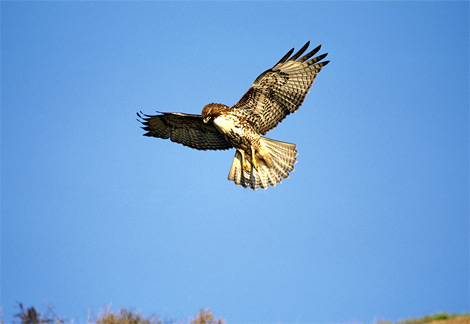
If this makes Madroño sound like Paradise and us like laborers in Eden, well, that’s what it felt like. At the same time, however, these things also happened: I watched a hungry red-tailed hawk flying low over the Chicken Palace, hoping for yet another carry-out chicken dinner. I awoke at dawn’s first glimmering to operatic squawking from the Chicken Palace but, unable to find a flashlight, had to wait until it was light to investigate. (Robert has killed more rattlers this spring than in his seven previous years at the ranch combined.) In fact, there was a dead hen, but we’re not sure what killed her; she may have been egg-bound. During my morning perambulation on the road above the lake, a dozen buzzards wheeled just overhead. I couldn’t smell anything dead, nor could I see the focus of their activity, but I remembered the shrieking white-tailed doe I’d heard at this same spot last spring. It was a heart-stopping noise. I glimpsed her thrashing through the underbrush on the cliff below me but was unable to find her again when I returned with reinforcements. Paradise it may be, but Madroño’s beauty is woven with the warp of nature’s potential and actual violence.

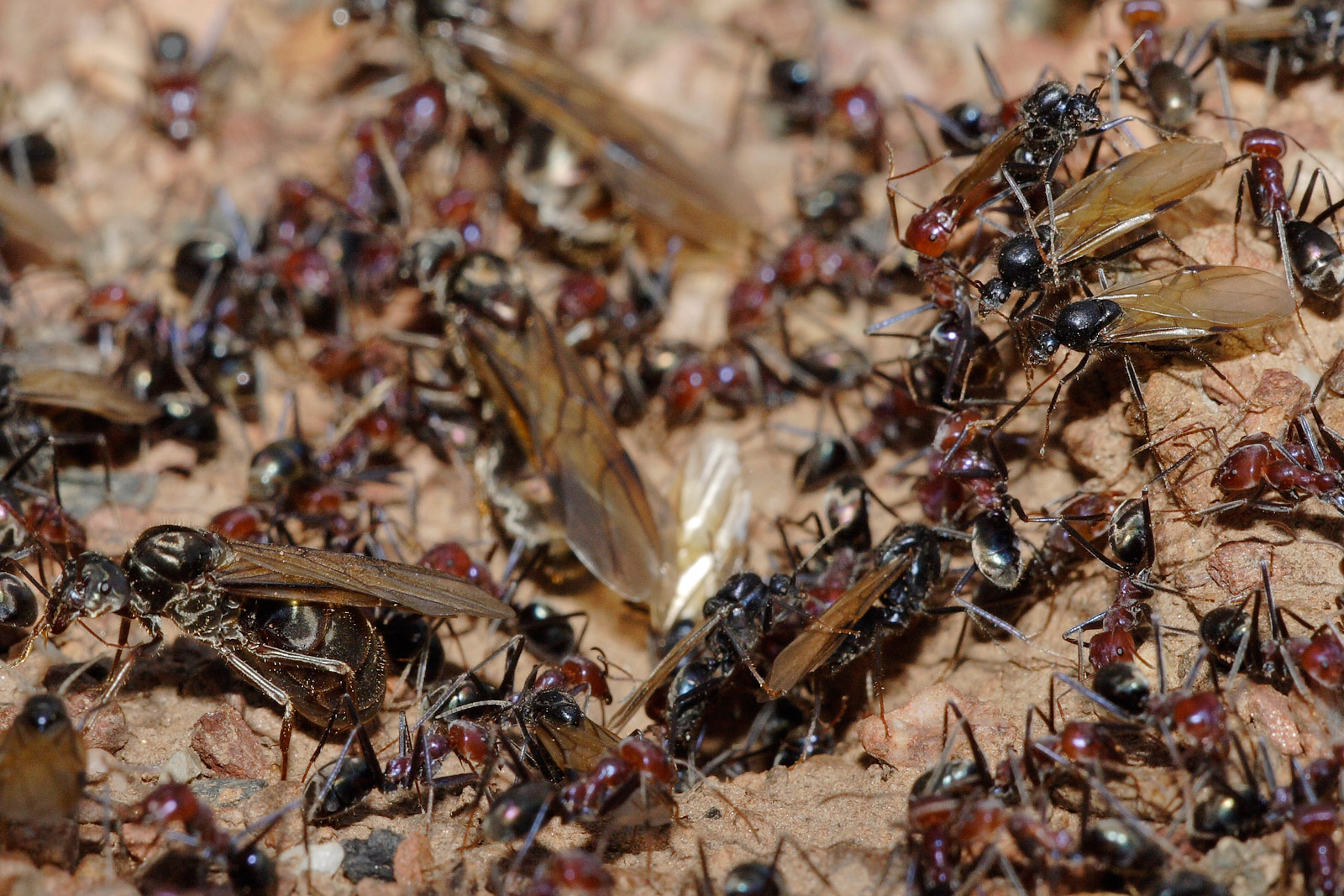
A good friend emailed me after my last post, saying, “I have read that if all the ants were eliminated from the planet it would cease to exist. My thought is that if all the humans somehow disappeared the earth would flourish.” I’ve had that thought as well, but I also think that, with or without us, earth’s flourishing has always involved violence and suffering. Predation, disease, floods, volcanic eruptions, earthquakes, tornadoes, and drought preceded human enviro-tinkering and will continue once we’re gone.

Given that humans are part of the natural order, it’s also a given that we will engage in violence. My definition of violence is idiosyncratic and personal: I define it as existing on a spectrum involving the imposition of one being’s (or group’s) will on another being (or group). So when you order your lollygagging child to stop staring at the ceiling and put on her school clothes, you are, according to my definition, moving into the realm of violence, albeit at the lowest possible vibration. If, as in this case, the imposition of said will is done to enable or assist the flourishing of the one imposed upon, maybe you get a free pass. I’m not sure about this. Nor am I sure how to word my definition to include violence against self, surely as invidious and terrible as violence against another. And of course violence is not restricted to the physical realm, nor is it directed only against humans. Our species’ casual, thoughtless violence against the natural world is relentless.

Unique to humans in this violent world, however, is the capacity to restrict the reach of our violence. Christians and Jews have been commanded to do so in no uncertain terms (as have the followers of virtually every faith tradition; it’s just that I’m most familiar with those two). Repeated several times in the Pentateuch is the phrase “an eye for an eye,” often misunderstood as an incitement to violent retribution. In fact, the point of the phrase was to minimize violence, not incite it; the loss of an eye could not be redeemed by murder. Leviticus 19:18 is even more to the point: “You shall not take vengeance or bear a grudge against any of your people, but you shall love your neighbor as yourself....” Jesus thought this a good enough line to use in the Sermon on the Mount, and reinforced it by instructing his followers to rein in their violent tendencies even more tightly: “If anyone strikes you on the right cheek, turn to him the other also” (Matthew 5:39). Human violence against nature is less of an issue in the Bible, as the capacity to inflict permanent damage on our world wasn’t ours at that point. But scripture does specifically address the correct treatment of animals; they were considered part of the community and were to enjoy a Sabbath rest (Exodus 20:10).

Restricting the reach of violence requires recognizing its ubiquitous footprint. I see its size 7 1/2 tracks all around me: in my sarcasm, in my imperious demands that things be done my way, in my constant consideration of my own comfort, in my need to have reality ordered in a particular way. Having spent the last couple of weeks in my garden at home, I’ve become aware of the arbitrary nature of life and death: what have those cute little flowering clovers ever done to me that they should be so unceremoniously yanked up? And don’t get me started on pill bugs.

Gardens are great places for contemplating unsolvable mysteries. How else are you going to keep your mind occupied when pulling weeds? But I think there’s a deep and distinctive link between restricting our carbon footprints and our violence footprints. When we accept that our flourishing always comes at the expense of someone or something else’s flourishing, it’s hard not to be humbled. What better place than a beautiful, infuriating garden to watch such a serious drama play itself out?
—Heather


What we’re reading
Heather: Matthew Scully, Dominion: The Power of Man, the Suffering of Animals, and the Call to Mercy
Martin: Richard Holmes, The Age of Wonder: How the Romantic Generation Discovered the Beauty and Terror of Science