Friday, April 16, 2010

It's a wonderful town


We recently spent a few days in the Big Apple, and the fact that the only souvenir we brought back was a bag of Nicola potatoes probably tells you all you need to know about us and our priorities.

Basically, I find New York completely overwhelming. We stayed mostly in midtown and downtown Manhattan, and my reaction upon venturing forth onto the chaotic streets and teeming sidewalks was always the same: Great googly moogly! Get a load of all them tall buildings, Maw!

You have to understand that I don’t know the city at all. The last time I spent any time there was during college, when we used to make occasional forays down from rural western Massachusetts in search of live jazz, cocktails, and the illusion of sophistication. Back then—I’m talking thirty years ago or more—New York seemed a really menacing place, which of course was part of the attraction; taking the subway in the middle of the night made us feel, well, dangerous. Even though we were actually just, you know, stupid.

On this trip, though, I discovered another Manhattan, one that exists behind or along with the gray concrete canyons and jostling hordes and schools of predatory taxis. The principal element of this greener, gentler Manhattan is, of course, Frederick Law Olmsted’s Central Park, the true heart (or perhaps I should say lungs) of the city.


Even when it’s jammed with pedestrians, as I imagine is usually the case in the spring, Central Park, with its forsythia and cherry trees blooming and its undulating serpentine walkways, is a true oasis from the frantic sensory overload that surrounds it. Even the constant din of car horns—the true soundtrack of any New York experience—seems muted and distant. I love Zilker Park in Austin, and Golden Gate Park in my native San Francisco, but neither of them seems as necessary as Central Park.

The hidden Manhattan also includes the High Line, an extremely cool elevated park on the West Side. Talk about creative use of space! On an island such as Manhattan, all the empty spaces in the grid have long since been filled in. But Rob Hammond (the son of our San Antonio friends Hall and Pat Hammond) had the bright idea of turning a disused elevated railroad track into a park. Walking above the streets of Chelsea opens up unexpected vistas; you look down into the surrounding neighborhoods, over the Hudson, and into New Jersey from above, and see them as if for the first time.


Another component of this city-within-the-city is the Union Square Greenmarket, an enormous (140 vendors) farmers market that’s open Mondays, Wednesdays, Fridays, and Saturdays and brings all manner of stuff—meat, vegetables, fruit, flowers,  bread, wine, cider—from the surrounding countryside into the heart of the city. (That’s where we bought the potatoes.) According to one of the vendors we talked to, Sarah Shapiro of Hawthorne Valley Farm, the Union Square market is one of about forty in the city. By my extremely rough calculations, given an estimated New York City population of circa 20 million, that works out to about one market for every 500,000 people in New York.


Speaking of food, we had lunch on Saturday at the Green Table, a tiny sustainable eatery tucked inside Chelsea Market, in the old Nabisco plant on Ninth Avenue. And we had a wonderful Easter dinner with friends at Savoy, a charming little Soho bistro specializing in fresh, locally sourced ingredients. It was all delicious.

I guess you really can find anything in New York, from a cast-iron Chrysler Building lantern to overhead parkland, if you just know where and how to look. Funny how a city that, to me at least, has always symbolized traditional, even obsolescent, urban culture—the subway! Radio City! the Brooklyn Bridge! Broadway! Grand Central!—can turn out to be so full of innovation. Those potatoes we brought back were darn tasty, too. Maybe in another five years or so, when we’ve recovered from this visit, we’ll be ready for another!
—Martin


What we’re reading
Heather: Alexander McCall Smith, Tea Time for the Traditionally Built
Martin: Bill Bryson, The Life and Times of the Thunderbolt Kid: A Memoir

Friday, April 9, 2010

The White Queen on the edge of chaos


To our surprise, Martin and I are going to be part of the Summer Literary Festival put on by Gemini Ink, a San Antonio writers’ center dedicated to building community through literature and related arts. Rosemary Catacalos, the executive director, is one of those forces of nature that mere mortals might consider defying, but only in daydreams or other altered states. So when she invited us to lead a seminar on Madroño Ranch as part of the summer festival, all we could say was, “Thank you, of course we will.” When we looked at each other later, all we could say was, “Gah! Are you nuts?”

I asked Leslie Plant, the director of Gemini Ink’s University Without Walls educational program, what in heaven’s name we should talk about. Since the festival theme is biomimicry, which the Biomimicry Institute defines as “the science and art of emulating Nature’s best biological ideas to solve human problems”—for example, looking at a gecko’s foot for ideas in designing nontoxic adhesives—she suggested the relationship between art and nature. Perfect. We wouldn’t have to talk about ranching, farming, business, and all the other things we know nothing about (yet). As I began to consider the topic, however, it seemed to me that virtually every field of human endeavor involves some aspect of the relationship between art and nature. So many big ideas, so many rabbit holes to fall down!

The first big idea that said “Drink me” was not particularly mind-altering: that the most important link between art and nature is that nature is the source of art. This is an idea with a long pedigree, going back at least as far as Aristotle, but because I’ve been reading Krista Tippett’s Einstein’s God, with its reflections on the nature of time, I started to wonder about origins. Are origins always rooted in the past, and do they always grow into the future as an arrow flies from a bow, in a thrust of forward motion? Or is there another way to think about them?

Tacked to the bulletin board above my desk is a quotation from Lewis Carroll’s White Queen: “It’s a poor sort of memory that only works backwards.” Tippett’s interview of Paul Davies, a theoretical physicist and cosmologist at Arizona State University, forced me to think about that quotation in a new way.

To Davies, clocks are emblematic of a kind of “intellectual straitjacket” into which we were forced relatively recently. Einstein was “obviously thinking very much about measuring time, and this is what led him to the notion that your time and my time might appear different. We might measure different time  intervals between the same two events if we’re moving differently. And also your gravitational circumstances. Gravity slows time. Time runs a little faster on the roof than in the basement. We don’t notice it in daily life. When you go upstairs and come down again, you don’t notice a mismatch but you can measure it with accurate clocks.”

A little later in the interview, Davies says, “Einstein was the person to establish this notion of what is sometimes called block time – that the past, present, and future are just personal decompositions of time, and that the universe of past, present, and future in some sense has an eternal existence. And so even though individuals may come and go, their lives, which are still in the past for their descendants, nevertheless still have some existence within this block time. Nothing takes that away. You may have your three-score years and ten measured by a date after your death. You are no more. And yet within this grander sweep of the timescape, nothing is changed. Your life is still there in its entirety.” So maybe there are memories that work forwards as well as backwards, remembering what is yet to come. Maybe there’s a state in which our origins are in our futures, or in which art is, in fact, the origin of nature.

This, by the way, might be an appropriate time to begin feeling sorry for the folks who sign up for our summer seminar.

But wait! Wait! If I throw in some more huge ideas, maybe it will clear everything up! In his 1995 address upon accepting the Templeton Prize, Davies discussed the origins of the universe and the elegant mathematical and physical laws governing its development from aboriginal simplicity to extraordinary complexity. These “laws do not tie down physical systems so rigidly that they can accomplish little, nor are they a recipe for cosmic anarchy. Instead, they encourage matter and energy to develop along pathways of evolution that lead to novel variety, what Freeman Dyson has called the principle of maximum diversity: that in some sense we live in the most interesting possible universe.”

He adds, “Scientists have recently identified a regime dubbed ‘the edge of chaos,’ a description that certainly characterizes living organisms, where innovation and novelty combine with coherence and cooperation. The edge of chaos seems to imply the sort of lawful freedom I have just described.”

Here’s what I think Davies means (and since I don’t speak science, I may have it wrong): the laws structuring the universe, both in and beyond time, seem to have aesthetic consequences every bit as profound as their practical ones. In fact, aesthetics and function don’t seem to be divisible. Cruising the internet, I found all kinds of great quotations, like this one from G. H. Hardy (1877–1947): “The mathematician’s patterns, like the painter’s or the poet’s must be beautiful; the ideas, like the colours or the words must fit together in a harmonious way. Beauty is the first test: there is no permanent place in this world for ugly mathematics.”

So here’s my ambition for Madroño Ranch as a writers’ residential center, a working ranch, a source of community nourishment, and a business: that it exist at the edge of chaos and in the midst of maximum diversity, and that it be as intensely productive as it is extravagantly beautiful. We’re beginning to plan a series of vegetable, herb, and forage gardens that we hope will symbolize this intersection. We hope that the writers—and everyone else—who come to Madroño Ranch won’t be confused about the relationship between nature and art. Or, at least, not more than two of Carroll’s other characters, the Mock Turtle and the Gryphon, were in their conversation with Alice in Wonderland:

“‘What is the use of repeating all that stuff,’ the Mock Turtle interrupted, ‘if you don't explain it as you go on? It’s by far the most confusing thing I ever heard!’

“‘Yes, I think you’d better leave off,’ said the Gryphon: and Alice was only too glad to do so.”
—Heather


What we’re reading
Heather: Bruce Chatwin, The Songlines
Martin: Colm Tóibín, Brooklyn

Friday, April 2, 2010

Of Frederick Law Olmsted, Mr. Brown, and Mexican Coca-Cola


Frederick Law Olmsted has been on my mind recently, in part because while we’re spending a few days in New York, we’re staying on Fifth Avenue, opposite the southeastern corner of Central Park, unquestionably Olmsted’s best-known creation.

Olmsted (1822–1903) was for all intents and purposes the father of American landscape architecture. Before he gained fame for reshaping much of the nations urban and suburban landscape, however, he was an adventurous journalist whose 1857 book A Journey Through Texas; or, a Saddle-Trip on the Southwestern Frontier is a classic of Texas travel literature. In the book, originally published in serial form in the New York Times, Olmsted recounts a trip he took with his brother John in 1853–54, traversing the Lone Star State from the Sabine River to the Rio Grande.

In A Journey Through Texas, as in A Journey in the Seaboard Slave States (1856) and A Journey in the Back Country (1861), Olmsted, a deeply committed abolitionist, attempted to explain how slavery prolongs, in a young community [such as antebellum Texas], the evils which properly belong only to a frontier,” including “bad temper, recklessness, and lawlessness.” (And this was before Interstate 35 even existed!)

Olmsted was a great admirer of the German settlers of the Hill Country (who, he pointed out, managed to earn a respectable living without employing slave labor) and of their private convictions of right, justice, and truth.” He repeatedly held their settlements—New Braunfels, Boerne, Sisterdale, and the like—up as examples of the sort of virtuous, prosperous, cultured communities that were possible where slavery did not exist.

For me, however, the best part of the book is Olmsted’s portrayal of Mr. Brown, the mule he and his brother bought in Natchitoches to carry their supplies. Mr. B., as Olmsted often referred to him, was “a stout, dun-colored, short-legged, cheerful son of a donkey, but himself very much a gentleman.... Though sometimes subjected to real neglect, and sometimes even to contemptuous expressions (for which, I trust, this, should it meet his eye, may be considered a cordial apology), he was never heard to give utterance to a complaint or vent to an oath. He traveled with us some two thousand rough miles, kept well up, in spite of the brevity of his legs, with the rest, never winced at any load we had the heart to put on him, came in fresh and active at the end, and, finally, sold for as much as we gave for him.”

Only once did Mr. Brown mutiny. As the party was preparing to cross Cibolo Creek, he suddenly gave “a snort of fat defiance” and raced off into the nearby scrub, attempting to scrape off the wicker hampers affixed to his sides. Olmsted noted admiringly that a short-legged mule, when fully under way in a stampede, is ‘some pumpkins’ at going,” but they soon ran him down and brought him back under control, and Olmsted tied him to a tree with no supper as punishment. “When morning came, his ears and spirits were completely wilted, and he always carefully avoided the subject of his private Cibolo stampede—never afterwards offering the least symptom of insurrection.”

In another memorable passage, the party was crossing Chocolate Bayou when they unexpectedly encountered a dangerously muddy bottom. Olmsted and his brother managed, with some difficulty, to free their mounts and lead them to safety, abandoning poor Mr. B. to his own devices. “Looking back, to learn the fate of the mule, we beheld one of the most painfully ludicrous sights I have ever seen. Nothing whatever was visible of Mr. Brown, save the horns of the pack-saddle and his own well-known ears, rising piteously above the treacherous waves. He had exhausted his whole energy in efforts that only served to drag him deeper under, and seeing himself deserted, in the midst of the waters, by all his comrades, he gave up with a loud sigh, and laid upon his side to die, hoisting only his ears as a last signal of distress.”

Fortunately Mr. B. rallied his spirits for one last effort and succeeded in freeing himself and wading to safety, dripping like a drowned rat. The wicker baskets he carried were, of course, not waterproof; “the hampers had become two barrels of water, which, added to our ridicule, the mule, his excitement over, found more than he could bear, and, sitting down, he gave us a beseeching look, as if ready to burst into a torrent of tears.” Mr. Brown was clearly a sensitive soul, and I’m a little surprised that Olmsted could bear to part with him at the end of his journey.

While I have had no personal experience with mules, my earliest encounter with a burro left deep psychological scars. When I was just a wee lad, no more than three or four, my parents, my grandmother, and I all crammed into my fathers Fiat 1100 and undertook a family trip from San Francisco to Mexico City. Somewhere in the Sonoran desert, we stopped at a dusty roadside establishment for gas, and my parents bought me a bottle of Coca-Cola—a rare treat indeed. Clutching my precious bottle of Coke, I wandered over to say hello to the poor little burro penned beside the gas station.

I was shocked when the creature came over, stuck his head through the slats of the fence, seized the bottle in his yellow teeth, and yanked it out of my hands. He tilted his head back and drained the contents in one long gulp, whereupon I burst into tears. My parents bought me another bottle of Coke, and the same thing happened! (Apparently I’ve always been a slow learner.)

After the tragic loss of the second bottle of Coke, my parents decided not to continue funding the burro’s drinking habit; perhaps they feared the effects of the rapid accumulation of so much carbonated beverage in his stomach. At any rate, they bundled me into the car—still screaming, no doubt—and headed down the highway.

As I grew older, I was as susceptible to the romantic myth of the cowboy as the next kid, but ever since that trip to Mexico I have generally distrusted all members of the genus Equus. Coke wasn’t introduced until 1886, but I like to think that, faced with the same temptation, the gentlemanly Mr. Brown would have exercised more self-control than his larcenous latter-day Sonoran cousin. But then I’ve always tended to idealize my literary heroes.
—Martin


What we’re reading
Heather: Krista Tippett, Einstein’s God: Conversations About Science and the Human Spirit
Martin: George Perkins Marsh, Man and Nature; or, Physical Geography as Modified by Human Action (still!)

Friday, March 26, 2010

Sorry, Dad: wilderness and government regulation


Harmonic convergences have ordained that I’m not done pondering wilderness yet.

For my recent post on “Mapping the geography of hope: our place in the wilderness,” I once again used a quotation without having read its source. My latest hit-and-run involved Wallace Stegner’s oft-repeated phrase “the geography of hope.” (That’s Stegner in the photo above.) I didn’t think I’d left the phrase gasping for the air of its original context, but this week I backtracked and read Stegner’s famous 1960 “Wilderness Letter,” which argued powerfully that the federal government should set aside sweeping tracts of wilderness to remain largely untouched by human hands. Since my post had expressed the modest hope that private landowners, especially responsible ranchers, could be full participants in, rather than obstacles to, wilderness preservation, I thought, “Oh, help and bother!

Then my sister forwarded me a lovely email from her friend Karin Teague, who noted that “we as a species are SO far from understanding and practicing living harmoniously with the land, with all our technological toys and need for speed and basic greed, THANK GOODNESS we had visionary thinkers like John Muir and Aldo Leopold who advocated for wilderness protection, otherwise we would have lost forever so many extraordinary landscapes.” Help and BOTHER.

Finally came the news of Stewart Udall’s death. As Secretary of the Interior, Udall presided over the passage of the Wilderness Act of 1964, the act that Stegner’s letter helped bring into existence, the act by which the government protected millions of acres from our “need for speed and basic greed”—a piece of legislation that not only kept foundational landscapes untouched, but advanced the idea that such landscapes have been necessary to the formation of the American character. Alright already!

To move ahead, I need to move back first. I am the product of a politically mixed marriage (Democratic mother, Republican father), though I have generally landed on my mother’s side, or somewhat to her left, most of the time. But learning about the hoops that our friends who are small farmers, ranchers, and chefs must jump through in order to keep up with rules designed primarily for agribusiness, I’ve begun foaming at the mouth over government regulation, which pleases my father. Our Madroño adventure has taught me about the daunting bureaucratic gauntlet through which community-minded entrepreneurs must run, and it gets my dander, hackles, and dyspepsia up.

These producers often see their customers every day and consequently feel a profound personal connection and responsibility to them. But they’re forced to run the same maze of regulations as do the agribusiness giants who don’t know me from Adam. Agribusiness’s faceless relationships with its customers are driven by the bottom line, a much more tangible measure of success than the idealistic-sounding yardsticks of community or environmental well-being. But my farming and ranching friends, whom I see every week at market, know that we are intricately bound together at many levels, not merely at the bottom line. Our health—economic, environmental, familial, personal—is a package deal. None of us prospers unless we all do.

So, yes, I’ve learned to be skeptical of government regulation. And yet, and yet... government shapes not just the reality of America, but the idea of America as well. As much as I hate stupid regulations, I hate even more the possibility that, without some external restraints, our apparently insatiable appetites might destroy the very source of our richest symbols and concrete sense of liberty. 

In his Wilderness Letter, Stegner wrote, “Something will go out of us as a people if we ever let the remaining wilderness be destroyed; if we permit the last virgin forests to be turned into comic books and plastic cigarette cases; if we drive the few remaining members of the wild species into zoos or to extinction; if we pollute the last clean air and dirty the last clean streams and push our paved roads through the last of the silence, so that never again will Americans be free in their own country from the noise, the exhausts, the stinks of human and automotive waste. And so that never again can we have the chance to see ourselves... [as] part of the environment of trees and rocks and soil, brother to the other animals, part of the natural world and competent to belong in it. Without any remaining wilderness we are committed wholly, without chance for even momentary reflection and rest, to the headlong drive into our technological termite-life, the Brave New World of a completely man-controlled environment. We need wilderness preserved—as much of it as is still left, and as many kinds—because it was the challenge against which our character as a people was formed.”


Flying over West Texas not long ago, I noticed that parts of the Permian Basin have been carved up into thousands of—well, I’m not sure what. I saw a network of dirt roads leading to what looked like empty squares of bare earth, which I presume are somehow connected to the oil and gas industry.

I know, I know: its not as if the Permian Basin were the Garden of Eden before. So what have we lost by carving up this cussedly dry and famously inhospitable landscape? Back to Stegner: “Let me say something on the subject of the kind of wilderness worth preserving. Most of those areas contemplated are in the national forests and in high mountain country.… But for spiritual renewal, the recognition of identity, the birth of awe, other kinds will serve every bit as well. Perhaps because they are less friendly to life, more abstractly nonhuman, they will serve even better.”


Texans have traditionally prided themselves on their ability to subdue and conquer even the most unpromising land—to make it pay, whether through cotton or cattle or petroleum. One of the unfortunate effects of this pride has been to minimize the value of the land as it exists before being improved. We treat it like, well, dirt, and not like our patrimony. In such cases, it seems that government, as Udall and his allies saw, is the only answer to our apparently endless need for speed and basic greed.” Until we demonstrate that we (both Texans and Americans) are able as a people to restrain ourselves from devouring what sustains us, I continue to support (wise) government intervention to save us from our grotesque appetites. There’s astonishingly little legislation that encourages us to feed our neighbors and the land that sustains us as we would have ourselves fed: with mutual respect and self-restraint. But I’ll support it when I see it and push for it when I don’t. (Sorry, Dad.)

Stegner quotes Sherwood Anderson as saying that the wild nature of the prairie has the capacity to “take the shrillness out of” us. Maybe I need to go spend the night under the vast West Texas sky to lose some of my own shrillness. But I’ve quoted Sherwood Anderson without ever having read anything by him, so at least I know what my next blog topic will probably be.
—Heather

What we’re reading
Heather: Catherine Keller, Face of the Deep: A Theology of Becoming
Martin: George Perkins Marsh, Man and Nature; or, Physical Geography as Modified by Human Action

Friday, March 19, 2010

Wings over Luckenbach: Jacob Brodbeck and the limits of history


This week, for spring break, we flew to Colorado to ski and to visit Heather’s sister Isa and brother John and their families. As I sat on the plane, gazing out the window at the green and brown patchwork unfurling far below us, I was reminded of one of my favorite Hill Country legends, this one involving the mysterious Jacob Brodbeck.

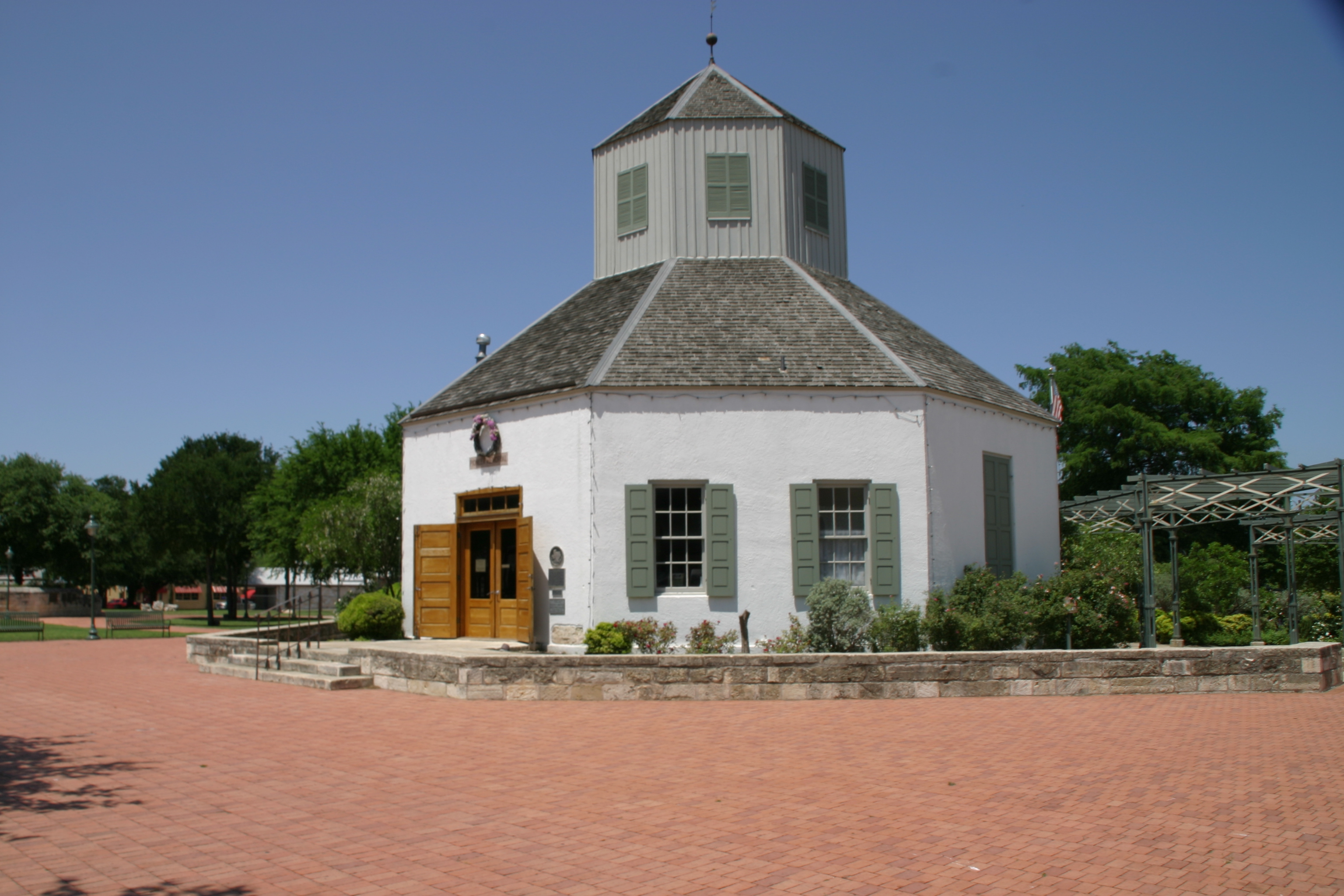
A German-born schoolteacher who arrived in Texas in 1847, Brodbeck became the second teacher at Fredericksburg’s Vereins Kirche, married one of his former students, and eventually fathered twelve children. But he is best remembered for his claim to be the first human to fly successfully in a heavier-than-air machine almost forty years before Orville and Wilbur Wright’s famous flight at Kitty Hawk, a claim that has never been proved—or, for that matter, disproved.

Brodbeck was an inveterate tinkerer; while living in Germany he had attempted to build a self-winding clock, and in 1869 he supposedly built an ice-making machine, no mean feat in those days before the Rural Electrification Administration brought electricity to the Hill Country. Apparently he worked on his “air-ship” for some twenty years.

In 1858 Brodbeck and his wife left Fredericksburg and moved to Luckenbach, where he became the second teacher at the three-year-old Luckenbach School. Five years later they moved to San Antonio, where he became a school inspector. Brodbeck built a working scale model of his craft, powered by coiled springs, which caused a minor sensation when he showed it at county fairs and other gatherings. He succeeded in convincing several investors, including the distinguished Dr. Ferdinand Herff of San Antonio, to bankroll the construction of a full-size version, promising to repay them within six months, after selling the patent rights to his creation.

At length, he completed that full-size version and prepared for his inaugural attempt. And this is where things get really fuzzy. One account says Brodbeck’s first flight took place in San Antonio’s San Pedro Park, and in fact a bust of him was later placed there; another says the flight took place in 1868. But the most commonly accepted version of events is that on September 20, 1865, in a field about three miles east of Luckenbach, Brodbeck and his craft travelled some 100 feet at a height of about twelve feet, but the springs unwound completely before he could rewind them and craft and pilot crashed to the ground. While Brodbeck escaped serious injury, his air-ship was destroyed.

For some reason, his backers (who had presumably given up on getting their money back) refused to fund the construction of a replacement, so Brodbeck took his show on the road, travelling the country in an attempt to raise the necessary scratch. (No word on what his wife thought of this – or, indeed, of the whole air-ship scheme.) His papers and plans were stolen in Michigan, though, or perhaps in Washington DC—again, accounts vary—and a discouraged Brodbeck returned to Texas and, apparently, gave up his dream of powered flight. He lived out his remaining years on a farm near Luckenbach and died in 1910, a little more than six years after the Wright brothers’ sensational flight at Kitty Hawk. I wonder how he greeted the news of their achievement.

I am myself becoming a bit of a nervous flyer—basically, I agree with George Winters, who said, “If God had really intended men to fly, he’d make it easier to get to the airport”—and I’ve never been bitten by the aviation bug. But a fairly substantial literature celebrates the glory and beauty of flight, and those who fly—Icarus, Lindbergh, Earhart, Saint-Exupéry, the astronauts—retain a lofty (ha ha!) position in our collective imagination. Perhaps flight is simply the most obvious metaphor for transcendence, a persistent human craving.

In the absence of his own words, I wonder why Brodbeck became so obsessed with the idea of flight. Perhaps, after being the second teacher in both Fredericksburg and Luckenbach, he was simply determined to be first in something. Perhaps after spending all those years dealing with classrooms full of blockheaded students, not to mention a dozen children at home, he found the mere idea of any solitary activity irresistible, especially one that promised literally to lift him above the mundane concerns of everyday life. Did he ever actually make it off the ground? Beats me. If he didn’t, though, he was neither the first nor the last dreamer to blur the line between aspiration and reality.

I also wonder what his neighbors thought of him. Did they view him, with stereotypical hard-headed German practicality, as a crackpot? Or did they secretly wish that they too could experience, however briefly, the sensation of breaking free from gravity and getting a view of the earth that, at least in theory, approximated that of God? Will we ever know what really happened in that dusty field outside Luckenbach? I doubt it, and honestly I think I’d rather not know. Anyway, does it really matter? History is, after all, not so much carved in stone as written on the wind. What were once facts are discovered to be interpretations, and the impossible to be the probable (and vice versa). We would do well to remember the words of Bertrand Russell: “those who feel certainty are stupid, and those with any imagination and understanding are filled with doubt. Arent we all, in the end, called upon to live with ambiguity? 
—Martin


What we’re reading
Heather: Rainer Maria Rilke, Rilke: Poems

Friday, March 12, 2010

Mapping the geography of hope: our place in the wilderness


Last week, during a visit to San Francisco that also took us to the nearby Djerassi Resident Artists Program, Martin and I spent a day exploring the Point Reyes National Seashore with his childhood friends Brad and Hans. Before setting off on our hike, we wandered into Point Reyes Books and wandered out again with the first two volumes of the West Marin Review, a nifty literary journal whose inaugural issue considers Wallace Stegner’s claim that “[w]e simply need... wild country available to us, even if we never do more than drive to its edge and look in. For it can be a means of reassuring ourselves of our sanity as creatures, a part of the geography of hope.”

Even if I can’t give coordinates for the geography of hope, I like the idea that it might exist on some map buried deep under the mess in my brain’s glove compartment. In current mainstream environmental thinking, however, humans and wilderness cannot exist together because humans are an inevitable contaminant. Having spent the drive from San Francisco to Point Reyes with my face glued to the car window taking in an enticing new vocabulary of birds, I’d like to think that the geography of hope includes a place where humans are part of wilderness, not set off from it.


Our hike took us north between Tomales Bay and the ocean, through herds of tule elk, watching waves crash on the rocky shore and tender crocuses and poppies huddled in the chilly wind. As we returned to the parking lot at Pierce Point Ranch, we heard the whine of chainsaws; the Park Service was taking down an enormous Monterey cypress, maybe 75 feet tall. The presence of rot in some branches posed a threat to the uninhabited cluster of historic ranch buildings at the head of the trail. The decision to cut down the tree seemed iconic of the destruction endemic to human activity in the natural world.

So it was with interest that I saw an essay in the West Marin Review entitled “The Fiction of Wilderness,” by Mark Dowie, the former editor and publisher of Mother Jones. Dowie suggests that the Wilderness Act of 1964 set in stone the idea that wilderness was best preserved by balkanizing large tracts of land and ejecting any permanent residents who might have lived there, as the Miwok tribe was ejected from Yosemite. He says this creates “a commodified wilderness... a deliberate charade, a culturally constructed neo-Edenic narrative played out for weary human urbanites yearning for the open frontier their ancestors ‘discovered’ then tamed—a place to absorb the sounds and images of virgin nature and forget for a moment the thoroughly unnatural lives they lead.” (Ouch.)

But Dowie suggests an alternative. His research revealed that many aboriginal peoples have nothing analogous to the Western conception of wilderness and were stumped when he tried to explain it to them. The closest equivalents in their languages were domesticated ones: “back yard,” “big farmyard,” “food,” or “pantry.” There was, in other words, no sense of separation between the people and the landscapes they lived in. Dowie quotes a Tarahumaran ethno-ecologist from Mexico who says that in his culture the landscape is granted the same love and affection as family, resulting in a “kincentric ecology.”

Dowie hopes that environmentalist notions of wilderness can change to include the possibility of human activity intimately embedded within the land in a mutually profitable relationship. When we see ourselves as apart from a pristine nature that exists outside the bonds of kinship, we are more likely to commodify and exploit it.

Serendipitously, my reading took me from the West Marin Review to a publication that our friends Hugh and Sarah Fitzsimons of Thunder Heart Bison gave me just before we left for San Francisco. Entitled Five Ways to Value the Working Landscapes of the West, it may not rise immediately to the top of the New York Times best seller list, although it makes for compelling reading. The first essay, “In Praise, and in Appraisal, of the Working Landscapes of the West,” begins with this heartening pronouncement: “The simplest fact about Western ranches tends to be the one which most folks tend to forget: raising range-fed livestock is one of the few economic activities that produces food—and potentially ecosystem health and financial wealth—by keeping landscapes relatively wild, diverse, and resilient.”

We’re planning our first bison harvest in the near future and have hopes of developing a food culture that will feed whoever happens to be staying at Madroño Ranch and perhaps others in the immediate community as well. Our concern can’t stop at our bellies, though: what feeds us must be fed as well, and well fed. The essay’s authors, Gary Paul Nabhan and Ken Meter, write of working landscapes: “if we commit ourselves to eating their bounty, we derive a good portion of our nourishment from the very ground on which we stand. We do not stand apart [my emphasis] from the energy and water flows of our home ground. Instead, they work through us, and we work because of them. The land is not mere scenery suitable only for tourism and leisure. It is a functioning community in which we either live well or poorly, depending on how efficiently and conservatively we participate in the land’s work.” And then, as the clincher, they quote my new hero Henry David Thoreau: “[P]erhaps we are here to ‘meet the expectations of the land’ and not the other way around.”

This whole blog post may be nothing more than a stemwinding rationalization for contaminating the rapidly disappearing Texas wilderness. But I hate the idea that there is no room for an ongoing and mutually satisfying exchange between the landscape and its human inhabitants. We need guides to lead us from here to there, though, guides who know both the intimate history of the land and the capacities and limits of new technologies. Increasingly, these guides are ranchers like Hugh and Sarah who cherish their working landscapes and who, in return, receive its abundance, even in lean times. We’d like Madroño Ranch to find its own place in this geography of hope.
—Heather

What we’re reading
Heather: Henri J. M. Nouwen, In Memoriam
Martin: Jay Parini, Promised Land: Thirteen Books That Changed America

Friday, March 5, 2010

Listapalooza: top ten books about Texas


Time for the next installment in our much-anticipated series of lists (our first two were on our top ten songs about Texas and our top ten books on the environment)! This time, we thought we’d offer up our ten favorite books, both fiction and nonfiction, about the Lone Star State.

Cormac McCarthy, All the Pretty Horses
Larry McMurtry, Lonesome Dove
Frederick Law Olmsted, A Journey Through Texas; or, a Saddle-Trip on the Southwestern Frontier

All right, all you Lone Star literati, let us have it. What classics have we missed and/or forgotten?
—Martin

What we’re reading
Heather: Shelley Silbert, M. Gay Chanler, and Gary Paul Nabhan (eds.), Five Ways to Value the Working Landscapes of the West