Friday, January 28, 2011

Shooting holes in the Constitution: some thoughts on guns and violence


Recently, like many Americans, I’ve been thinking about the issue of guns in civil society. The tragic shooting in Tucson certainly focused attention on the topic, as did a story on National Public Radio that identified the United States as the source of most of the guns being used by cartels in the Mexican drug wars, a story that aired days before we visited friends whose ranch is just a few miles from the Rio Grande. But other, more personal circumstances also got me thinking, like the three different episodes of gun violence, or the threat of gun violence, occurred during the past semester on the college campuses (2,000 miles apart) where two of our children are students. And all this happened before our first bison harvest at Madroño Ranch this past Monday, in which two 1,500-pound animals were felled by single shots from a .270 rifle.

Full disclosure: I don’t own a gun myself, although we have a gun safe well stocked with rifles and shotguns at the ranch. (They mostly belong to our son.) My grandfather taught me to shoot with a pellet gun, an activity which he oversaw carefully and I enjoyed mightily. I still take pleasure in target practice and found, the one time I tried it, that shooting skeet was a fine way to while away an afternoon. I don’t hunt and don’t expect that I ever will, although I have no objection to ethical hunting. I’ve thought that it might be wise to have a pistol when I wander around the ranch, in case one of the dogs riles up a pack of feral hogs and brings them back to me. My fear of shooting my own dog is sharper than my fear of rampaging pigs, however, and I remain pistol-less.

While there’s been no change in the number of guns I own, my thinking about guns has changed considerably over the last few years, to wit: I’ve concluded that there’s a difference between urban guns and rural guns. (Yes, yes, hold your applause.) A gun is a necessary tool on a ranch or farm. I’m very grateful that Robert, the ranch’s redoubtable manager, is an excellent shot. If the bulls we harvested this week felt any pain, it was less than momentary; they were dead quite literally within a couple of seconds.

And then there’s the issue of self-defense. A friend recently told me about an encounter he’d had on his remote South Texas ranch with an armed and heavily tattooed non-English-speaking trespasser he suspected of being a member of the fearsome MS-13 gang. My friend didn’t have a firearm at hand, but fortunately, after a tense exchange, the trespasser left. “I’ve never felt so naked,” my friend said. I understand: I, too, would have wanted some clothing in that situation.

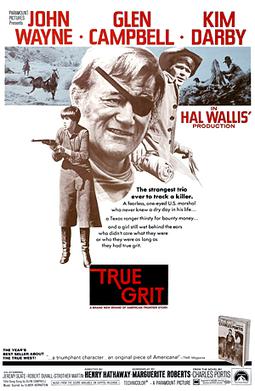
And yet, and yet... we recently saw and thoroughly enjoyed the Coen brothers’ adaptation of True Grit. That is, Martin saw it; I had my hands over my eyes during several violent scenes. Even so, I loved the movie. At the same time, I made a new connection: imbedded in the myth of the American West is the image of the lone gunman, meting out swift and violent justice. No amount of regulation is going to smother the breathe from that compelling image.

Don’t get me wrong; I’m all for intelligent gun control. I’ve never felt so naked as the day that a student opened fire on the UT Austin campus a block from the room where our son Tito was in class. But I emphatically would not have felt more clothed if, as a bill passed by the Texas Senate in 2009 proposed, his fellow students been permitted to carry concealed handguns. Guns do not belong on campuses. Or in the hands of the mentally ill. Anyone who wants to own a gun has a responsibility to register, and law enforcement agencies should be able to trace every gun to its owner. Anyone who wants to buy an automatic or semi-automatic weapon should have to jump through a lot more hoops than a weekend hunter does. Gun shows should be heavily regulated. But the image of that lone, justice-seeking gunman is more powerful than any regulation. Did I walk out of True Grit disgusted by its glorification of violence? Of course not: I loved it, even as I was distressed by some of it. The story is part of my identity as a westerner, as a Texan.

On Wednesday, as I was wrestling with this post, Martin received a membership solicitation from the NRA. I suspect that the trigger for this unlikely offer must be the fact that he recently purchased from Amazon.com a copy of Jose Ortega y Gasset’s Meditations on Hunting, the introduction of which was written by a visiting professor of environmental perception at Dartmouth College—not exactly a rip-roarin’ shoot-’em-up. If I’m correct, the NRA’s tracking mechanisms qualify as spooky at best, and maybe terrifying, but also revelatory of a mentality that refuses to see any kind of subtlety or gradation of perception.

Here’s the opening salvo of that membership solicitation: “Your constitutional right to own a gun is under attack by hundreds of anti-gun politicians, global gun ban diplomats at the U.N., militant anti-hunting extremists, radical billionaires and the freedom-hating Hollywood elite.”

The letter consistently associates freedom with gun ownership; restricting gun ownership equals restricting personal freedom. “Remember: the NRA is the one firewall that stands between our Second Amendment rights and those who would take our freedoms away.” Freedom, in this view, has nothing to do with national service, with love of country and fellow-citizens, with restraint or knowledge or self-discipline.

I visited the NRA website and found it even more appalling than its fear-mongering letter. Of the assault in Tucson, it says: “Our thoughts and prayers are with the victims of this senseless tragedy, including Representative Gabrielle Giffords, and their families during this difficult time. We join the rest of the country in praying for the quick recovery of those injured.” There was no condemnation of the gunman who perpetrated the senseless tragedy. There was found no call for self-examination. There was no exhortation to the faithful to adhere to any code of responsibility or ethics. I found nothing that encouraged gun-owner restraint or training, or an acknowledgment of the enormous social responsibility that comes with owning a gun.

I did find a persistent paranoia that encourages NRA members and sympathizers to view strangers as threatening and potentially aggressive. I did find—even as someone with a sympathetic view of some gun use—a willful and destructive distortion of that figure so many Americans love: Rooster Cogburn, the courageous gunman who takes the law into his own hands and then rides off into the empty landscape. Many of us love Rooster, yes, but his place is in the mythic past, not in the increasingly urban present.

I know and respect—and even love—individual members of the NRA; my grandfather was one of them. I went to its site in hopes of finding something to change my mind about gun control. But I left loathing the rhetoric the NRA has adopted in recent years. (In this regard, I highly recommend Jill Lepore’s excellent article “The Commandments,” about the way various groups, including the NRA, have sought to interpret the Constitution, in the January 17 issue of The New Yorker, and thank our daughter Elizabeth for bringing it to my attention.) To encourage people to think that their fellow citizens are their enemies is surely to unravel the careful work of the Constitution, which recognizes the precarious balance inherent in a federalist system, a balance requiring trust, self-restraint, and mutual good will among its participants. So while calls for legislation are important in curbing American’s extravagant gun violence, they aren’t enough: we need to call the NRA’s violent distortions of the Constitution to account. Maybe guns don’t kill people: maybe it’s NRA rhetoric that kills people.
—Heather


What we’re reading
Heather:
Thich Nhat Hanh, Living Buddha, Living Christ
Martin: Laura Hillenbrand, Unbroken: A World War II Story of Survival, Resilience, and Redemption

Friday, January 21, 2011

South Texas: a fierce and unexpected beauty


Yum! This week has afforded me yet another in a long—seemingly infinite, in fact—series of opportunities to eat crow. Heather and I returned yesterday from a visit to our friends Hugh and Sarah Fitzsimons’ Shape Ranch, outside Carrizo Springs.

As regular readers know, Hugh and Sarah have loomed large in our efforts to get Madroño Ranch off the ground. Hugh, the dueño of Thunder Heart Bison, is our guru in all things bison; in fact, we bought our original herd of twelve animals (which has now tripled in size) from him three years ago.

But our connections with Hugh and Sarah go back much farther than that. Heather had been buying their meat at the farmers’ market for several years before picking up one of the business cards Hugh happened to set out at his booth one day. When she saw his name, something clicked.

“Did your grandmother live on Argyle Avenue?” she asked him.

Startled, Hugh affirmed that she did, and within a very short time he and Heather had determined that their grandparents had lived across the street from each other in Alamo Heights; that Heather had enjoyed many a snack of milk and cookies in Hugh’s grandmother’s kitchen; and that Heather was “Uncle Henry’s” granddaughter (“uncle” in this case being a term of friendship rather than kinship). They hadn’t seen each other for about forty years, but that shared history was the basis of a new friendship.

Furthermore, Sarah‘s brother sings in the choir at our church in Austin, and, as if all that weren’t enough, we subsequently discovered that our daughter Elizabeth and Hugh and Sarah’s daughter Evelyn were not just cabin mates, but actually shared a bunk during a summer at Camp Mystic, many years ago.

The connections, in other words, are various and deep. But even though Heather had been down to Shape Ranch several times to observe Hugh’s bison operation, this week’s visit was my first. Heather had told me that the place was gorgeous, but Heather is after all a native Texan and therefore not to be trusted on such matters.

Now, you have to understand that Carrizo Springs is in South Texas. Flat, scrubby, harsh South Texas, of course, couldn’t be more different from the hilly, wooded, green Central Texas Hill Country which is home to Madroño Ranch. Never mind that most of my experience of them has been restricted to what you can see from a car at seventy miles an hour; as far as I’m concerned, flat places like the central California valleys, the Midwestern corn belt, and, yes, South Texas are to be avoided, or at least passed through as rapidly as possible en route to hillier, and ergo prettier and more interesting, places: the Bay Area, the Sierra Nevada, the Rockies, and the Hill Country.

On Wednesday afternoon, the landscape grew steadily flatter as we made our way from Madroño down to Carrizo Springs via Medina, Utopia, Sabinal, Uvalde, La Pryor, and Crystal City, and all my old prejudices were kicking in, but I was prepared to be a good sport about it, for Hugh and Sarah’s sake.

We drove south out of Carrizo Springs on FM 186 and, a few miles after the pavement gave out, turned in at their front gate, and I began to taste that familiar corvine tang in my mouth. The land was not in fact perfectly flat, but softly undulating, yielding sudden and unexpected vistas. And it was undeniably scrubby, but the winter mesquite and sage and rust-colored seacoast bluestem and purple, pink, and yellow prickly pear were undeniably lovely.


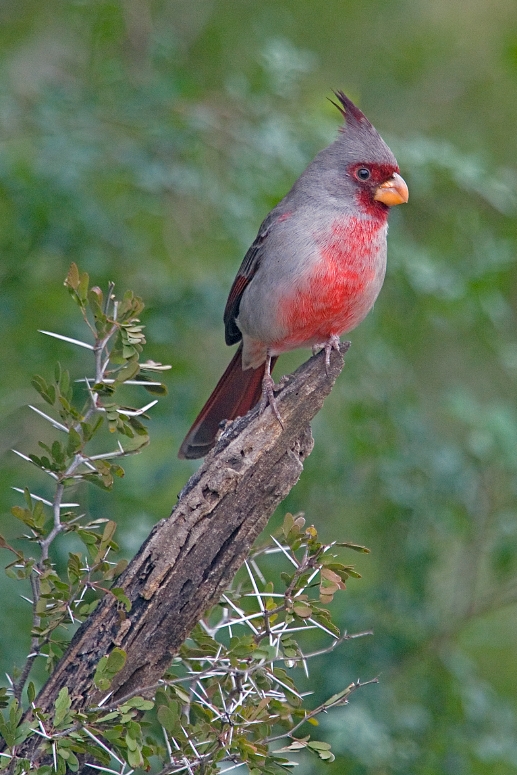
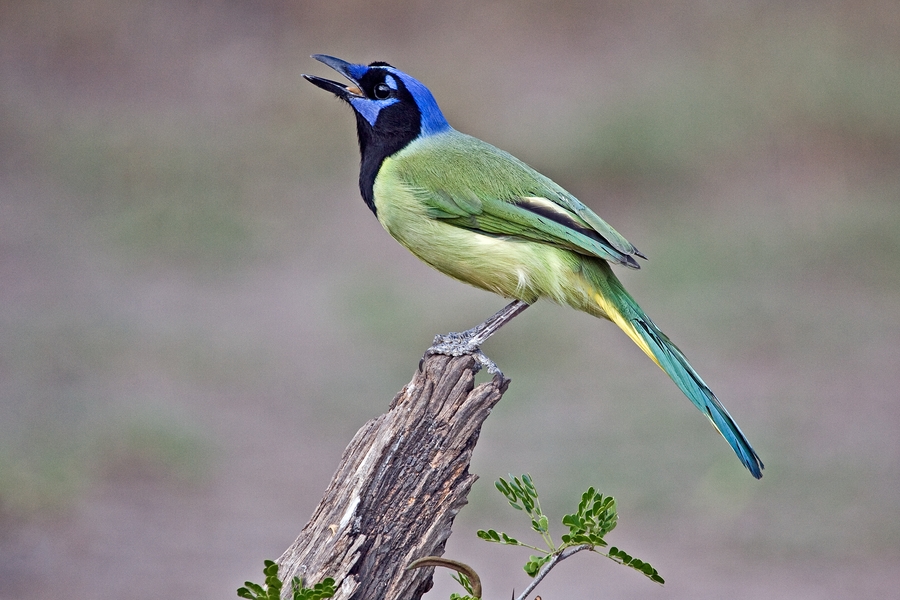
And the birds! Heather is the birder in the family, but even I was amazed by the number and variety of the birds we saw: caracaras and pyrrhuloxias and cardinals and thrashers (both brown and curved-billed) and green jays and white-crowned sparrows and one big blue heron and assorted hawks and kestrels and... well, you get the idea.

After driving several more miles of labyrinthine dirt roads seemingly devoid of physical landmarks, other than the occasional oil pump jack, we somehow arrived at Hugh and Sarah’s house, which is shaded by Arizona ash trees (virtually the only real trees on the place). Hugh and Sarah suggested we dump our bags, grab some beverages, jump in the pickup, and drive up to a picnic table that is their favorite place to watch the sunset. We pulled up and found an amazing 360-degree panorama, with the sun sinking low in the western sky. Sarah told us that when the sun sank low enough, we’d be able to see the mountains of Mexico on the horizon.

Sure enough, as the sky turned tropical-drink orange and pink the mountains came into view. And then, a few minutes later, from the opposite direction, we saw the bright orange full moon rising behind the windmill. Then, to complete the jaw-dropping array of effects, the coyotes—at least two different packs—began serenading us. Clearly, the only thing to do was to return to the house and enjoy dinner and conversation, and still more red wine, around the fire that Hugh built on the back patio.

Yesterday a front blew in, cold and gray and misty, while we were on our morning walk with Hugh and Sarah; the sharp, wet wind made the brunch that followed, of scrambled eggs and sausage and sliced avocado and grapefruit and lots and lots of strong hot coffee, even more welcome. In some ways, with its unnerving, disorienting sameness and plentiful thorns and scarcity of water and shade, this is not a particularly gentle or hospitable land, but yesterday afternoon, when Heather and I finally left to begin the long drive over to I-35 and up to Austin, it felt, just a little, as though we had been expelled from the Garden of Eden. And, believe me, those are not words I ever imagined myself writing about South Texas.

Hey, could I get a side of fries with that order of crow, please?
—Martin


What we’re reading
Heather:
Jon Fasman, The Geographer’s Library
Martin: Suzannah Lessard, The Architect of Desire: Beauty and Danger in the Stanford White Family

Friday, January 14, 2011

The rising light


Although it’s sometimes hard to tell, we’re in the season of rising light.

Some of us have a confused relationship with this time of year. The prevailing story, at least in Western culture, has a particular purchase on anyone who’s lived through a northeastern, Midwestern, or Great Plains winter: that story relates the flare of cheer in the Christmas season, followed by a plunge into the long, dark, depressing slog of January, February, and March. People who live in this story yearn for sunlit beaches, skimpy clothing, and drinks with little umbrellas in them, reminding them of what they’ve temporarily left behind. Anyone with aching snow-shoveling muscles in New England after this week’s blizzard will attest to the power of this story of the season. The rising of the light—the lengthening of days—is a promise of kinder times ahead.

Many of us in central Texas long—perversely, perhaps—for this story to ring true here as well. (I’m wife or mother of some of them.) We yearn for a white Christmas, and when the late December temperature creeps up to the 80 degree mark, we moan, “It’s not supposed to be like this! It’s supposed to be cold!” Despite the prevailing story that cold and dark are to be dreaded, in central Texas this is the season to yearn for, the season of dark and (intermittent) cold. For at least some of the year, it’s the light and heat, not the cold and dark, that can be downright unpleasant, almost unbearable. I feel that our winter and spring (so compressed they can be conflated) are the equivalent of fall in New England: tourists come and say, “How beautiful!” but the natives sigh, knowing that what’s just ahead will require some toughness to get through. Here it can be a real pleasure to burrow into the dark; the rising light brings with it a whiff of the (probable) scorching to come.

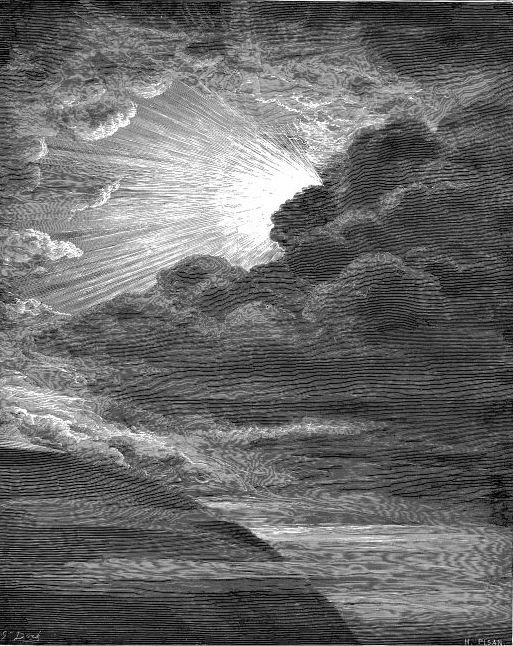
My musing on light has its roots in non-climatological terrain as well; Martin and I are in a group that’s reading and discussing Genesis: Translation and Commentary, by Robert Alter. Although there’s no particular comment on that most famous of first utterances, Let there be light, I can’t help but think about what it might mean that light is the firstborn of creation, at least according to Jews and Christians. This light is distinctive from sun- and moonlight, which weren’t created until the fourth day, and which seem to be subordinate to the aboriginal light of the first day. As God’s breath hovered over the waters, over the deep, and the darkness, God spoke, and there was light. And God saw the light: presumably this means that God had not experienced light before this moment, although virtually everything I just wrote—God, experienced, light, before this moment—should probably be in quotation marks or resting upon a tower of footnotes. But according to this story, light is humanity’s older sibling, both of them created by that which knew the deep, the dark, the tohu-bohu before they did in a distinctive way: before the light.

I’ve also been lurching my way through Marilyn Robinson’s elegant new screed Absence of Mind: The Dispelling of Inwardness from the Modern Myth of the Self, in which she argues against what she sees as an absurdly reductive definition of the human brain and mind by some, perhaps many, modern scientists, a definition that refuses to take into account what she calls “that haunting I who wakes in the night wondering where time has gone, the I we waken to sharply aware that we have been unfaithful to ourselves, that a life lived otherwise would have acknowledged a yearning more our own than any of the daylit motives whose behests we answer to so diligently.” This “haunting I,” so profoundly felt, is dismissed by those scientists (or “parascientists,” as she calls them) as mere subjectivity or, worse, evidence of the annoyingly persistent and primitive superstition we moderns call religion.

In one of those serendipitous encounters with my subconscious, as I reread Robinson’s description of this persistent human sense of hauntedness, of leasing interior real estate to someone you recognize but don’t really know, I read the next sentence completely wrong. She writes: “Our religious traditions give us as the name of God two deeply mysterious words, one deeply mysterious utterance: I AM.” Except at first, I read “I AM”—God’s own self-definition—as “1 A.M.”

I AM often awake at 1 a.m., in the deepest dark of the night, the time when most of us know ourselves to be haunted. If you awaken at 1 a.m. with a dream vibrating in your mind, the dream stays with you in ways that it doesn’t when you wake to light. Sometimes you can play with the dream, poke and shape it in ways that make it pop when it encounters daylight. Sometimes at 1 a.m. you can be wide awake and create as complicated a nightmare as any dreaming mind can produce. To stalk the mind at night—at least, for some of us—is to move as close to the realm of tohubohu, of aboriginal chaos, as created beings are able to get, at least without ingesting psychotropic drugs or harrowing the hell of human atrocity.

Despite the categorical confusion it causes, this season may be my favorite, if for no other reason than the blade-bright light of late afternoon, especially as I get to see it from the kitchen window at Madroño. The copper and golden grasses of the pasture in front of the house blaze as the sun drops behind the western hills, each shoot seemingly sharp enough to pierce the chests of the bison passing across it. The bison themselves look like something out of an ancient dream, not the product of my own tiny experiences but arising from some atavistic communal memory. There are those who might pooh-pooh these moments as fanciful or irrelevant to anything “real.” But in this time of rising light, this time between sleep and waking, between the relief of winter and the slog of summer, I’m compelled to remember that light and humanity once inhabited the same chaotic womb, that we rise and fall together. It’s a good season, once you’ve written your thank-you notes, to watch the rising light with gratitude for the family of creation. And with resignation, too: if it’s already January 14, August will be here before we can even blink.
—Heather


What we’re reading
Heather:
Cynthia Bourgeault, The Meaning of Mary Magdalene: Discovering the Woman at the Heart of Christianity
Martin: Keith Richards with James Fox, Life

Friday, January 7, 2011

A new year at Madroño Ranch: bison harvests, chicken tractors, hog schools, and more


Happy new year! The beginning of the year is always a good time to take stock, so we thought it might be appropriate to look back at what we accomplished—and, erm, failed to accomplish—during the last twelve months. Much remains to be done before our hopes for Madroño Ranch are completely realized, though we took what felt like some significant strides in 2010. With apologies for any perceived self-indulgence, here are some of them.

First, thanks to the wonderful and talented Shawn and Susanne Harrington of Austin’s Asterisk Group, Madroño Ranch now has a vibrant, striking, beautiful visual identity—logo (above), wordmark, etc.—which we hope eventually to splash all over actual and virtual reality. (Madroño Ranch T-shirts! Madroño Ranch gimme caps! Madroño Ranch bumper stickers and koozies and belt buckles and....)

Second, we’ve begun to rethink our initial determination to offer residencies only for environmental writers, however broadly defined (poets, philosophers, essayists, whatever). We had initially thought we would restrict our offerings to writers because, well, as a couple of recovering English majors, we felt like we knew writing better than we knew art, and (perhaps more important) we didn’t want to spend a lot of money on infrastructure (kilns, darkroom facilities, printing presses, whatever). Most writers, after all, are highly mobile these days, requiring little in the way of equipment beyond a laptop computer. But it has become increasingly obvious, even to us, that virtually the same is true of many visual artists as well—digital photographers and collagists, to name just a couple. Painters can travel with paints, portable easels, and suchlike. And then there are environmental artists, like Andy Goldsworthy, who use materials found on-site—rocks, leaves, branches, etc. Why should we exclude such creative thinkers from our pool of potential residents?

Third, while we are still a long way from officially opening our residential program for environmental writers (and artists)—we have yet to construct the small casitas we envision as individual workspaces, and we have yet to hire the necessary personnel to cook and care for our residents—we have managed to find a couple of brave souls willing to serve as “guinea pigs.” Melissa Gaskill and E. Dan Klepper will each spend several days at Madroño Ranch in the next couple of months, working, resting, and experiencing some if not all of what our actual residents will experience once we’re fully up and running. We look forward to hearing their feedback, suggestions, etc.

Fourth, our friend Jesse Griffiths of Dai Due came up with a new and exciting way to open the ranch to a wider public through a variety of sustainable hunting, fishing, and cooking “schools” throughout the year. The first, Deer School, brought six guests to the ranch in November, and was a thoroughgoing success; now we’re looking forward to Hog School in early March and Freshwater Flyfishing School in mid-May, both of which have already sold out. If they go well, we’re hoping to make these (and perhaps other such schools) an annual tradition at Madroño Ranch.

Fifth, we finally gained state approval of the label that will appear on the packages of bison meat we sell, which means we can finally go ahead with our first “harvest” (as it’s euphemistically called) this month. (We had hoped, naively, to harvest our first bison in October, but the approval process turned out to be considerably longer and more complicated than we had imagined.)

Sixth, Heather made significant progress in her quest to become a true chickenista, following the example of local legend Carol Ann Sayle of Austin’s Boggy Creek Farm. Our original flock of fifty or so laying hens took up residence in their bombproof (and, we trust, owl- and hawkproof) new coop, which we call the Chicken Palace (pictured below). A few months later Robert’s brilliant creation the Chicken Tractor (actually a mobile coop on wheels) became the home of a new flock of about twenty younger hens. (As of last week, the two groups were just beginning to commingle.)


Seventh, while we still don’t have an actual Madroño Ranch website (though we’re working on it!), we do have an official Madroño Ranch Facebook page. We invite those of you on that ubiquitous social network to check it out, and click the “Like” button if you’re so inclined; until our website is up and running, that will be the easiest way to keep track of what’s happening at the ranch in what we hope will be an exciting twelve months to come.

Perhaps none of these accomplishments sounds terribly important in and of itself, but each brought us just a little closer to our goal. Our hope for 2011 is that we—and you too, Gentle Reader—keep striding throughout the new year, whether the steps be large ones or small.
—Martin


What we’re reading
Heather:
Marilynne Robinson, Absence of Mind: The Dispelling of Inwardness from the Modern Myth of the Self (still—it’s hard!)
Martin: Michael Lewis, The Big Short: Inside the Doomsday Machine

Friday, December 31, 2010

Getting to good food


Happy New Year! This week, sparing no expense as we recover from the excesses of the holiday season, we have once again secured the services of a top-shelf guest blogger. In this post, Tito Kohout reflects on some of the challenges of rethinking our societal infatuation with “easy” foods.

I start feeling self-righteous when I see some greasy, fatty dude walking out of Wendy’s with a greasy, fatty Number 5 combo. He doesn’t know anything about anything, I say to myself as I pedal furiously past him. I bet he voted for someone I find loathsome. I bet his taste in music is as bad as his taste in burgers. I bet he’s the kind of apathetic American who is, every day, moving us closer to breaking the seventh seal and unleashing some kind of very big and very biblical evil on the world. Then my stomach rumbles and I think that it’s only another dozen blocks until I’m home and can slather some Fiesta-brand peanut butter on my Fiesta-brand wheat bread fried in Crisco until it’s moist and crispy and freaking delicious.

Yeah, that’s stupid. Like really stupid. Like Titanic stupid. Here I am, with my refrigerator full of food from my neighborhood Fiesta Mart (which resides at pretty much the opposite end of the foodie spectrum from Central Market), looking down on some poor guy just trying to grab an easy meal. The Earl Campbell sausages I mix with nameless cheddar cheese in my eggs aren’t any better, and I know it. After all, my parents write this blog, and organic, local, slow, humane food—what I’ll refer to as “good food” from here on in—is obviously important to them, although they weren’t always strictly consumers of good food; I distinctly remember frozen fish sticks being one of my favorite childhood dinners.

So where did they go wrong, raising a son who’s dumb enough to eat seventy-nine-cent cans of pork and beans on a regular basis? The answer is nowhere. I know that Fiesta’s meat comes from factory farms and its vegetables are probably shipped in from heaven-knows-where covered in pesticides. I know how wrong that is. But, man, it’s easy.

I’ve got the expenditures of your typical dumb male college student: rent, utilities, rugby fees, beer, and, of course, food in large quantities. To more easily afford these things, I buy the cheapest food I can. I’m not much of a cook—a few days ago, I suffered a pasta disaster of substantial proportions—but even the simple things cost more at the farmers’ market than at the supermarket.

But even more than the financial price, the price in effort puts me off. I could find ways to save money. I could get a plot in the community garden a block from my house. I could put myself out on the tutoring circuit again. I could sell my car, since I barely drive it anyway. I could be a better citizen of the earth, but I know I’ll keep on eating seventy-nine-cent cans of pork and beans as long as it’s convenient.

The other day, my older sister told me that Americans spend a smaller proportion of their incomes on food than the inhabitants of any other country. I believe her, both because she’s generally pretty well informed for an older sister and because it’s believable; I certainly work to spend less time and money on food. The question is, “How do we not only make good food competitive in prices with the other stuff, but make the U.S. of A. and the world realize that good food isn’t some weird and mildly threatening eccentricity reserved for rich, white, liberal yuppies and scary people from the lunatic fringe?”

I read my parents’ blog posts, and this is the part where they generally propose a solution to the problems they’ve outlined. I got nothing. I just know that good food is important for the survival of our species and of many others, and that we—not we the consumers of good food (I don’t include myself), but we the people—need to make good food not just a societal priority but a societal norm. Otherwise, we’re all in deep trouble, and I’m going to keep on eating Earl Campbell’s tasty, questionable, preservative-packed sausages.
—Tito


What we’re reading
Heather: Marilynne Robinson, Absence of Mind: The Dispelling of Inwardness from the Modern Myth of the Self 

Martin: Jane Leavy, The Last Boy: Mickey Mantle and the End of America’s Childhood

Friday, December 24, 2010

Listapalooza, holiday edition: all-time top tens


Like Rob Fleming, the protagonist of Nick Hornby’s High Fidelity, I seem to have a strong taxonomic impulse. Longtime readers of this blog have already seen several manifestations of my obsession with list making, but Heather and the kids will tell you that one of my more annoying habits is my annual end-of-the-year insistence that we all update the Kohout family top ten lists.

Every New Year’s, I insist that the whole family, and whatever friends and innocent bystanders happen to be around, sit down and list their ten all-time favorite novels, movies, and albums. This always occasions a good deal of grumbling, at least from the family, but they usually do it.

Here are the basic rules:
  • Each list must include ten items, no more and no less, though I’ll cut you some slack when it comes to works in multiple parts (for example, we customarily count The Lord of the Rings trilogy or the Harry Potter series as one entry).
  • Unlike so many end-of-the-year lists, these aren’t your favorites from the last twelve months; they’re supposed to be your all-time favorites, which is why you’ll always find at least a couple of children’s books on my list.
  • The items don’t have to be in order of preference; just your ten favorites, in whatever order they occur to you.
  • Plays count as fiction, as does epic poetry (The Odyssey, Paradise Lost); lyrical poetry does not.
  • All this is done with the understanding that if you were to do it again tomorrow, you might come up with a very different list.
Since we’re approaching the end of another year, and I’m preparing to crack the whip on the family again, I thought it might be interesting to share my own most recent top-ten lists, even at the risk of exposing myself to the ridicule of our readership. (More so than usual, I mean.)

Without further ado, then, here they are:

Fiction (in alphabetical order by author)
Richard Bradford, Red Sky at Morning
Margaret Wise Brown, The Sailor Dog
Michael Chabon, The Yiddish Policemen’s Union
Kenneth Grahame, The Wind in the Willows
Dennis Lehane, The Given Day
Hilary Mantel, Wolf Hall
Herman Melville, Moby-Dick; or, The Whale
Richard Price, Lush Life
William Shakespeare, A Midsummer Night’s Dream
Wallace Stegner, Angle of Repose

Movies (in alphabetical order by title)
Casablanca
Funny Bones
The Godfather/The Godfather Part II
Groundhog Day
Local Hero
A Night at the Opera
Sense and Sensibility
The Third Man
Wings of Desire
Young Frankenstein


Albums (in alphabetical order by artist)
Dave Alvin, Ashgrove
The Cambridge Singers/La Nuova Musica, directed by John Rutter, The Sacred Flame: European Sacred Music of the Renaissance and Baroque Era
Rosanne Cash, Black Cadillac
Manu Chao, Clandestino: Esperando la Ultima Ola
Derek and the Dominoes, Layla and Other Assorted Love Songs
Howlin’ Wolf, The Definitive Collection
Iron and Wine, The Shepherd’s Dog
Mark Knopfler and Emmylou Harris, All the Roadrunning
The Rolling Stones, Exile on Main Street
Jordi Savall, El Nuevo Mundo: Folías Criollas

Bonus List: Nonfiction (in alphabetical order by author)
Brendan C. Boyd and Fred C. Harris, The Great American Baseball Card Flipping, Trading and Bubble Gum Book
Drew Gilpin Faust, This Republic of Suffering: Death and the American Civil War
Doris Kearns Goodwin, Team of Rivals: The Political Genius of Abraham Lincoln
Adam Gopnik, Angels and Ages: A Short Book About Darwin, Lincoln, and Modern Life
S. C. Gwynne, Empire of the Summer Moon: Quanah Parker and the Rise and Fall of the Comanches, the Most Powerful Indian Tribe in American History
Tracy Kidder, Home Town
Ben Macintyre, Operation Mincemeat: How a Dead Man and a Bizarre Plan Fooled the Nazis and Assured an Allied Victory
David Quammen, The Song of the Dodo: Island Biogeography in an Age of Extinctions
Henry David Thoreau, Walden; or, Life in the Woods
David Winner, Brilliant Orange: The Neurotic Genius of Dutch Football

To me, one of the pleasures of this exercise, besides the inherently enjoyable experience of summoning up cherished treasures from one’s past, is seeing what’s on other people’s lists, which can be quite revealing. (I, for example, clearly have a thing for lightweight movie comedies and for books about Abraham Lincoln and the Civil War.) They can also bring some worthy books or movies or music to your attention, or inspire you finally to read or watch or listen to that classic you’ve been meaning to read or watch or listen to for years.

So what about you, Faithful Reader? What works have mattered most to you over the course of your life?
—Martin


What we’re reading
Heather:
Gail Caldwell, A Strong West Wind: A Memoir
Martin: Elizabeth S. D. Engelhardt, Republic of Barbecue: Stories Beyond the Brisket

Friday, December 17, 2010

Singing in the dark


The relentless sunshine of the current weather here in Austin might make those in the Midwest or on the East Coast sigh with envy. A photo on the front page of Tuesday’s New York Times shows an Ohio man ineffectually fending off the great whorls of snow around him with an umbrella. His head is bent, his shoulders hunched, his attention presumably forced inward. Strangely, as I bask in the sunshine, I’m the one who’s a little envious.

Not of the cold, certainly—I start getting chilly when the temperature drops below eighty degrees. But what I see in the picture is someone forced by the world to withdraw his attention from it, to shift his focus inward, even if it’s just to check in and notice that he’s cold. He won’t be able to stay out for long; he must retreat inside.

In one of her typically wonderful blogs, our friend Joy recently wrote an homage to darkness, to the gestational, inward gaze of the season of Advent. The punch line is, of course, that great discipline is required to move inside at this time of year, when a blizzard of parties, shopping, and end-of-year scrambling—or of loneliness and loss—assaults us. Frequently, we just sit out there in the cold, not realizing that we can go inside. Another friend of mine, prone to good works, told me that when she was pregnant and people called asking her to do something, she would look at her waxing belly and say, “Sorry, I’m busy,” and then go back to sitting quietly. Even as we attend to the frenetic tempo of this singular season, something beckons us, at least occasionally, to go inside and sit, maybe in the dark.

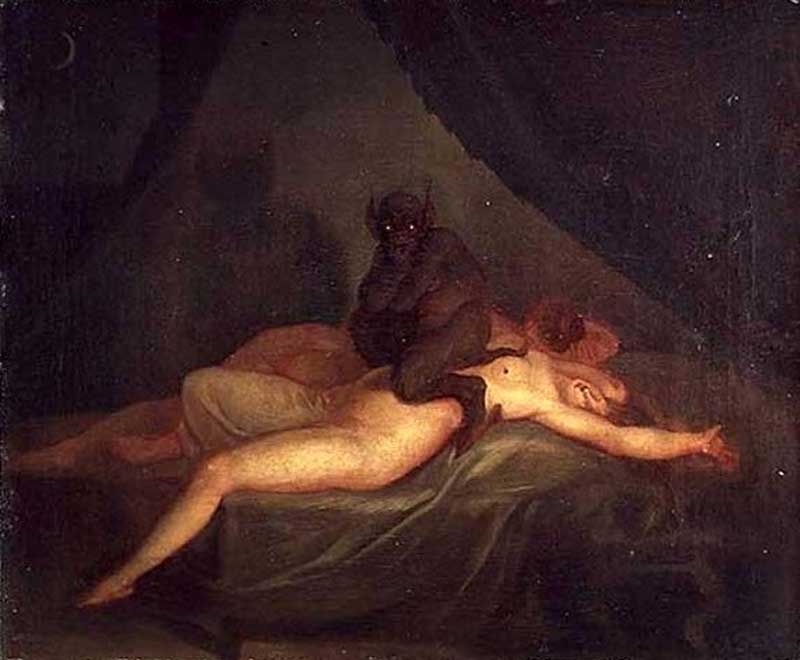
And what awaits us inside, in the dark? Well, any child can you tell that: scary stuff! Chupacabras (that’s one in the picture at the top of this page, by the way)! Things with too many legs and too many teeth and not enough eyes! With too much hair or not enough, with horns and scales and long dirty nails! The list of monsters gets less imaginative but no less scary as we get older: past humiliations and failures, anxieties about money, relationships, reputation, health, death. All those things wait for us in the dark. (Of course, sometimes they wait for us in broad daylight as well.)

But that’s not all that waits there. Wendell Berry, my favorite grumpy sage, has advice on how to get by the monsters:

I go among the trees and sit still.
All my stirring becomes quiet
around me like circles on water.
My tasks lie asleep in their places
where I left them, like cattle.

Then what is afraid of me comes
and lives in my sight.
What it fears in me leaves me,
and the fear of me leaves it.
It sings, and I hear its song.

Then what I am afraid of comes.
I live for a while in its sight.
What I fear in it leaves it,
and the fear of it leaves me.
It sings, and I hear its song.

Those things we fear, according to Berry, have their own songs if we sit still and listen for them. In this particular collection of poems, A Timbered Choir: The Sabbath Poems 1979–1997, the forest is his place of Sunday worship, where he brings his deepest questions and listens to the forest’s exhalations, to the words made of branch rustle and river rush and birdsong, iterations of the original Word spoken by God in the beginning. Berry is not alone when what he is afraid of approaches him; he’s in the midst of a community he knows intimately.

This kind of trope can dissolve into rank sentimentality and cruelty when those in the midst of the light and bustle use it to admonish those sitting in the sight of what they fear to buck up. But Berry’s language in this collection is rooted in an ancient warrant for the practice of sitting in the company of chaos and darkness: when, as God began creating, God shared space with the tohuvabohu, the formless void, with the darkness, and with the deep. Through them came the words: Let there be. And what came to be was good. It sang.

The fears don’t have the last word in the poem: Here’s the final verse:

After days of labor,
Mute in my consternations,
I hear my song at last,
and I sing it. As we sing,
the day turns, the tree moves.

Only after he labors and rests from his labors, after he sits quietly and listens to the songs of what fears him and what he himself fears, does Berry hear his own song. Only then is he able to join the singing already in progress, a singing that harmonizes with a wider reality (the turning of the day) and the immediate reality (the moving of the trees).

Whether or not you’re observing Advent, the deepening shadows of the season encourage most of us to move inside and prepare ourselves for this inexorable guest, darkness. Some of us will cook, some of us will shop, some of us will wrestle with monsters and despair, some will not pause from our labors or notice anything at all. If possible, go sit quietly among the bare trees. Or sit hospitably at home with whatever invisible reality is leavening within you and tell everyone you’re busy. Then go find your community and sing.
—Heather


What we’re reading
Heather:
C. S. Lewis, The Screwtape Letters
Martin: John le Carré, Our Kind of Traitor